painting, oil-paint
#
dutch-golden-age
#
painting
#
impressionism
#
oil-paint
#
landscape
#
charcoal drawing
#
cityscape
Dimensions: height 86 cm, width 126 cm, depth 12.5 cm, weight 36 kg
Copyright: Rijks Museum: Open Domain
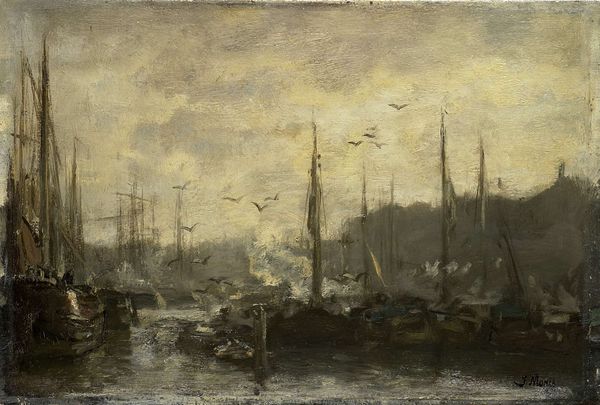
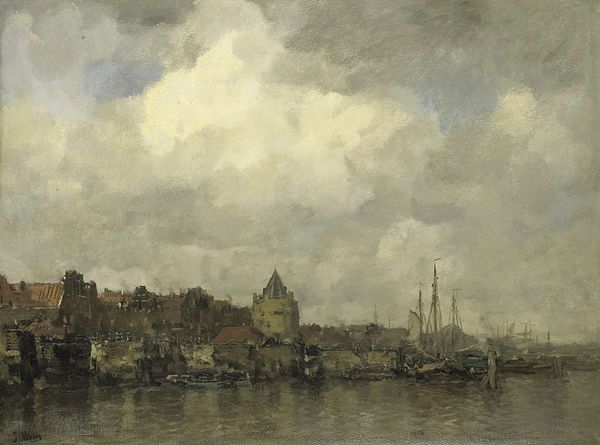
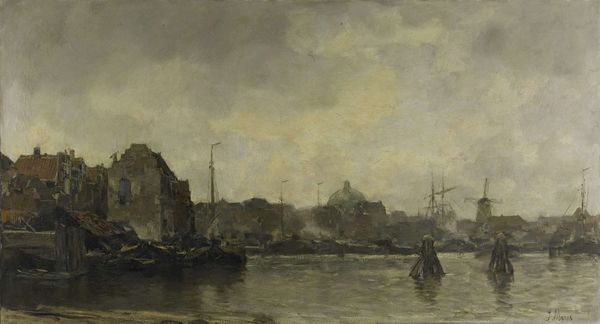
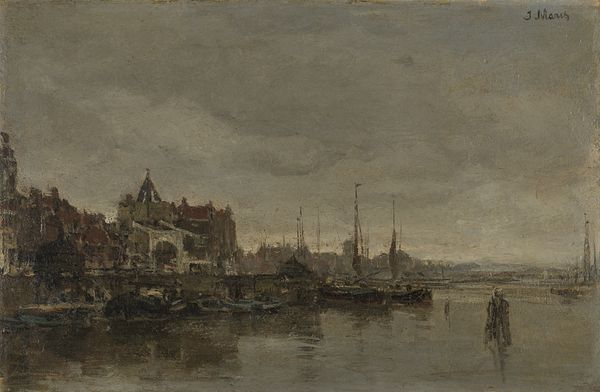
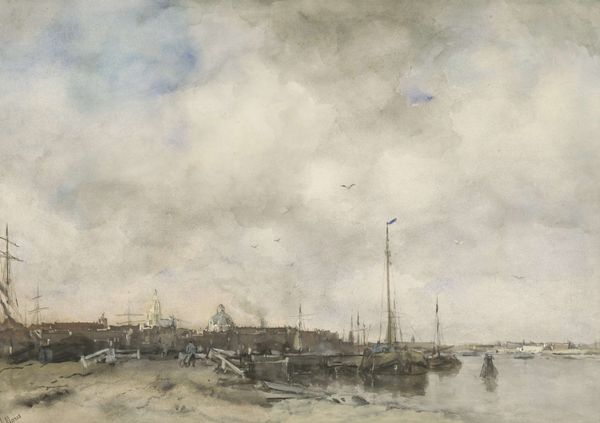
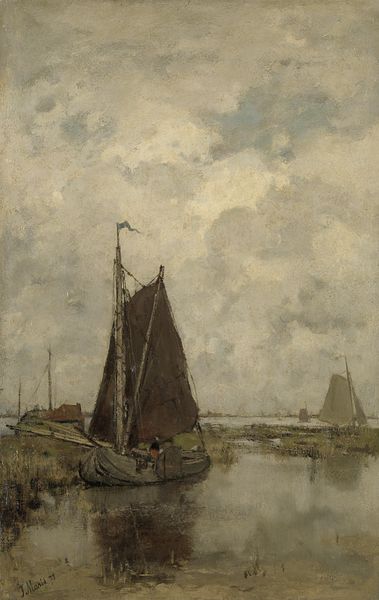
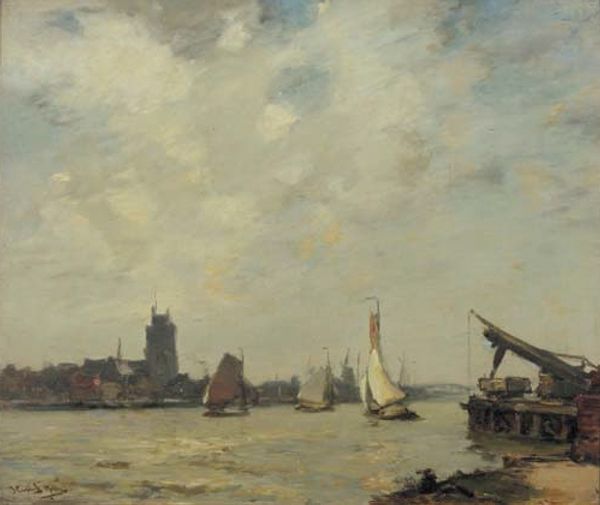
Curator: Here we have Jacob Maris’s "Cityscape," painted between 1885 and 1887, a compelling example of his engagement with the Dutch landscape tradition. Editor: It's incredibly atmospheric. The muted palette and the almost ethereal quality of the light create a sense of melancholy, even oppression. The way the buildings seem to dissolve into the mist—it feels quite bleak. Curator: Observe how Maris masterfully employs tonality to evoke mood. The subtle gradations of grey, brown, and white, are building form and space with these minimal tonal differences and delicate brushstrokes. Note also the arrangement of the verticals: masts and building edges offer a scaffolding of structured contrast, bisected by the horizontality of water and vessels. Editor: Right, and that pervasive grey feels…loaded. Urban environments, particularly port cities during this era, are sites of intense economic disparity. The obscured architecture could be read as an intentional veiling of social realities. Consider also how the haze itself could symbolize industrial pollution—an almost literal manifestation of social ills hanging in the air. Curator: Interesting, though I think grounding our interpretation solely on those factors limits our understanding of the pictorial composition. Instead, observe how the composition uses layered masses: light over dark; mist blurring definition between foreground and background. Maris builds space—not through depth of color, but deft modulation. Editor: But is it simply “space” Maris is building, or a particular space with a specific history and social context? The composition reinforces a visual hierarchy, obscuring potentially impoverished neighborhoods within the painting's deep field, which certainly merits consideration. Curator: Fair enough, but the focus for Maris is the study of atmosphere as a carrier of symbolic content. I'd prefer to conclude that he emphasizes visual, formal relations. Editor: Perhaps that ambiguity itself speaks volumes about the relationship between artistic representation and the complexities of lived experience during the industrial age, providing insight into economic structures or social classes. Curator: Well, at the end, whether a structural or sociological response guides you most, one can agree that "Cityscape" speaks eloquently on the human experience. Editor: Yes, Jacob Maris provides much food for thought and conversation for all who encounter his "Cityscape."
Comments

rijksmuseum over 2 years ago
⋮
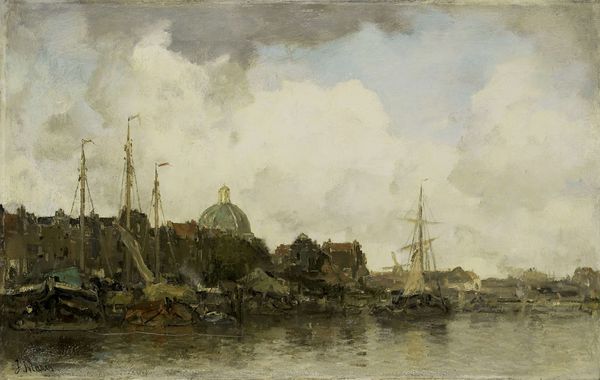
Maris’s city views are not topographically accurate, which is why they were given neutral titles. He was interested above all in composition and atmosphere. The painter himself said: ‘If I feel it is necessary to interrupt the long, straight roof lines, I simply add a domed roof, especially where the sky or cloud formation calls for such support. Why should I not be allowed to build my own cities?’


Join the conversation
Join millions of artists and users on Artera today and experience the ultimate creative platform.
 Collect
More like this