About this artwork
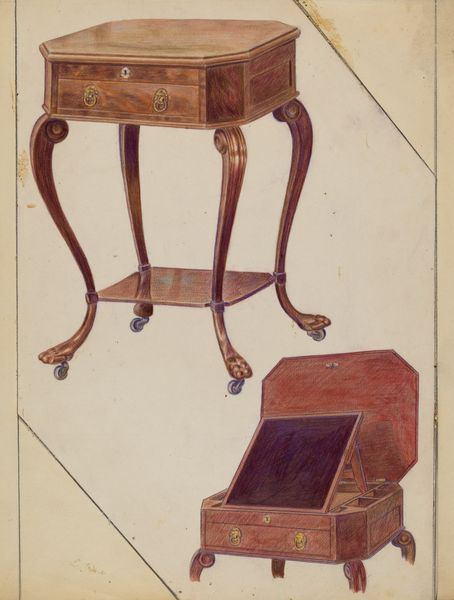
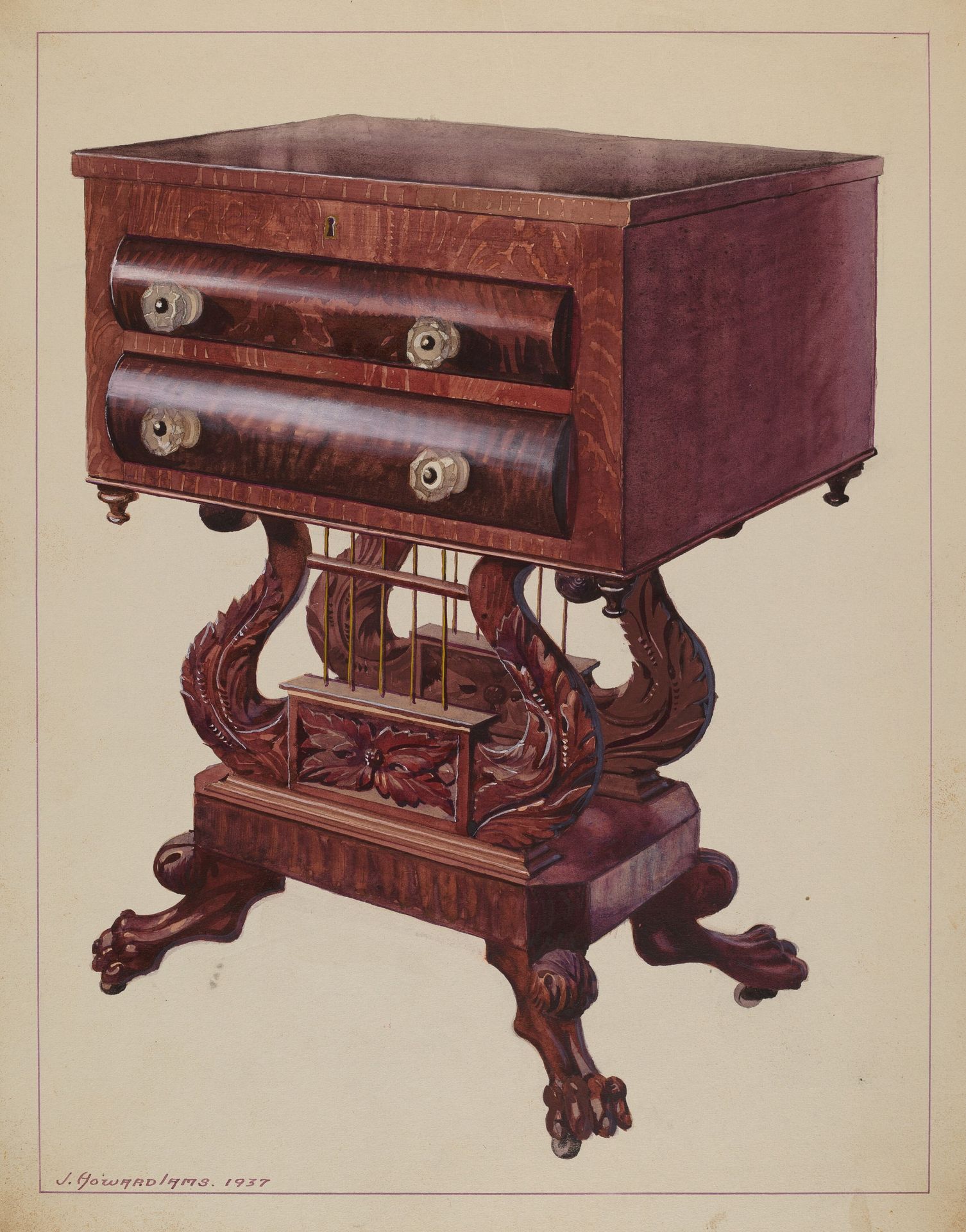
J. Howard Iams created this watercolor artwork called "Table - Double Lyre Base," focusing on furniture design. At first glance, the drawing presents a wooden table, its form and color immediately striking. The wood's rich, reddish-brown hue dominates, contrasted by the light background, emphasizing its texture and intricate patterns. Iams plays with geometric forms, juxtaposing the rectangular drawers and tabletop with the flowing curves of the lyre-shaped base. This interplay destabilizes the traditional, fixed meanings associated with furniture design, inviting us to reconsider functionality. Through a semiotic lens, the table embodies cultural codes of status and taste. The lyre base, a classical motif, suggests refinement and artistry. However, the drawing is not merely representational, it challenges the established meanings by blurring the lines between function and art. It serves as an ongoing interpretation of design, where aesthetic form intersects with cultural expression.
Table - Double Lyre Base 1937


Artwork details
- Medium
- drawing, coloured-pencil
- Dimensions
- overall: 35.5 x 27.8 cm (14 x 10 15/16 in.) Original IAD Object: 32"high; 21 1/2"x16"=top. Bottom 14 1/2x11 1/2 inches
- Copyright
- National Gallery of Art: CC0 1.0
Tags
drawing
coloured-pencil
oil painting
coloured pencil
decorative-art
watercolor
Comments
No comments
About this artwork
J. Howard Iams created this watercolor artwork called "Table - Double Lyre Base," focusing on furniture design. At first glance, the drawing presents a wooden table, its form and color immediately striking. The wood's rich, reddish-brown hue dominates, contrasted by the light background, emphasizing its texture and intricate patterns. Iams plays with geometric forms, juxtaposing the rectangular drawers and tabletop with the flowing curves of the lyre-shaped base. This interplay destabilizes the traditional, fixed meanings associated with furniture design, inviting us to reconsider functionality. Through a semiotic lens, the table embodies cultural codes of status and taste. The lyre base, a classical motif, suggests refinement and artistry. However, the drawing is not merely representational, it challenges the established meanings by blurring the lines between function and art. It serves as an ongoing interpretation of design, where aesthetic form intersects with cultural expression.
Comments
No comments