

1921
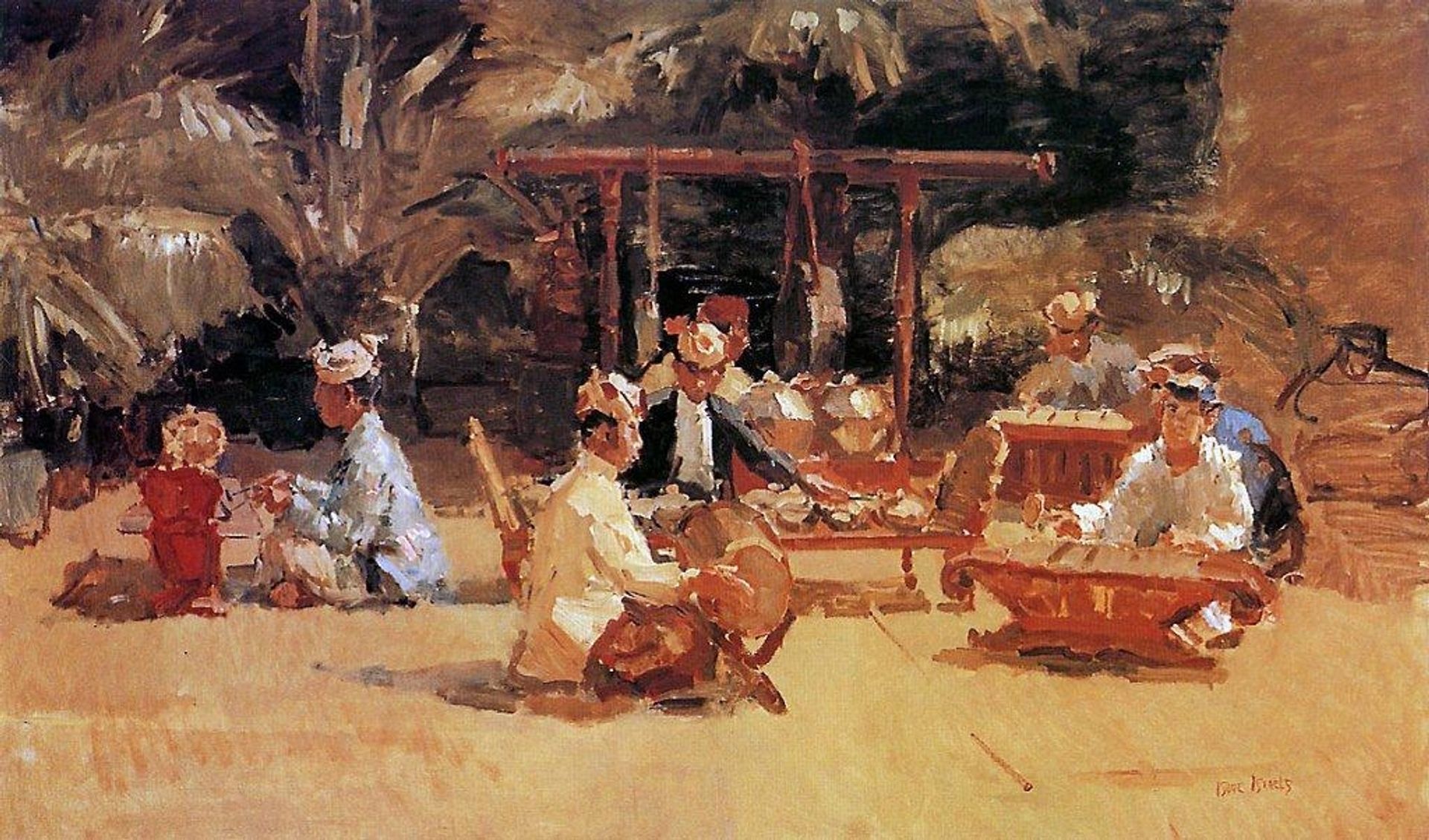
Gamelan Orchestra in Bali, Jakarta Or Solo

Listen to curator's interpretation
Curatorial notes
Editor: This is Isaac Israels's "Gamelan Orchestra in Bali, Jakarta Or Solo," painted in 1921, seemingly using oil paints and maybe gouache. The brushwork feels so loose, almost impressionistic. It captures a fleeting moment. How do you interpret the artist's formal decisions here? Curator: The emphasis seems less on accurate representation and more on capturing the sensation of light and atmosphere. Notice the horizontal composition—how the eye is led across the canvas, mirroring the spatial arrangement of the orchestra. Consider how Israels employs color, favoring earthy tones that contrast subtly with the cooler blues, establishing a serene mood. What effect do you think this balance of warm and cool has on the viewing experience? Editor: It makes the scene feel very relaxed and almost dreamlike. It’s less about sharp detail and more about the overall feeling. But, if the image were more sharply detailed, might we perceive that differently? Curator: Potentially. However, by obscuring details, Israels forces us to focus on the fundamental visual components—form, color, line. Look, for example, at the lack of deep linear perspective; space is created through overlapping planes and tonal shifts. Are we, therefore, invited to perceive reality through feeling? Editor: Yes, absolutely. I'm also struck by how the figures almost blend into the environment. It creates a sense of unity, like the music and the surroundings are one. Curator: Precisely! It is less about a portrait of individual performers and more a study of shapes, colors, and their interrelationships to achieve dynamic expressionism. This focus encourages the audience to notice the purely aesthetic qualities of the piece above representational accuracy. Editor: That makes a lot of sense. Focusing on these key elements has definitely broadened my understanding and appreciation for the composition! Curator: Indeed. By isolating formal aspects, we've hopefully uncovered something essential about its artistic strategy, and about the enduring possibilities latent in visual representation.