

1864
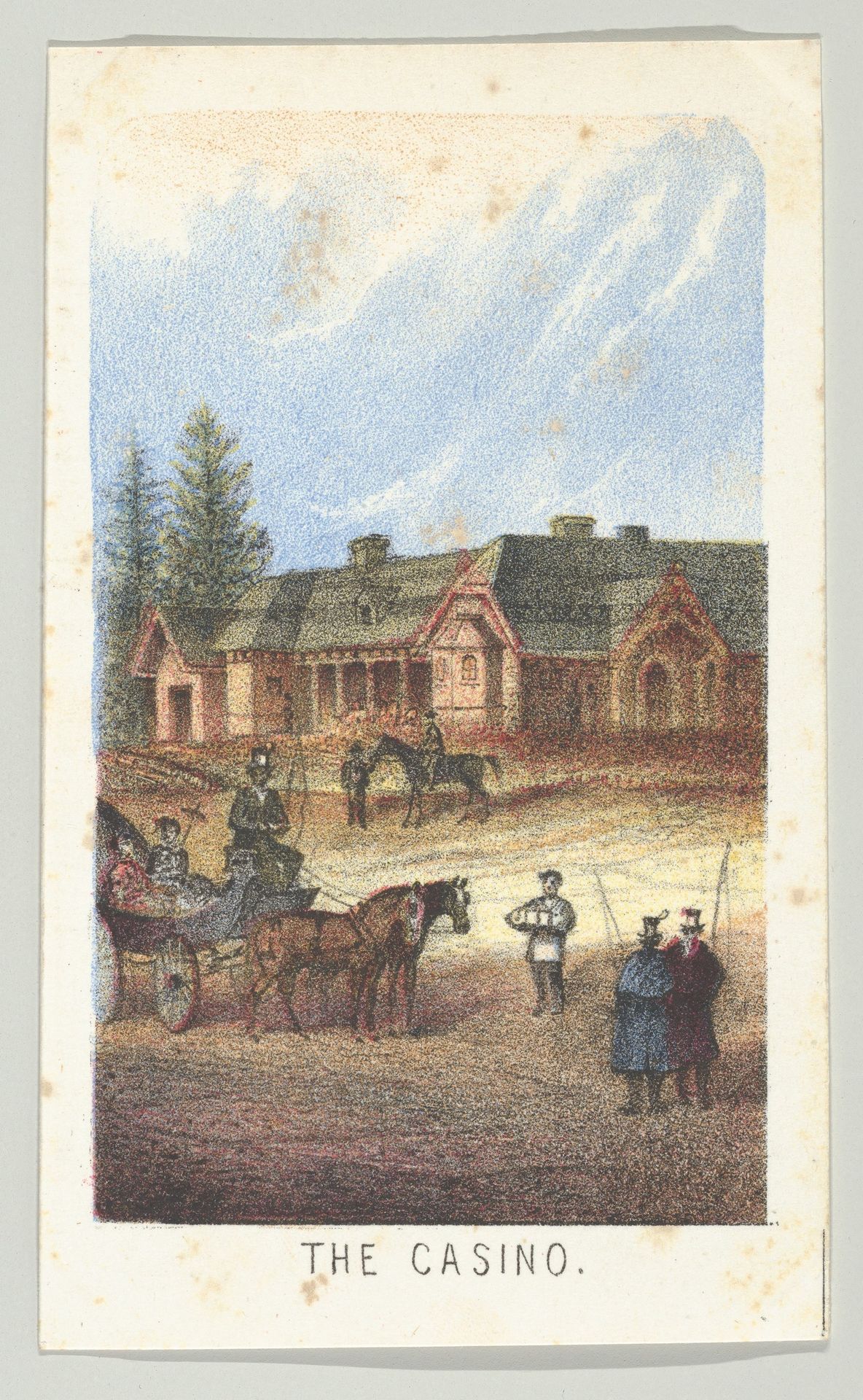
The Casino, from the series, Views in Central Park, New York, Part 3

Listen to curator's interpretation
Curatorial notes
Curator: This charming print, titled "The Casino, from the series, Views in Central Park, New York, Part 3," was created around 1864 by Louis Prang & Co. Editor: It has an oddly quaint, even melancholic air for something depicting, well, a casino. It feels less about excitement and more about restrained societal observation, rendered beautifully through delicate strokes. Are we talking lithograph? Curator: It appears to be a drawing, employing coloured pencils and then reproduced as a print. The printmaking aspect is critical; consider how this choice democratized the experience of art for the rapidly expanding urban population of New York. Images like these brought curated slices of Central Park into middle class parlors. Editor: Absolutely, these mass-produced prints had the capacity to shape perception through distribution. Here, there’s such a striking focus on representing Central Park not merely as a public resource, but almost as a curated tableau of the affluent – see the fashionable carriage arriving, the refined observers, all presented against what would have been state-of-the-art public landscape design. The materials are also significant; these inexpensive coloured pencils allowed for vivid representation without the expense of painting. Curator: Precisely, consider also that the architecture here—while named a "casino"—carries connotations reaching beyond mere gambling. The very idea of a central, often ornate, meeting place is evocative, harking back to Roman villas or even sacred temples. In many cultural narratives, locations for "games of chance" were perceived as being connected to places of heightened perception—the intersection of fate, hubris, and humanity's will to shape their world. Editor: But it also begs the question – a casino implies risk, but the actual material conditions depicted offer a tableau of bourgeois comfort, subtly papering over anxieties around class and access at the time of production. Consider the labor behind the landscaping, or behind the making of those coloured pencils - likely obscured for the consumption of leisure here. Curator: It seems the artist perhaps intended a dual message: celebrating the promise of Central Park as a symbol of civic harmony, but also leaving visible hints regarding what elements remained strategically unseen to maintain that image. Editor: A subtle tension visualized beautifully by the materiality itself; a mass produced impression hinting at a world far removed from the access many might expect a public space to enable. Still, that doesn’t mean it isn't incredibly elegant work of observation.