drawing, mixed-media, ink, pencil
#
drawing
#
mixed-media
#
landscape
#
figuration
#
ink
#
pencil
#
mixed media
Copyright: Ivan Eyre,Fair Use
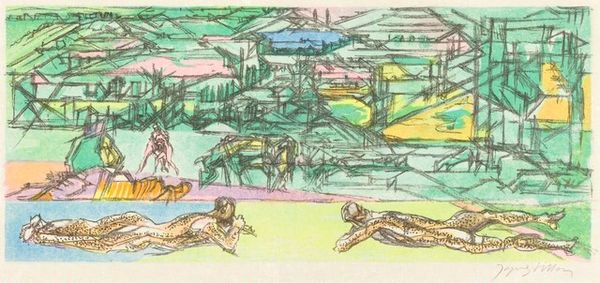
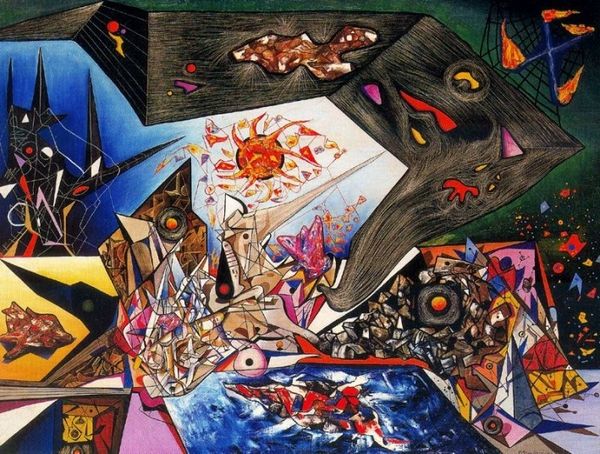
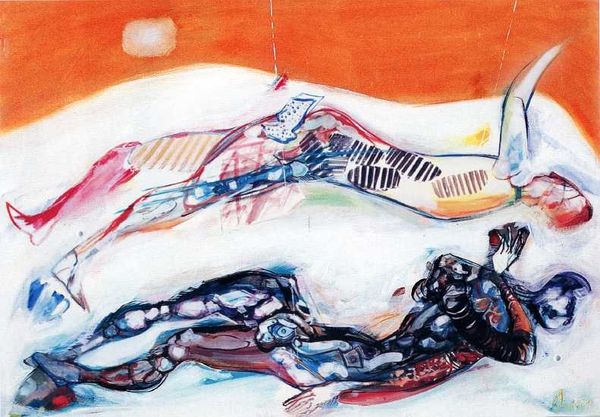
Curator: So, here we have Ivan Eyre's mixed media drawing, "Study for Black Woman." What grabs you about it? Editor: It's a little unsettling, if I’m being honest. There are nude figures and machinery scattered throughout, and the landscape itself seems…industrial. How do all of these materials come together to create this picture? Curator: I see a landscape, but one deeply entwined with the apparatus of production and the labor implied by that. Note the layering: the bodies appear on sheets of paper amidst the anvils, the cauldrons, the…machinery, if you will. There seems to be little difference between those elements. They are materials that have been handled, manipulated. Notice that there’s a horizon with a smokestack. The artist is pointing us to the relationship between our labor, the body, and the industrial landscape, it seems. Do you notice any implied boundaries between categories of image-making or objecthood here? Editor: That’s interesting – you’re right. The figures *are* drawn on separate sheets of paper within the drawing. That collapses any sense of clear figure-ground separation…it is almost a collage! Like the figures are items on a worker’s workbench. So how does Eyre’s choice of mixed media play into that message of labor and materiality? Curator: Well, each medium represents a decision made about the character and accessibility of labor. Pencil suggests a quicker form of reproduction compared to, say, a meticulously crafted oil painting. The ‘unfinished’ look also highlights process, inviting us to reflect on each stage of the image’s material construction. The body becomes another form subject to processes and reproduction within capitalism. Editor: So the materials themselves are kind of 'performative'–commenting on art's relationship to industrial work. It’s given me a whole new way to consider what the artist intended to say about these bodies. Curator: Indeed. And consider what role is offered to *us* by these decisions. Are we witnesses, or implicated in this complex image? Editor: I'm left thinking about how often we overlook the material realities that underpin art. This has definitely changed my understanding of Eyre’s process. Curator: Me too. These unexpected juxtapositions create space for us to consider all the relationships between the elements in a picture.
Comments
No comments
Be the first to comment and join the conversation on the ultimate creative platform.
 Collect
 React
React Comment
More like this