

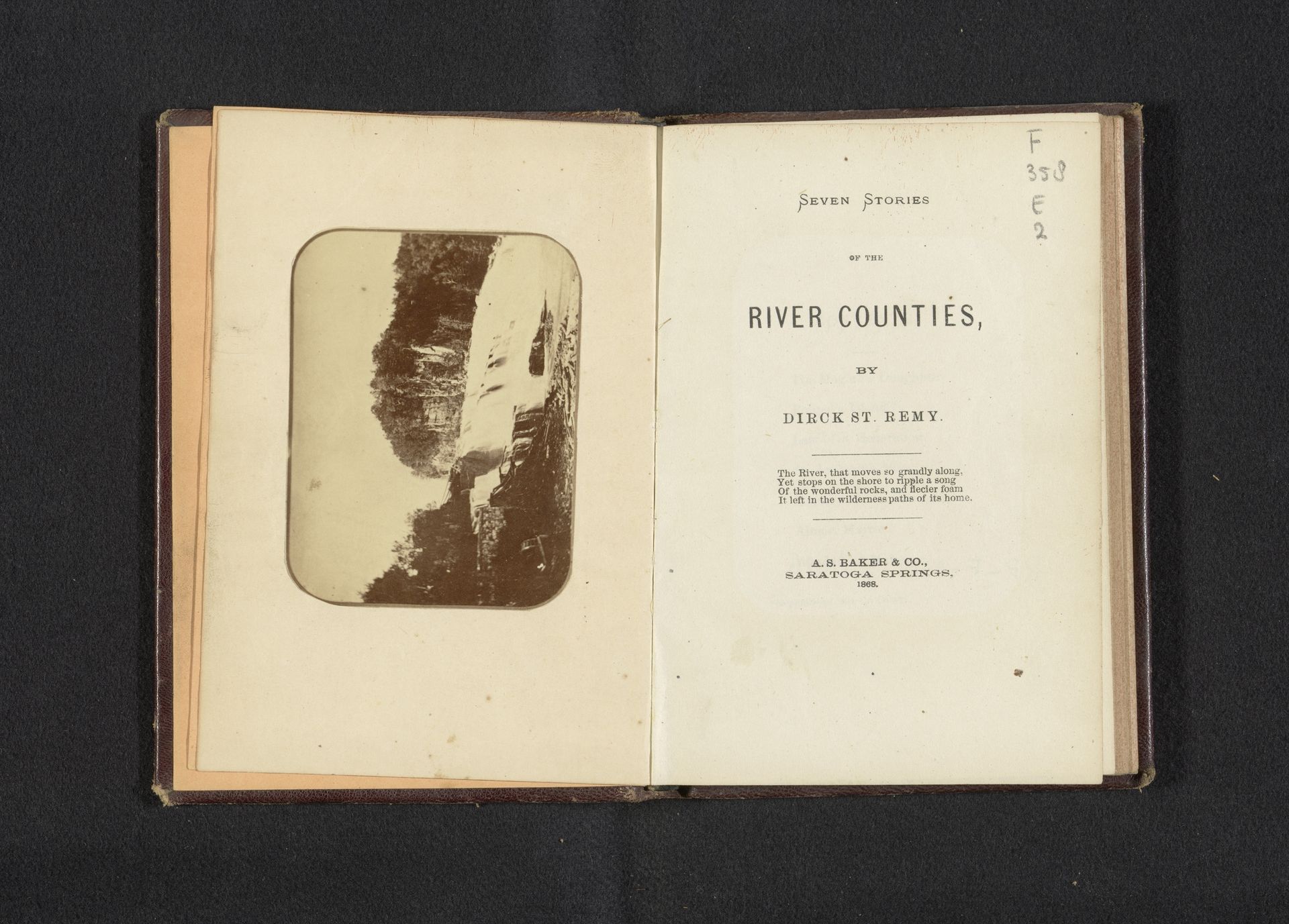
1868
Seven stories of the river counties

Listen to curator's interpretation
Curatorial notes
Editor: This is "Seven Stories of the River Counties," a book created in 1868, featuring an albumen print. There's a stillness about it, the sepia tones give it a very historical feel. How would you interpret this work? Curator: Considering the period, I see this object as a testament to the cultural importance of landscape in 19th-century America. How might we understand its role in shaping national identity, especially given the context of westward expansion and industrialization? Notice the composition - the juxtaposition of text and image, of the 'civilized' book and the 'untamed' landscape. Who had access to these depictions? Editor: That’s interesting. It makes me think about accessibility…who got to experience these landscapes, versus who just saw them represented in print? Curator: Exactly. This also raises questions about whose stories are being told and whose are being omitted. In what ways does this portrayal of the river counties reinforce or challenge existing power structures? Think about race, class, and gender in relation to land ownership and resource control. Was everyone invited to these ‘River Counties’? Editor: I never thought of it that way…so the beauty could also obscure inequalities that existed. Curator: Precisely. And it highlights the tension between preservation and exploitation that continues to shape our relationship with the natural world today. Consider how photography, as a technology, plays a role in mediating this relationship. What does it mean to capture and possess an image of a landscape? How does it impact our understanding of environmental ethics and social justice? Editor: This has really opened my eyes to layers I hadn't considered. Thank you. Curator: My pleasure. Hopefully, these discussions can help us question dominant narratives, even seemingly benign images like this.