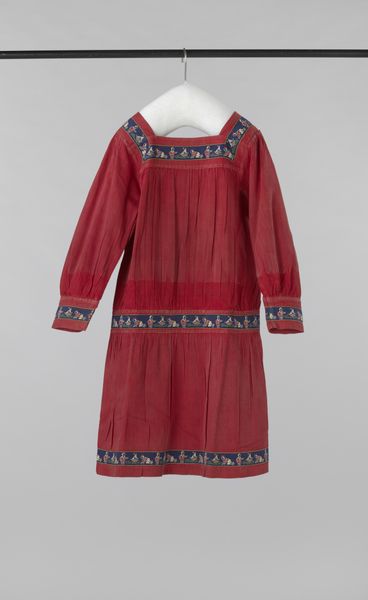
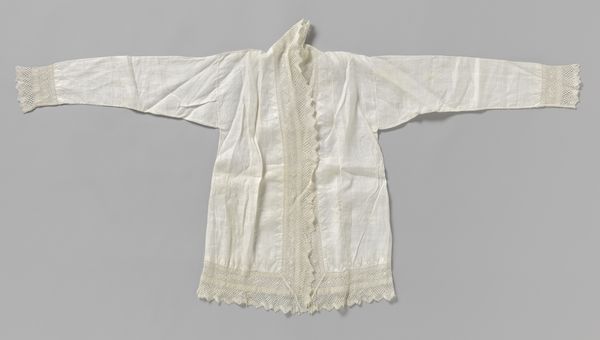
Kinderschort met lange mouw en achtersluiting met twee knopen van beige linnen, langs de mouw, hals en zoom afgezet met boerenkinderen, molens en schepen c. 1926 - 1930
0:00
0:00

textile
#
portrait
#
underwear fashion design
#
fashion mockup
#
fashion merchandise
#
textile
#
clothing promotion photography
#
fashion and textile design
#
fashion based
#
clothing photography
#
clothing theme
#
clothing photo
#
decorative-art
#
clothing design
Dimensions: height 72 cm, depth 40 cm, length 72 cm, diameter 40 cm
Copyright: Rijks Museum: Open Domain
Editor: Here we have a child's long-sleeved linen apron, believed to be made between 1926 and 1930 by M. Insinger. What immediately strikes me is how the decorative border contrasts with the simple form. What can you tell us about this piece? Curator: Well, let's think about this apron in the context of its time. Early 20th-century clothing often reflected very specific societal expectations. Do you notice anything in the decoration that might point to this? Editor: I see images of children, windmills, and ships embroidered on the borders. It feels very folksy and… wholesome? Curator: Exactly! The depiction of idealized rural life tells us a lot. At the time, there was a significant movement to promote traditional values and national identity, especially among children. These motifs subtly reinforce that ideal, presenting a specific vision of childhood and Dutch heritage. Editor: So, the apron isn’t just practical; it’s communicating cultural ideas? Almost like propaganda in fabric form? Curator: In a way, yes. While it’s certainly not overt propaganda, the imagery subtly shapes a child's understanding of their world and their place within it. It's interesting to consider the role of women, who would have likely created these items and passed these ideals along to children through both form and function. Do you think the choice of linen says something too? Editor: It's practical, durable…maybe suggesting a kind of resilience? It would stand up to rough play and frequent washing. Curator: Precisely. Linen was both accessible and enduring, suggesting values of practicality and durability. In short, this seemingly simple apron reflects much more than just a piece of clothing. It's a fascinating glimpse into a specific historical moment and the social values it embraced. Editor: I never thought about clothing this way before! It's really fascinating how even everyday objects can be powerful cultural artifacts.
Comments
No comments
Be the first to comment and join the conversation on the ultimate creative platform.
 Collect
 React
React Comment
More like this