photography
#
pictorialism
#
landscape
#
photography
#
coloured pencil
Dimensions: height 121 mm, width 168 mm
Copyright: Rijks Museum: Open Domain
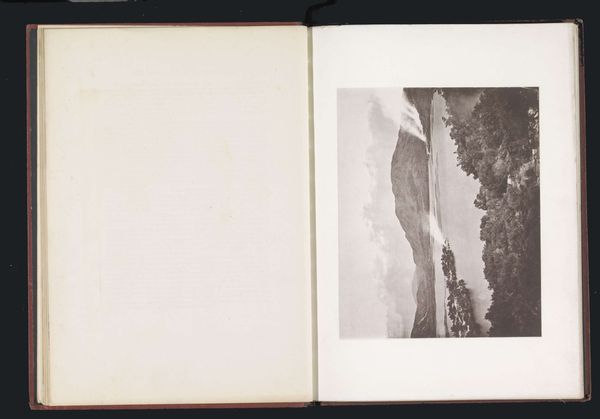
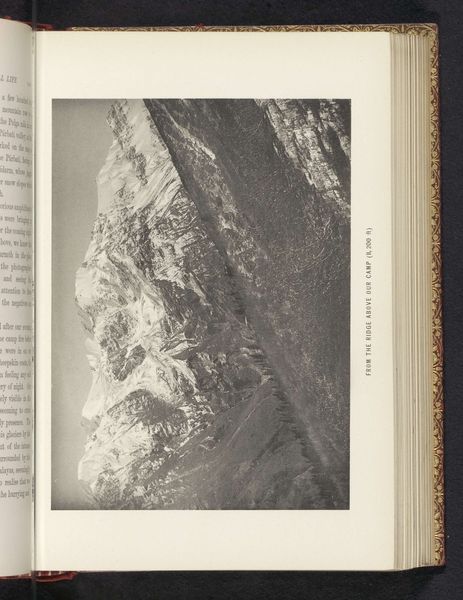
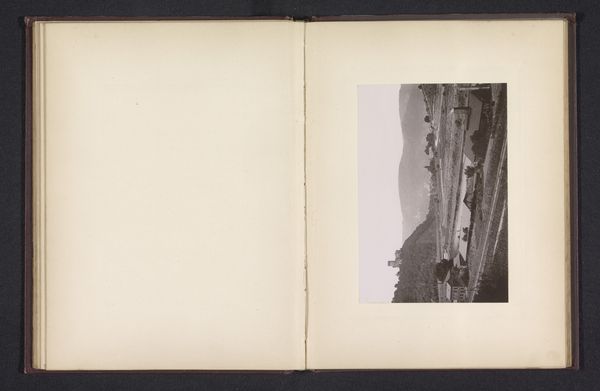
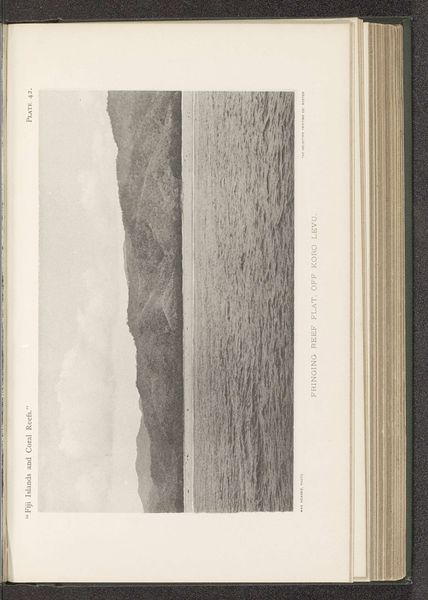
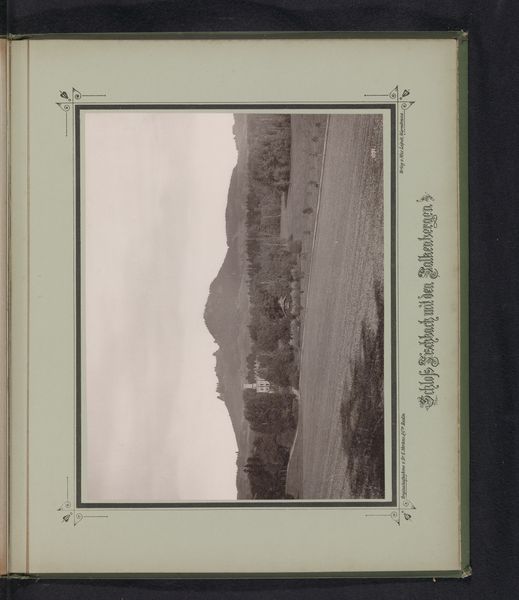
Curator: Let's explore this photograph, "The Upper Kulu Valley at Nagar" by Frederick Saint John Gore, taken before 1895. Editor: The print is mounted on a page, like an open book, making it feel really intimate. It's also interesting to think about its existence within the context of a physical book. What do you make of the image? Curator: As a materialist, I'm immediately drawn to the photographic process. The silvery tones, the paper's texture, these aren't just aesthetic choices. Photography at this time was a specific industrial process. I see Gore carefully controlling his medium to represent the landscape of the Kulu Valley, maybe suggesting an arcadian landscape while using mass-reproducible materials and formats. How might this tension reflect colonial perceptions of India? Editor: That’s a great point about colonialism and perception. The printmaking process brings a new dimension to it, making it mass-produced while retaining a sense of preciousness. The tonal range almost renders it into a drawing. Curator: Exactly! The very act of capturing this vista via photographic print implicates a particular, consumable version of ‘India.’ How much does it change by being mass-produced into a portable product? And is the print mimicking more hand-rendered techniques? It makes us question the perceived division of photography, printmaking and ‘high art’ practices, no? Editor: Definitely! I hadn't considered the commodification aspect so directly before. So it makes me see a clash between appreciating natural beauty and the commercial lens through which it's captured and consumed. I guess both are true, aren’t they? Curator: Precisely, and seeing them in tension with each other is the crucial part. What appears seamless is revealed to be full of fractures, much like the terrain presented!
Comments
No comments
Be the first to comment and join the conversation on the ultimate creative platform.
 Collect
 React
React Comment
More like this