1616 - 1657
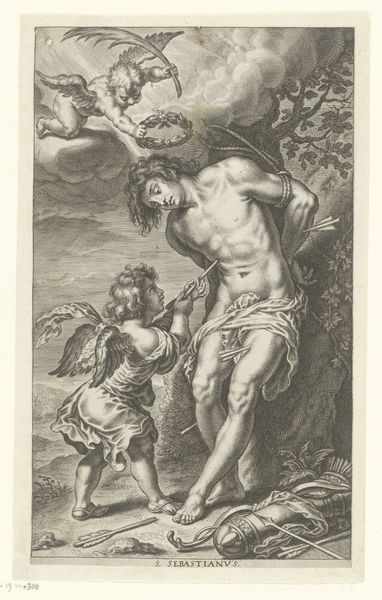
H. Sebastiaan

Paulus Pontius
1603 - 1658Location
RijksmuseumListen to curator's interpretation
Curatorial notes
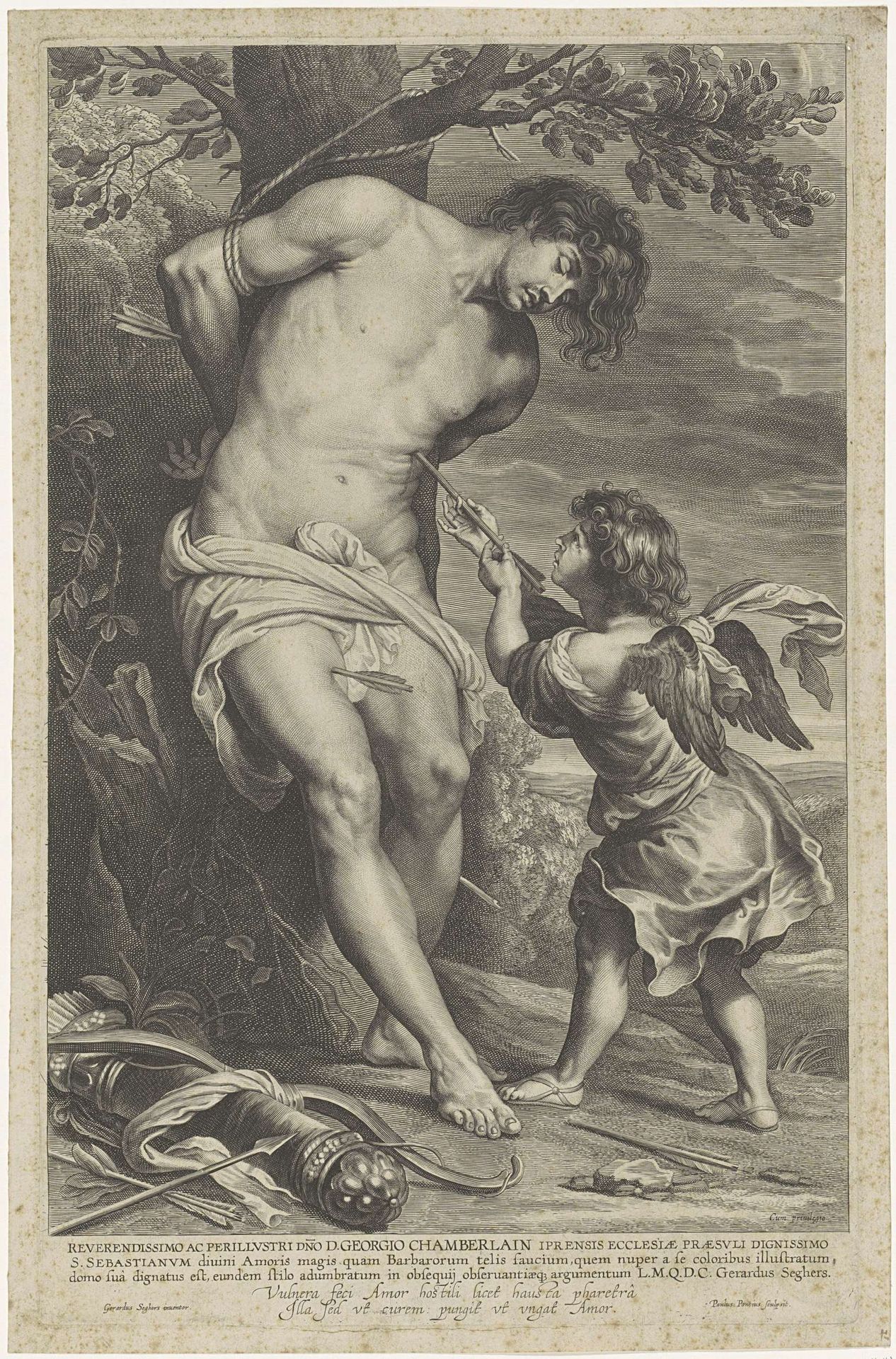
Editor: This engraving, "H. Sebastiaan" by Paulus Pontius, created sometime between 1616 and 1657, really strikes me. The stark contrast and the pose of Saint Sebastian – it’s quite dramatic. What stands out to you when you look at it? Curator: Immediately, the composition commands attention. Observe how the engraver uses the body of Saint Sebastian as a strong vertical axis, bisecting the image. Then, consider the formal qualities of the figure itself – the musculature, the fall of drapery – these are rendered with considerable precision. How does the rendering of light play into the emotionality? Editor: It seems to spotlight the saint’s body, enhancing the drama and pain, I guess. What about Cupid? How does he fit in? Curator: A formal reading of Cupid reveals a crucial counterpoint. Note the cherubic softness of Cupid's figure contrasted against the taut physicality of Sebastian. Semiotically, what meaning can we draw from Cupid re-arming Saint Sebastian? Editor: Is it love triumphing through his suffering? Or physical resilience from a symbol of sensuality? Curator: It's open to interpretation, however considering the structure, one sees the contrast between the earthly pain and heavenly aid creates a fascinating visual paradox within the composition, don't you agree? The Cupid figure draws focus toward the wounded body as one complete compositional unit. Editor: I hadn't thought of the Cupid and the body as an enclosed, unified composition. The paradox really becomes clear through that formal contrast. Thanks! Curator: It’s in attending to the forms and their relationships that we can move closer to understanding the artwork’s structure, after all.