About this artwork
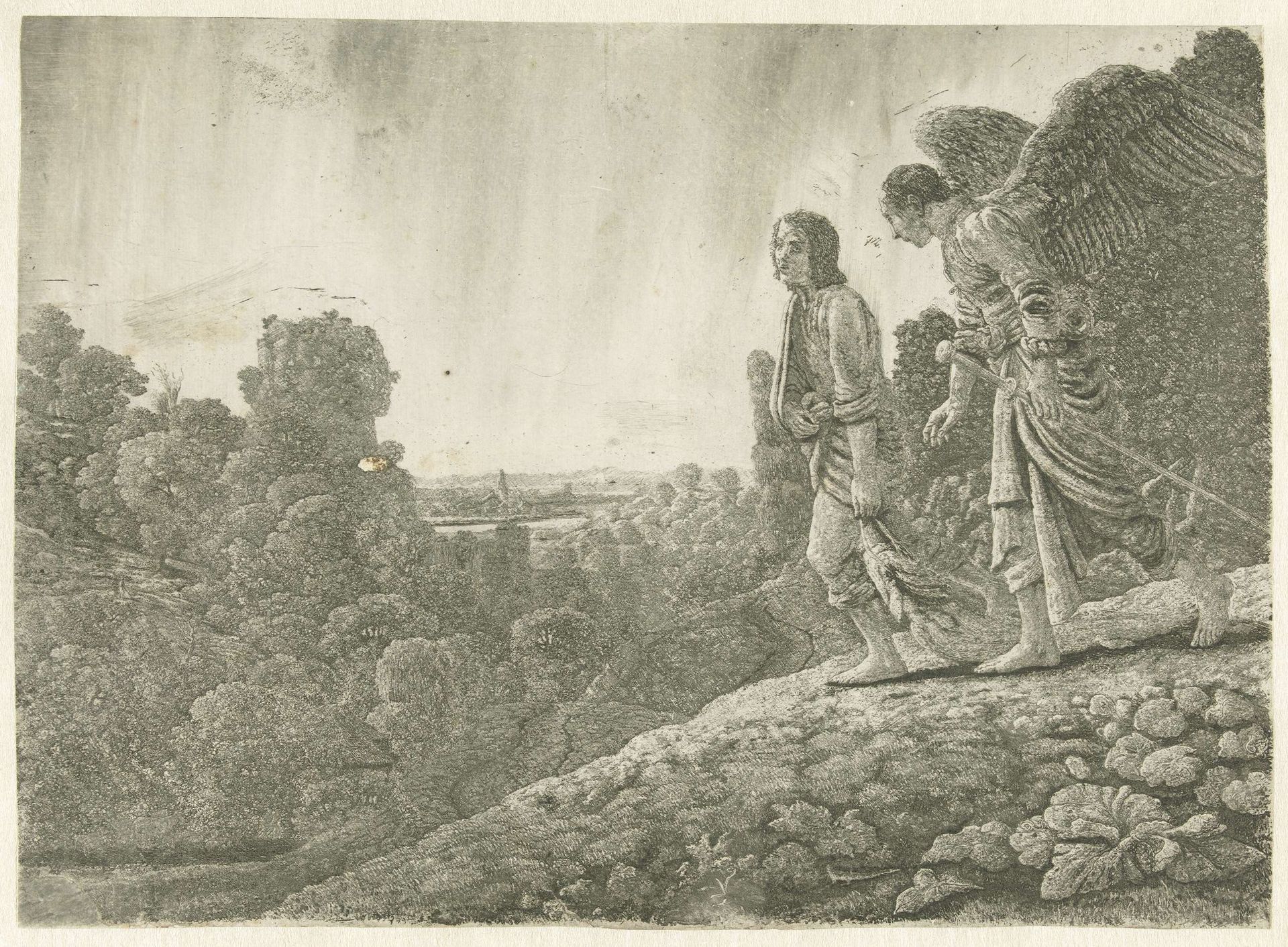
Curator: Here we have Hercules Segers' "Tobias and the Angel," an etching dating from about 1630 to 1633, part of the Rijksmuseum collection. What strikes you when you first see it? Editor: Immediately, the misty light, or lack thereof. It feels otherworldly, like a vision half-remembered. There's something melancholic in the muted tones, almost like a memory fading into the landscape itself. Curator: Segers’ etchings are remarkable for their experimental techniques. It seems that the artist manipulates textures and printing methods, imbuing the final print with unique qualities. Editor: I can see that. It almost doesn't look like an etching. He manages to create this whole strange new world, an entire tonal and tactile experience on this small surface. You get lost in it, somehow. It reminds me of some ancient place, half real and half imagined. Curator: This particular print illustrates a scene from the Book of Tobit, where the Archangel Raphael guides young Tobias on his journey. It has figuration, naturally, but the real protagonist here is landscape. He often repurposed existing plates and tinted the prints in different colors to explore atmosphere and tone. Editor: It’s like he’s pushing against the confines of the etching medium itself. It's very unusual how he embeds the figures within this dominant natural setting, they're really just small details in this big sweep of nature. It does evoke a journey of sorts—both inner and outer, with the angel sort of fading in from somewhere beyond, like he is both inside Tobias's head and walking alongside. Curator: He aimed to elevate the status of printmaking. For his printing process he favored painterly qualities over the clean and standardized qualities found in other prints. His innovative methods surely served to bridge a conceptual and tangible connection to painting. Editor: Seeing the level of control and artistic invention that went into Segers' work, it is clear why his work was sought after by others, including Rembrandt himself. You really get a feel for how it's made—all the layering and pulling back—as though, in the landscape, you're actually in the workshop! Curator: Precisely, this piece shows not only technical proficiency but an artistic sensitivity, so that the end result of it evokes much more than is present. Editor: That’s very true, and I agree—it certainly gives us much more to contemplate!

Artwork details
- Medium
- print, etching
- Dimensions
- height 202 mm, width 276 mm
- Location
- Rijksmuseum
- Copyright
- Rijks Museum: Open Domain
Tags
Comments

On the basis of the watermark in the paper used for this etching, it could be dated to around 1630–1633. It must have been one of Segers’ last prints, and given the representation and its sensitive execution also his most ambitious one.
About this artwork
Curator: Here we have Hercules Segers' "Tobias and the Angel," an etching dating from about 1630 to 1633, part of the Rijksmuseum collection. What strikes you when you first see it? Editor: Immediately, the misty light, or lack thereof. It feels otherworldly, like a vision half-remembered. There's something melancholic in the muted tones, almost like a memory fading into the landscape itself. Curator: Segers’ etchings are remarkable for their experimental techniques. It seems that the artist manipulates textures and printing methods, imbuing the final print with unique qualities. Editor: I can see that. It almost doesn't look like an etching. He manages to create this whole strange new world, an entire tonal and tactile experience on this small surface. You get lost in it, somehow. It reminds me of some ancient place, half real and half imagined. Curator: This particular print illustrates a scene from the Book of Tobit, where the Archangel Raphael guides young Tobias on his journey. It has figuration, naturally, but the real protagonist here is landscape. He often repurposed existing plates and tinted the prints in different colors to explore atmosphere and tone. Editor: It’s like he’s pushing against the confines of the etching medium itself. It's very unusual how he embeds the figures within this dominant natural setting, they're really just small details in this big sweep of nature. It does evoke a journey of sorts—both inner and outer, with the angel sort of fading in from somewhere beyond, like he is both inside Tobias's head and walking alongside. Curator: He aimed to elevate the status of printmaking. For his printing process he favored painterly qualities over the clean and standardized qualities found in other prints. His innovative methods surely served to bridge a conceptual and tangible connection to painting. Editor: Seeing the level of control and artistic invention that went into Segers' work, it is clear why his work was sought after by others, including Rembrandt himself. You really get a feel for how it's made—all the layering and pulling back—as though, in the landscape, you're actually in the workshop! Curator: Precisely, this piece shows not only technical proficiency but an artistic sensitivity, so that the end result of it evokes much more than is present. Editor: That’s very true, and I agree—it certainly gives us much more to contemplate!
Comments
On the basis of the watermark in the paper used for this etching, it could be dated to around 1630–1633. It must have been one of Segers’ last prints, and given the representation and its sensitive execution also his most ambitious one.