print, metal, engraving
#
allegory
#
baroque
# print
#
metal
#
old engraving style
#
figuration
#
pen-ink sketch
#
engraving
Dimensions: height 143 mm, width 173 mm
Copyright: Rijks Museum: Open Domain
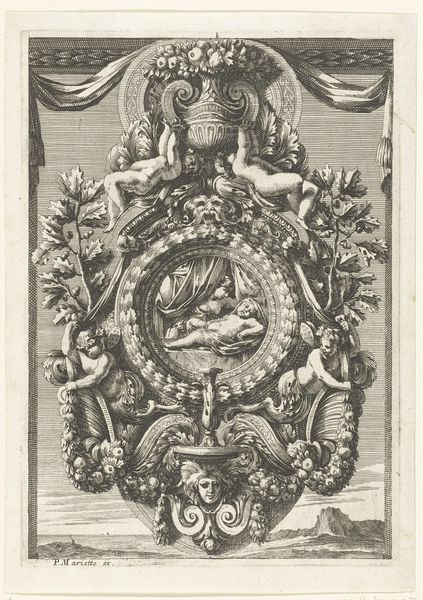
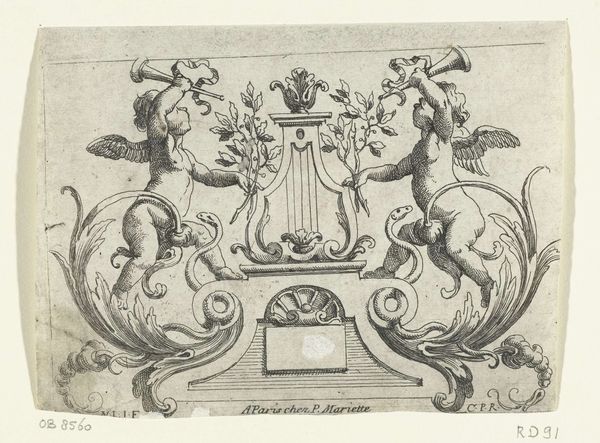
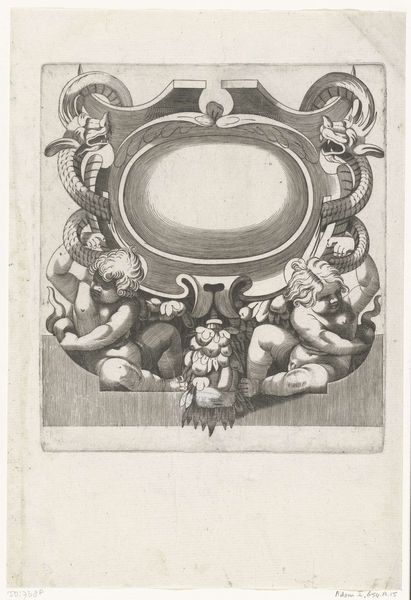
Curator: Here we have an engraving, created before 1689, by René Lochon. It’s titled "Ovaal medaillon omringd door drie putti," which translates to "Oval medallion surrounded by three putti." It resides here in the Rijksmuseum. What strikes you initially about this piece? Editor: The scene looks so serene—even decorative. These chubby, cherubic figures almost make me feel as if I’m looking at royal propaganda... or perhaps, advertising for the ruling class? Curator: It does have that ornate quality, very typical of the Baroque style. The composition itself is an allegory, centered on an oval medallion. At the top of this medallion sits a crown, above the conjoined initials. Below it, a bed of garland. Can you feel it almost calling out the royalty's eternal legacy? Editor: Precisely! And those putti—the cherubic children—positioned carefully around the central oval...they feel staged, deliberately placed to idealize power, innocence, and legacy. Do we know for whom this was commissioned? Curator: Historical records don’t specify for whom the engraving was made. Lochon produced many decorative prints, often intended for books or other printed materials, so it's likely this was created as a design element. His engravings often contain allegorical figures and ornamental details—this is a world of symbolism and carefully constructed messaging. Editor: It's interesting to consider how printmaking served not only as a form of artistic expression, but also as a powerful means to distribute ideology and visual representations of authority. Even these curly ribbons dancing in the upper background... every little detail appears curated to produce this desired effect. Curator: Absolutely. I like to imagine the original audience pondering these emblems—interpreting the messages woven into the allegorical design. A far cry from our soundbite culture today. It's a different mode of visual thinking. Editor: True, though that visual language and symbolism haven’t vanished. They've simply morphed, perhaps to appear in a different medium to convey related forms of messages today. The cherubic form now advertising, the symbols of legacy, promoting some company with historical ties... The engraving itself, an uncanny precursor. Curator: I love how you connect the dots between then and now. Thinking about the threads that weave through art history is a bit like adding my own curly ribbon to this particular piece. Editor: I suppose I tend to see everything through the lens of power dynamics, and it's refreshing to consider art from such a different yet aligned viewpoint!
Comments
No comments
Be the first to comment and join the conversation on the ultimate creative platform.
 Collect
 React
React Comment
More like this