

1878 - 1940
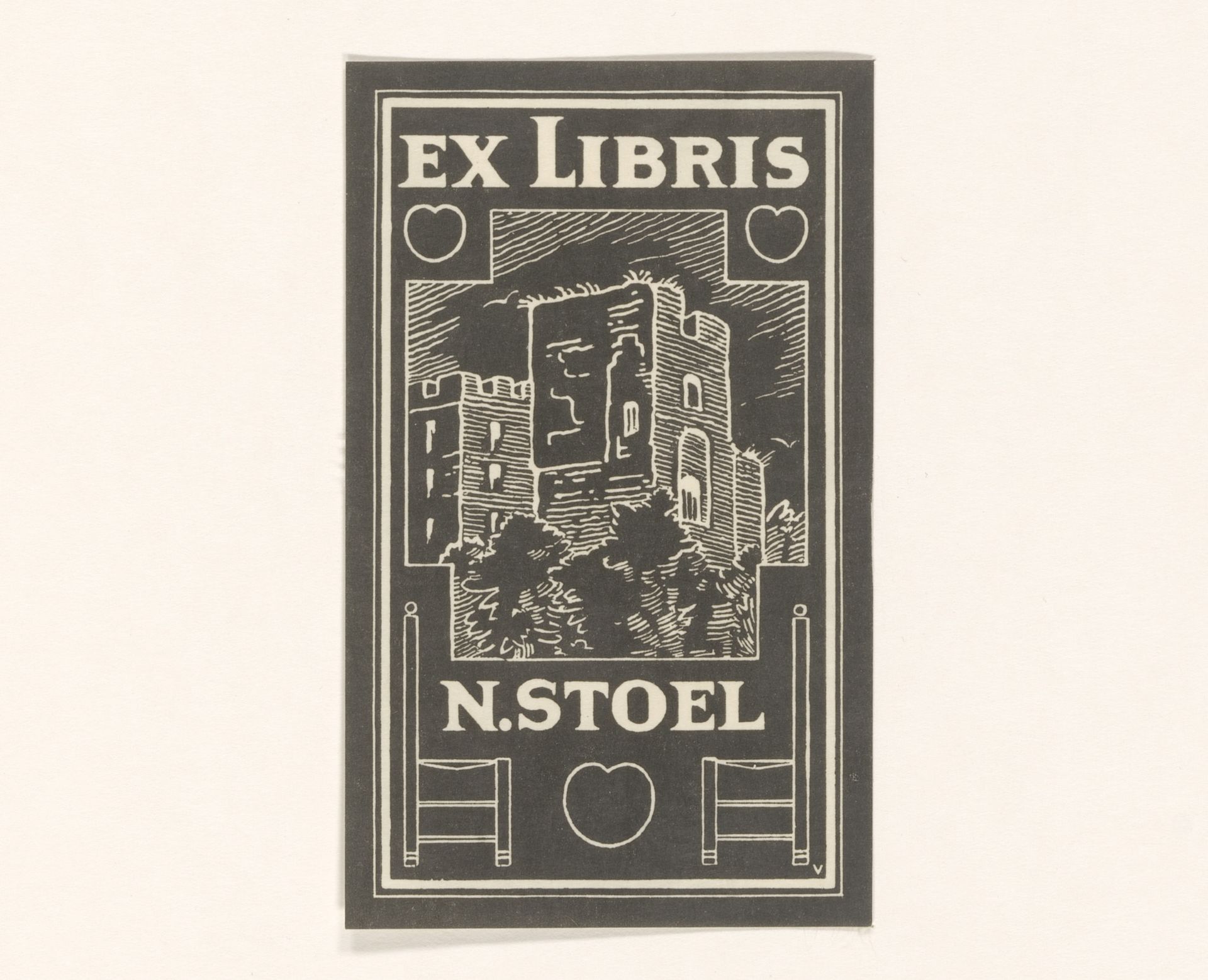
Ex libris van N. Stoel

Listen to curator's interpretation
Curatorial notes
Curator: Here we have a bookplate designed by Elias Voet Jr. sometime between 1878 and 1940. The artwork, titled "Ex libris van N. Stoel", is a woodcut print, showcasing the artist's engraving skills. Editor: It evokes a strong sense of gothic romanticism, doesn't it? The dark tones, stark geometric borders, the image is dominated by a brooding castle on a small, intimate scale, like a window into another world. Curator: Exactly. The geometric border emphasizes the linear qualities of the print. Notice how the rigid frame contains organic shapes. See the foliage, stylized hearts, the castle ruin, even the twin chairs which all speak to natural forms. Editor: And "N. Stoel," the name it bears, certainly points towards the personalization of literature and ownership of the written word within a specific class dynamic. Bookplates like this signified status and literacy. Curator: The chairs lend the entire composition an understated sense of wit, almost like two guards flanking either side of the “Stoel” name while pointing up towards a higher authority. And the castle, with all of its historical, hierarchical allusions! Editor: Right. In a more contemporary context, what narratives are being overlooked? The castle isn’t neutral. It represents systems of power built on foundations that often disregarded those outside the privileged classes, even erases certain populations altogether. The use of geometric shapes also strikes me. Is it perhaps to mimic or allude to the rise of industrialism? Curator: Well, perhaps…though one can also consider them as purely structural elements. By organizing negative space, they lead your eye systematically through Voet's imagined landscape, and then return you smoothly through the upper register with a pleasing unity. Editor: Which underscores, to me, how these images acted as silent promoters of a social order—symbols reinforcing established hierarchies. Thank you for highlighting this gem. It reminds us that art isn't just aesthetics, but history crystallized. Curator: And thank you for offering up a thoughtful deconstruction. This exercise shows, among other things, how timeless even seemingly minor artwork can provoke insightful, critical analysis.