photography, gelatin-silver-print
#
wedding photograph
#
pictorialism
#
wedding photography
#
marriage
#
photography
#
gelatin-silver-print
#
genre-painting
#
post-impressionism
Dimensions: height 75 mm, width 100 mm
Copyright: Rijks Museum: Open Domain
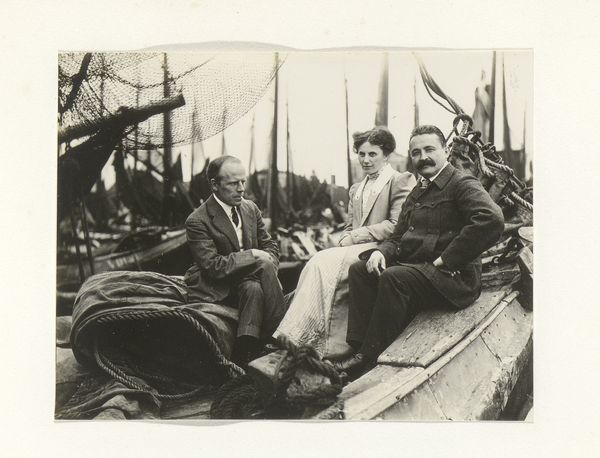
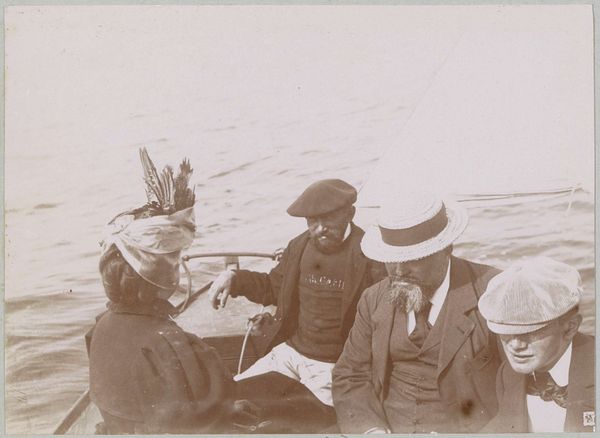
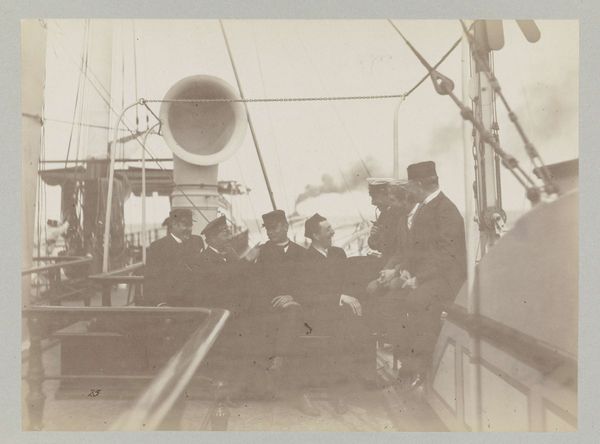
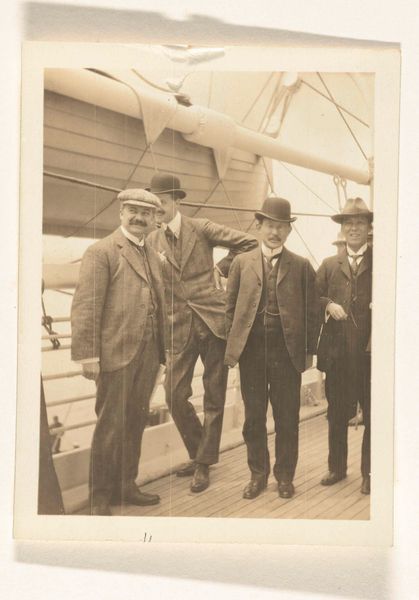
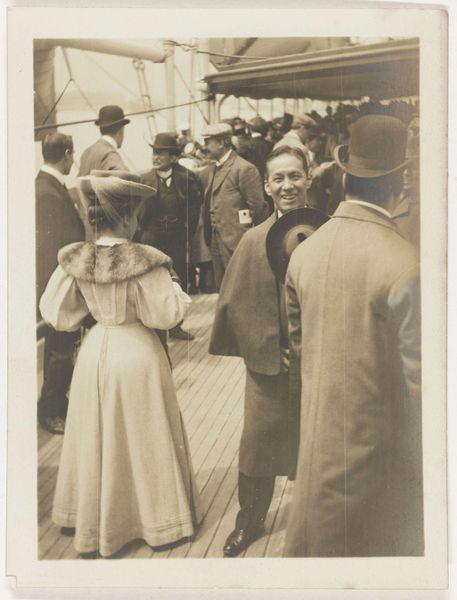
Editor: Here we have a gelatin-silver print from around 1900 to 1910, entitled "Mannen en vrouw op een boot," so “Men and women on a boat.” It reminds me of early wedding photos I’ve seen; however, the mood is quite ambiguous to me, with one figure looking detached while the others are expressive. What do you see in this piece? Curator: I see echoes of maritime ritual and the complex symbolism surrounding journeys and unions. Water, historically, has been seen as a transitional element, a bridge between worlds, and a boat, a vessel carrying souls. Do you notice the net draped in the background? Editor: Yes, it looks almost like a bridal veil. Is that intentional, then, to associate this scene with marriage? Curator: Potentially. The net could also represent the 'catch' of marriage, societal expectations, or even entrapment. The gestures of the figures also interest me; one figure is sitting, almost stoic, while another stands with a raised arm. What do you make of these contrasts? Editor: It almost feels like the standing figure is commanding attention, contrasting with the other man's apparent indifference and the woman's stoic passivity. The photograph is full of subtle storytelling. Curator: Indeed. And the setting—aboard a working vessel, rather than a pleasure craft—further complicates our understanding of leisure and obligation. We often associate the sea with freedom, but here, labour seems ever-present. These are potent images—what’s ‘caught’ can carry cultural memory far. Editor: It’s amazing how a seemingly simple photograph can be so dense with layers of meaning and potential interpretations. I had not thought of a marriage scene in these terms before. Curator: Exploring such nuances is key to unlocking deeper understandings of both the artwork and the culture that produced it. It reveals cultural values in visual form, doesn't it?
Comments
No comments
Be the first to comment and join the conversation on the ultimate creative platform.
 Collect
 React
React Comment
More like this