

1841
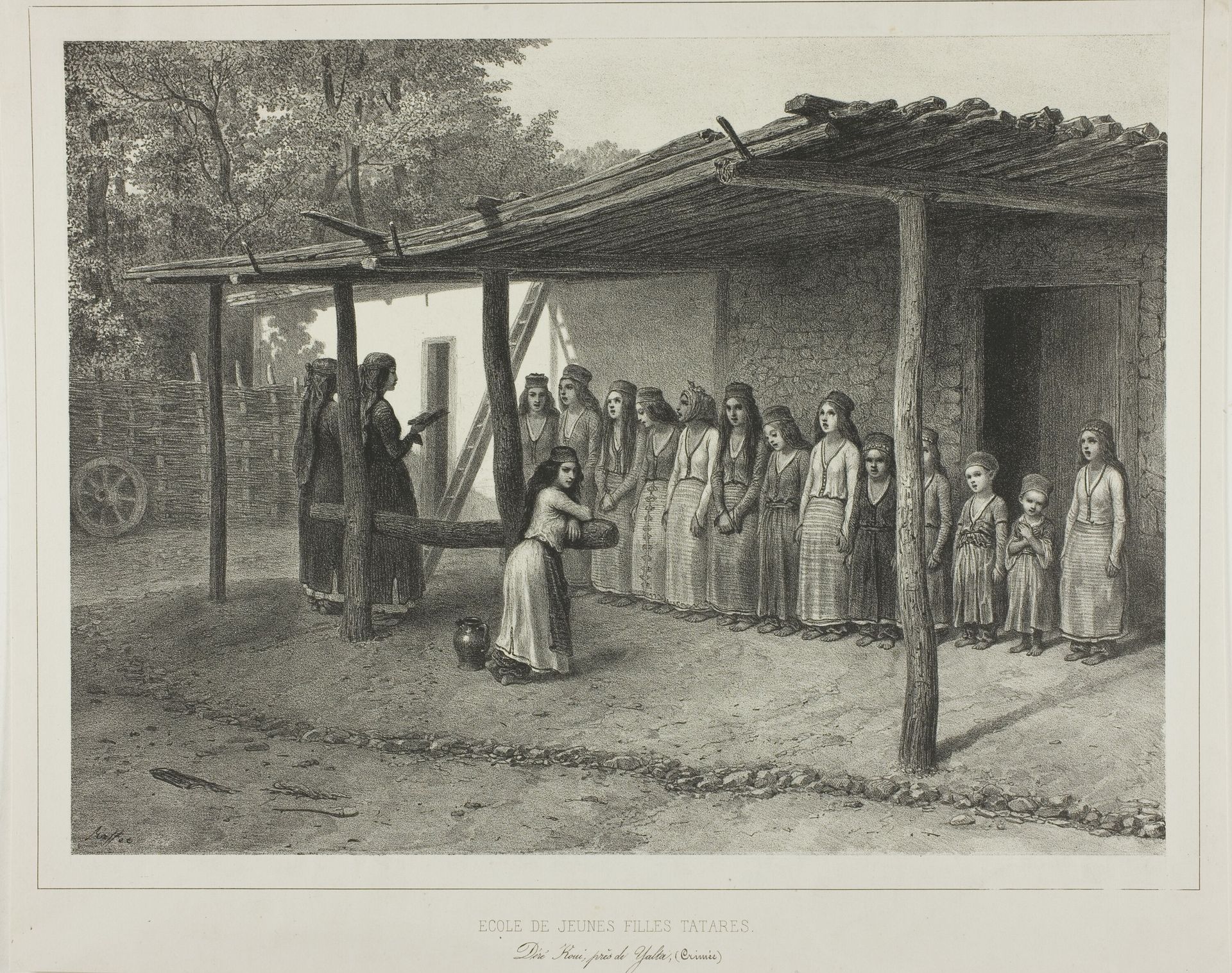
School for Young Tartar Girls


Listen to curator's interpretation
Curatorial notes
Editor: Here we have "School for Young Tartar Girls," a lithograph on paper created in 1841 by Auguste Raffet. It's a monochromatic image, dominated by linear figures arranged within a simple architectural space, creating a feeling of both constraint and anticipation. What draws your eye as you analyze its structure and form? Curator: Note how Raffet uses contrasting tonal values to articulate the scene. Light and shadow interplay to define form, create depth, and draw the eye toward certain areas. Observe the almost regimented placement of the girls and their instructor. The composition's rigidity, coupled with the architectural framework, hints at the social structures in play. How does the medium--the print-- affect your understanding of its artistic function? Editor: I see the order now; the teacher is the focal point in contrast to her students who almost act as part of the backdrop. Being a lithograph I see it as an inexpensive way of mass distribution. Could that say something about education during that period, or the accessibility of this art in particular? Curator: Precisely. The graphic quality underscores its dual role: an artistic rendering, but also a readily available form that broadcasts particular realities and perspectives. Does it influence how you read its potential meaning? Consider how the lines articulate clothing, gesture, and physiognomy. How do the aesthetic choices enhance or detract from any intended message about gender and power dynamics? Editor: It presents an interesting paradox; on one hand, we see all the girls learning together, possibly moving society forward. At the same time, we have the almost rigid and militaristic grouping which highlights limited individual expression. This focus has changed my view of the artwork. Curator: Indeed, these contradictions form the nucleus of this artwork, allowing us to see how structure can, in effect, dictate function and perception.