

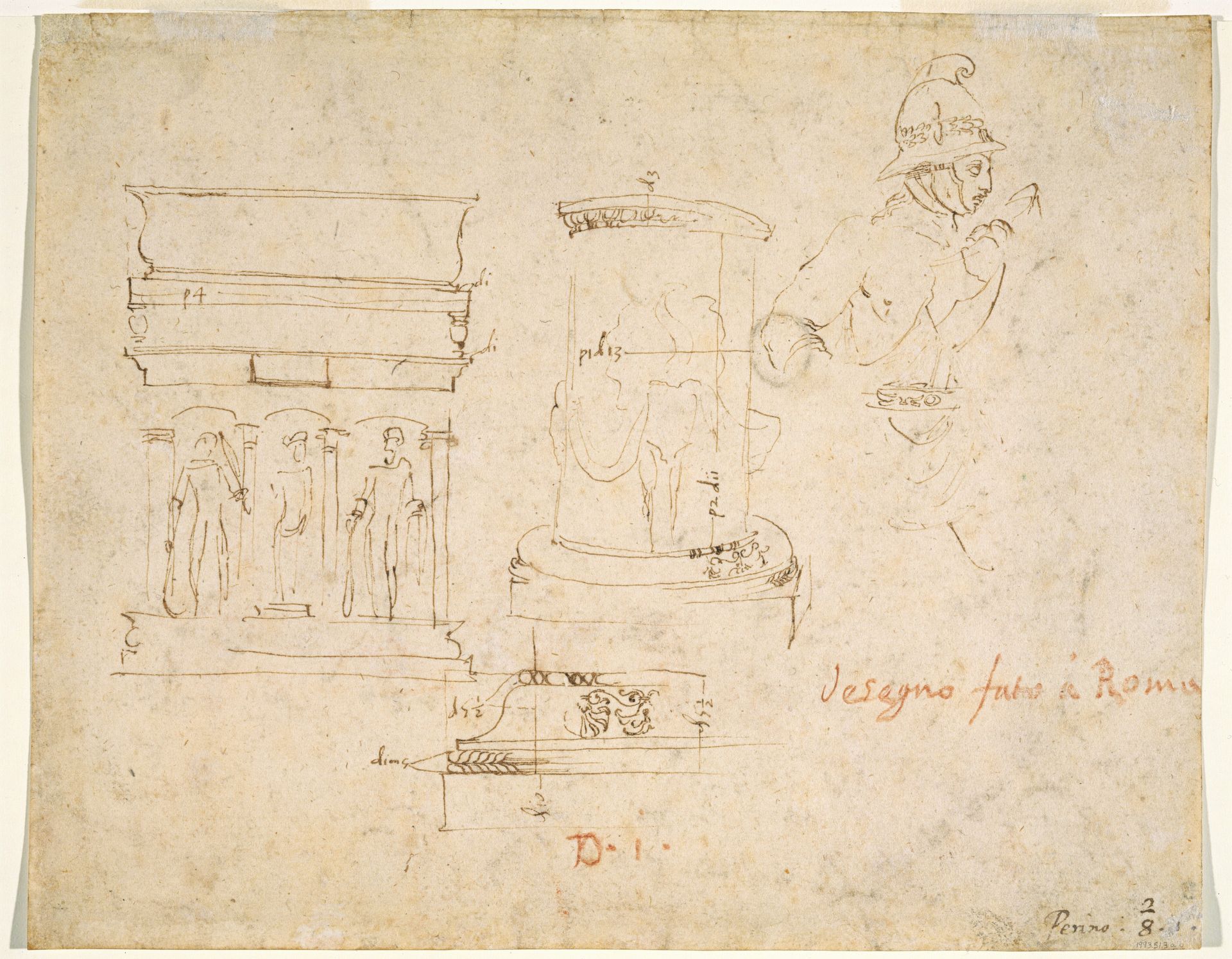
Architectural Details and a Soldier [verso]


Listen to curator's interpretation
Curatorial notes
Curator: What strikes me immediately is the artist’s inscription at the lower right: “drawing made in Rome”. Editor: This is "Architectural Details and a Soldier," a drawing on paper attributed to Raphael, from the Renaissance. I'm struck by the artist’s keen observation and capture of detail. How do you interpret this work, seeing it today? Curator: We are offered here what amounts to a Renaissance sketchbook page, a jumble of studies rendered with immediacy. But these architectural studies are far from neutral records of classical forms; they're assertions of cultural power. Remember that the Renaissance was obsessed with rediscovering and appropriating classical antiquity. These drawings allowed Raphael to absorb, reimagine, and ultimately assert his dominance over that legacy. What kind of dialogue do you think is in play here? Editor: So you are saying the act of drawing isn't just replication, it’s also claiming authority over a historical precedent? Do you mean how Renaissance artists studied the remains of ancient Rome to revive classical art and culture, thus situating themselves within that historical continuum, shaping their own identity and legacy? Curator: Exactly. And consider the lone soldier – an isolated figure representing military might or civic duty. Where does he stand in relation to the architectural assertions of the day? Are the architectural assertions enabling violence, power or are they aesthetic only? The soldier's presence injects a contemporary, perhaps even a political element into what might otherwise be seen as simple studies. Editor: It sounds like there's a complex interaction between art, power, and society embedded in what looks like a simple sketch. Curator: Precisely. By examining these historical contexts, we unveil how even seemingly straightforward images can participate in broader ideological currents, raising essential questions about identity and the historical role of the artist. Editor: This has opened my eyes to consider such undercurrents that I wouldn't have noticed otherwise!