drawing, mixed-media, collage, paper
#
drawing
#
cubism
#
mixed-media
#
toned paper
#
art-nouveau
#
collage
#
constructivism
#
paper
#
geometric-abstraction
#
abstraction
Dimensions: overall (approximate): 36.5 x 56 cm (14 3/8 x 22 1/16 in.)
Copyright: National Gallery of Art: CC0 1.0
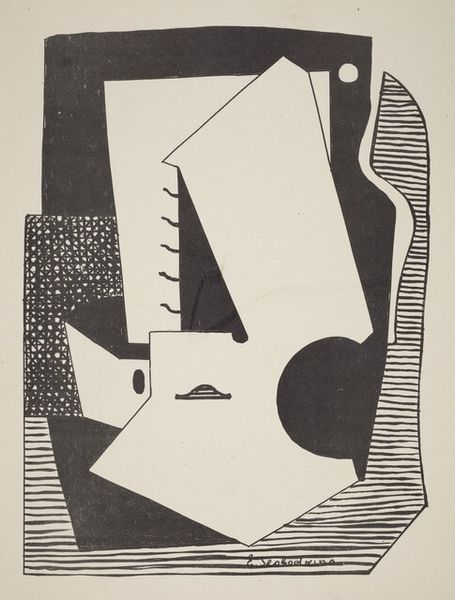
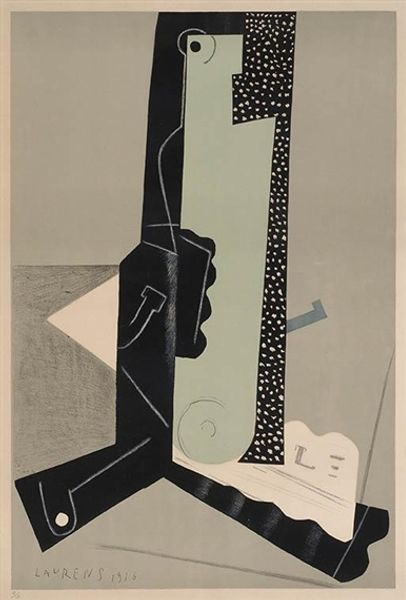
Editor: Here we have Henri Laurens’ "L'Instrument de Musique" from 1916, a mixed-media collage on paper. It has this almost muted, earthy tone. I’m immediately drawn to how Laurens uses different textures and the layering of the paper. What stands out to you when you look at this? Curator: What jumps out is Laurens' process. The work is so materially rich; you see not just drawing, but collage, the very stuff of everyday life being incorporated into high art. Notice how he uses cheap materials—toned paper, likely scraps—elevating them through artistic labor. It challenges this division between fine art and, say, the poster or the sign. How does the title, “The Musical Instrument,” play into this understanding for you? Editor: I see that the title provides a starting point, almost a guide, to interpreting the shapes, but I am not quite sure how to correlate the music to those common materials? Curator: Exactly! Laurens isn't just representing a guitar; he's dissecting its very essence through these materials. The scraps become metaphors for the sounds, the labor of making music made visible. It reveals the conditions in which art is produced and consumed. Editor: So you’re saying that the art itself reflects and comments on a wider social context. Like, the working class making the instruments? Curator: Precisely! These materials weren't "art supplies" in the traditional sense; they're pedestrian, readily available. What he's presenting, is a very direct challenge to the idea that art is made from precious or rarefied materials. It makes the production itself the subject matter. It opens this discussion beyond a visual or historical point. Editor: That is amazing! Thinking about the materials in that light completely shifts my perspective. Now it's more about the construction and the deconstruction rather than the representation. Curator: Indeed, looking at it this way makes it more accessible and connects it directly with the lived experiences of people creating and interacting with music, in all of its form, from the elite salon, to the music hall.
Comments
No comments
Be the first to comment and join the conversation on the ultimate creative platform.
 Collect
 React
React Comment
More like this