1888
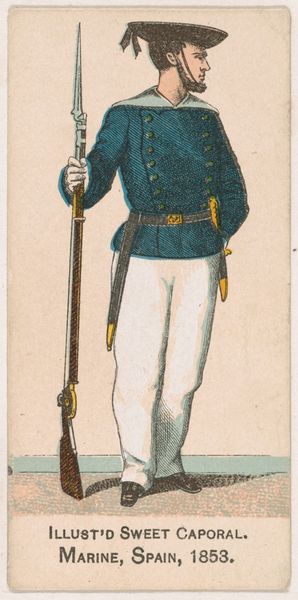
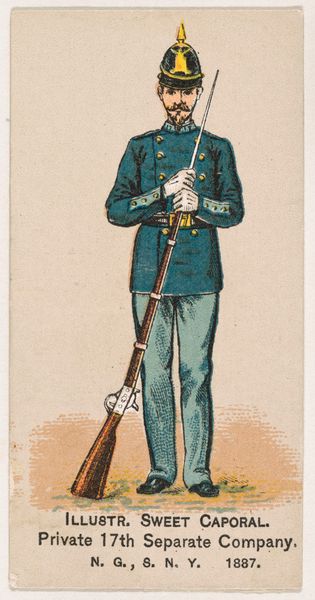
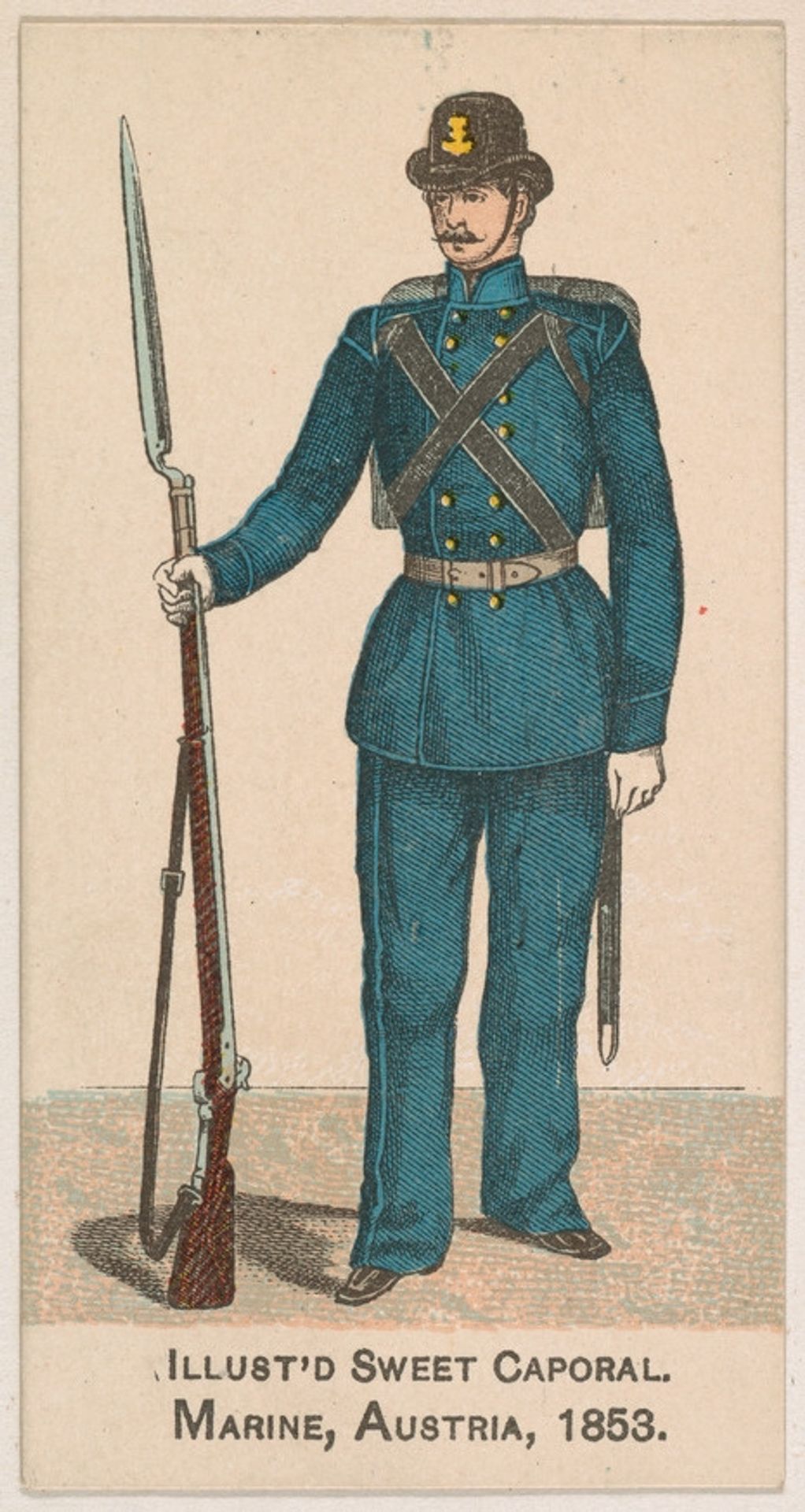
Marine, Austria, 1853, from the Military Series (N224) issued by Kinney Tobacco Company to promote Sweet Caporal Cigarettes

Kinney Brothers Tobacco Company
1869 - 2011
The Metropolitan Museum of Art
Metropolitan Museum of Art, New York, NYListen to curator's interpretation
Curatorial notes
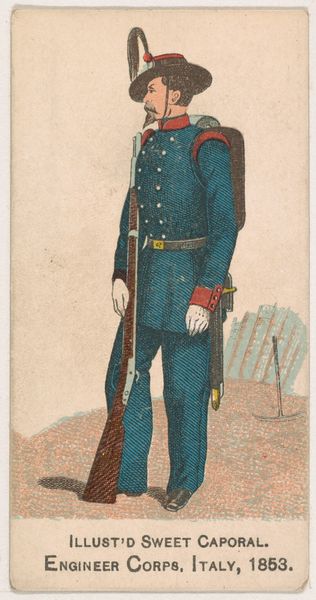
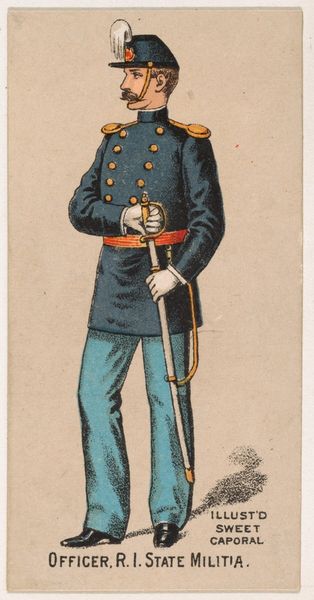
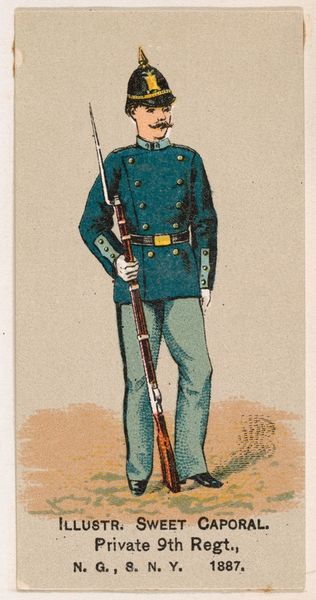
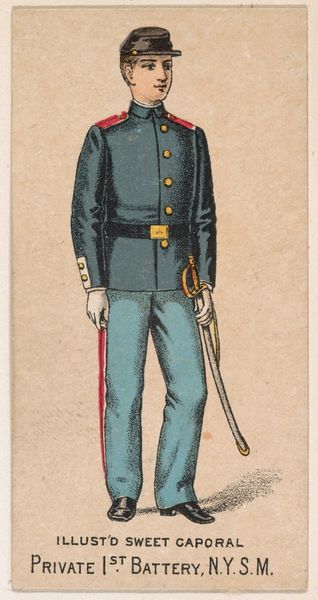
Editor: Here we have "Marine, Austria, 1853," a print from 1888, part of the Military Series promoting Sweet Caporal Cigarettes. There's something stark and a little unsettling about the figure’s stiff pose. What stands out to you from a formal perspective? Curator: Note the precision of line and clarity of form. The composition is dominated by a rigid verticality, from the bayonet to the soldier's posture. This emphasis underscores a kind of stoicism. Editor: It’s almost like the figure is presented as a collection of shapes, the hat, the coat. Curator: Indeed. Consider how the colour palette further articulates these forms. The teal uniform, punctuated by the ochre of the buttons and straps, creates a visual rhythm. Ask yourself how the limited tonal range influences your reading of the subject. Editor: It seems almost hyper-realistic, or staged. I keep noticing that everything has hard edges, from the buttons to the bayonet. Is it intended to emphasize the uniform as much as the soldier? Curator: The image certainly operates on that premise. Look at how the uniform nearly dwarfs the figure's head. The success is less about representation and more about communicating a certain notion of militaristic order through its graphic design. A semiotic code for nationhood perhaps? Editor: That's a perspective I hadn't fully considered, viewing the uniform as the primary signifier, rather than the soldier. I guess I’ve learned that form isn’t just about appearance but about communication too. Curator: Precisely. The artist’s deliberate choices regarding form and color, dictate our interaction with, and interpretation of, the piece.