mixed-media, collage
#
portrait
#
cubism
#
mixed-media
#
collage
#
harlem-renaissance
#
figuration
#
mixed media
Copyright: Romare Bearden,Fair Use
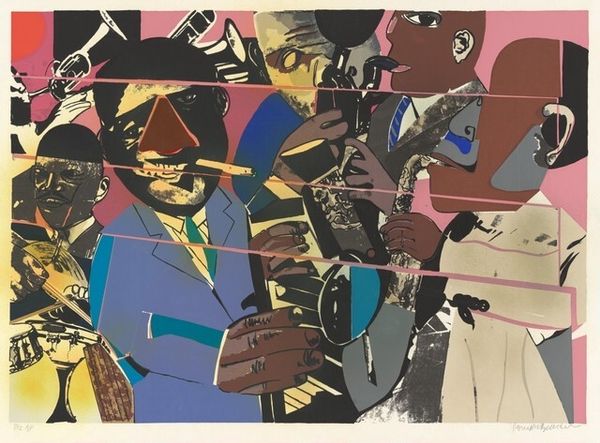
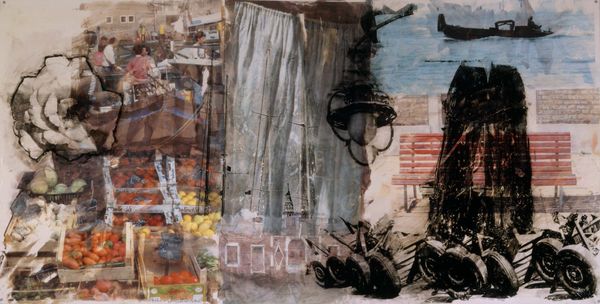
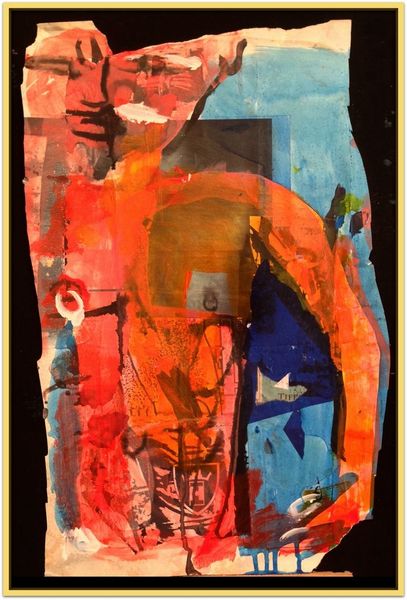
Editor: We're looking at Romare Bearden’s "Pittsburgh Memory" from 1964, a mixed-media collage. The fragmented composition of the figures against what seems like a cityscape definitely strikes me as melancholic and contemplative. What do you make of the visual relationships created in this work? Curator: Indeed. If we consider this work through a formal lens, the initial element that commands attention is Bearden’s fragmented aesthetic. Each shard of paper, each carefully selected hue, interlocks to generate a mosaic effect, mirroring the multifaceted character of memory itself. Notice the juxtaposition of textures – the grainy surfaces contrasting against the smoother, photographic elements. How do you feel the artist manipulated space through collage? Editor: Well, the varying depths created by the overlapping fragments give the artwork a chaotic sense of space. The collage style definitely subverts a more traditional representation. But, where does Bearden depart, or converge, from typical Cubist ideas? Curator: That is astute. While sharing Cubism's fragmented perspective, Bearden distinguishes himself through the explicit integration of found materials and photographs. This disrupts any commitment to pure form, creating a dynamic interplay between representation and abstraction. What does that juxtaposition suggest to you? Editor: That there's something profound in repurposing ordinary elements to represent lived experiences! It reminds me to question the limits of visual vocabulary. Curator: Precisely. Consider how each carefully chosen material serves a purpose in communicating Bearden's Pittsburgh. In the end, we see collage operating beyond mere reproduction, to become a symbolic landscape of lived experience and memory. Editor: This makes me rethink collage’s potential for artistic narratives.
Comments
No comments
Be the first to comment and join the conversation on the ultimate creative platform.
 Collect
 React
React Comment
More like this