Étude historique sur le marquis de Pombal, 1738-1777 / par le baron Édouard de Septenville 1868

portrait
history-painting
academic-art
Dimensions: height 190 mm, width 138 mm, thickness 33 mm
Copyright: Rijks Museum: Open Domain
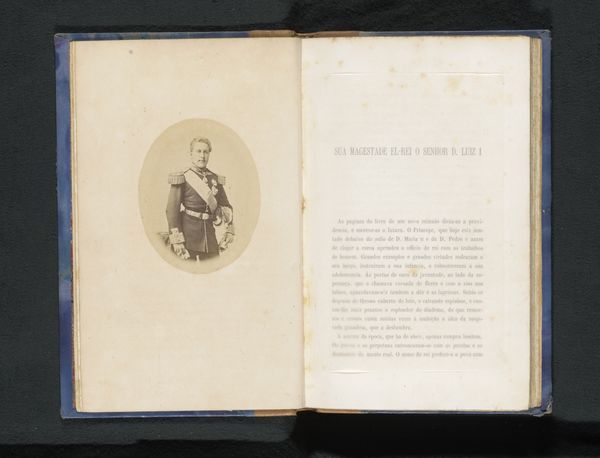
Curator: The piece before us, dating back to 1868, is an "Etude Historique sur le Marquis de Pombal," crafted by Baron Edouard de Septenville. It appears to be a print, likely purposed to illustrate Septenville’s historical account. Editor: There’s a faded quality to it. Like catching a whisper from the past… the figure, that of the Marquis I presume, seems almost translucent, as though he’s stepping forward from a dream or a memory. Curator: Indeed. Semiotically, the work operates through established visual tropes of power and history, though muted, or perhaps softened by the printmaking process. The linear precision and compositional arrangement guide the viewer’s eye systematically across the page. Notice how the artist’s inclusion of text as an element in the piece contributes additional informational depth, operating as paratext adding substance to the pictorial plane. Editor: And a certain kind of weight too, or solemnity. Despite being a "study," there’s an official feel to the inclusion of title and heraldry—as though history demands a certain decorum. The book format and subdued color palette suggests not drama but thoughtful deliberation. I imagine it more akin to carefully pouring over archival documents than to, say, witnessing the Marquis himself stride through a court. Curator: The visual rhetoric supports your assertion. Note how the graphic layout facilitates a structural juxtaposition between image and textual inscription which serve a specific historical narrative, framing it with academic authority. It signifies historical representation rather than pure spectacle. Editor: Ultimately, it feels more literary than visual—more a study OF a portrait than a powerful artwork IN itself. Still, there is something very evocative to this work in its ability to bring this character into focus and get a little taste of history in print. Curator: Precisely. It's about conveying both the historical narrative and also, perhaps, the gravitas of historical record itself. It captures a pivotal point in time. Editor: Exactly! This "Etude" prompts us to imagine all that and, paradoxically, fade back into history ourselves.
Comments
No comments
Be the first to comment and join the conversation on the ultimate creative platform.
 React
React Comment