About this artwork
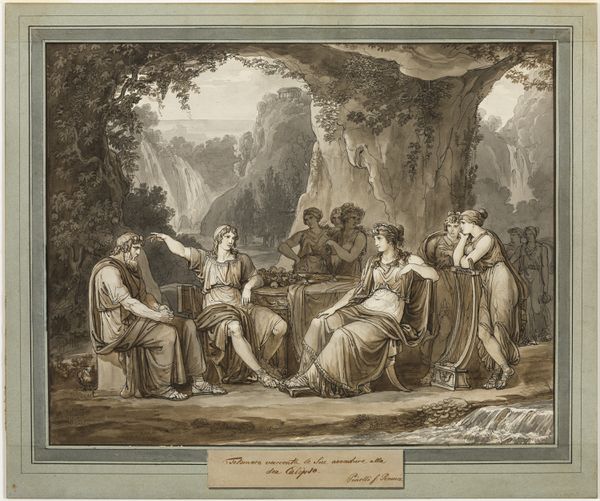
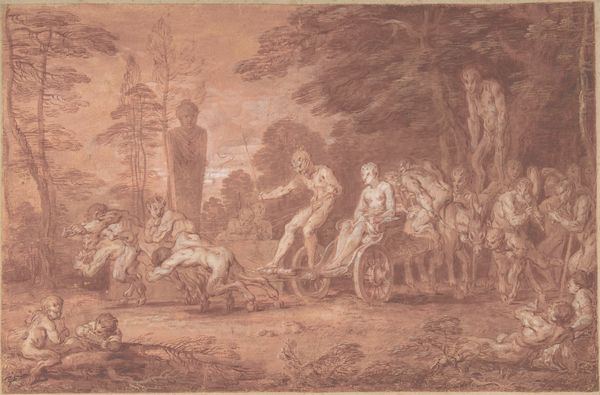
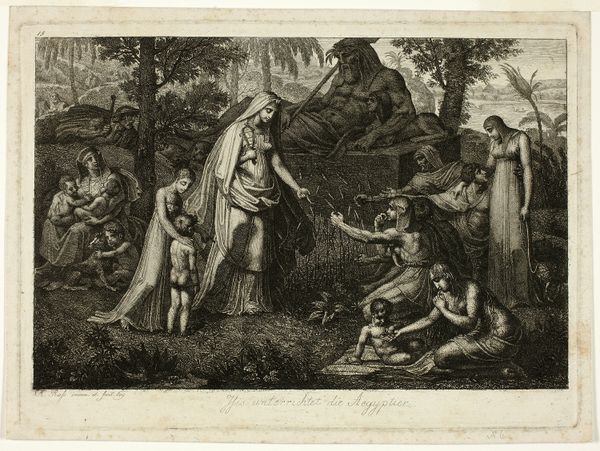
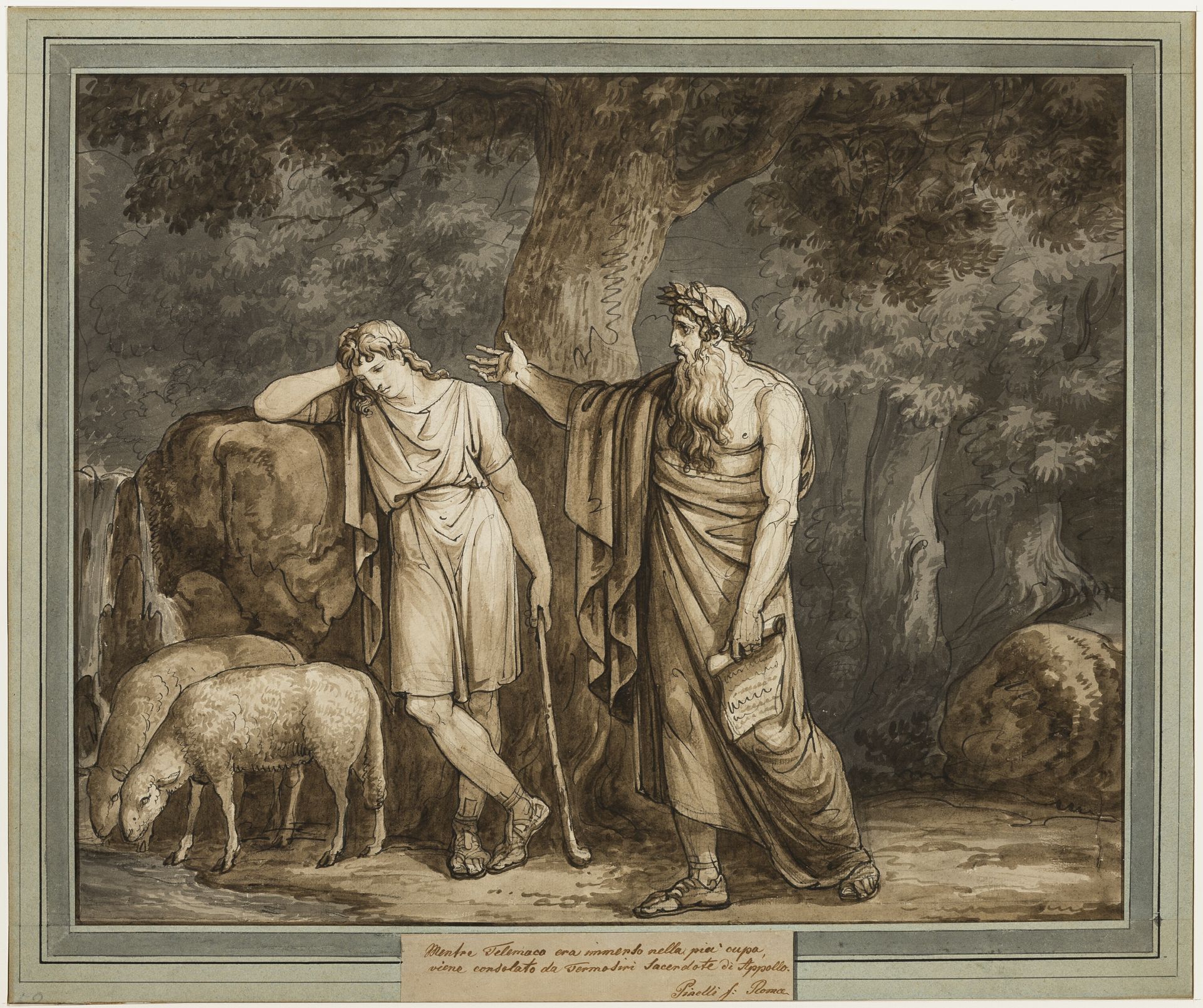
Bartolomeo Pinelli created this artwork, "Telemachus is Consoled by Termosiris, Priest of Apollo," using pen and brown ink with brown wash. Here, we see Telemachus, son of Odysseus, being comforted by Termosiris, a priest of Apollo. The priest, adorned with a laurel wreath, a classical symbol of wisdom and victory, extends a hand in a gesture of solace. This very gesture echoes across time, doesn’t it? Think of ancient Roman sculptures where emperors extend their hands in a similar manner, promising peace and protection. Even in early Christian art, Christ uses this gesture to bless or heal. The gesture transcends its original context, morphing into a universal expression of guidance, reflecting our collective need for reassurance. We can see this primal yearning for guidance manifesting itself across cultures. It is a potent psychological tool that taps into our deepest emotions, promising resolution and hope in times of distress. Thus, a simple gesture becomes a cultural echo chamber, resonating with our shared human experiences.
Telemachus is Consoled by Termosiris, Priest of Apollo, from The Adventures of Telemachus, Book 2 1808


Artwork details
- Medium
- drawing, print, paper, ink, charcoal
- Dimensions
- 476 × 590 mm
- Location
- The Art Institute of Chicago
- Copyright
- Public Domain
Tags
drawing
neoclacissism
narrative-art
landscape
classical-realism
charcoal drawing
figuration
paper
ink
classicism
charcoal
history-painting
academic-art
Comments
No comments
About this artwork
Bartolomeo Pinelli created this artwork, "Telemachus is Consoled by Termosiris, Priest of Apollo," using pen and brown ink with brown wash. Here, we see Telemachus, son of Odysseus, being comforted by Termosiris, a priest of Apollo. The priest, adorned with a laurel wreath, a classical symbol of wisdom and victory, extends a hand in a gesture of solace. This very gesture echoes across time, doesn’t it? Think of ancient Roman sculptures where emperors extend their hands in a similar manner, promising peace and protection. Even in early Christian art, Christ uses this gesture to bless or heal. The gesture transcends its original context, morphing into a universal expression of guidance, reflecting our collective need for reassurance. We can see this primal yearning for guidance manifesting itself across cultures. It is a potent psychological tool that taps into our deepest emotions, promising resolution and hope in times of distress. Thus, a simple gesture becomes a cultural echo chamber, resonating with our shared human experiences.
Comments
No comments