

c. 1881 - 1916
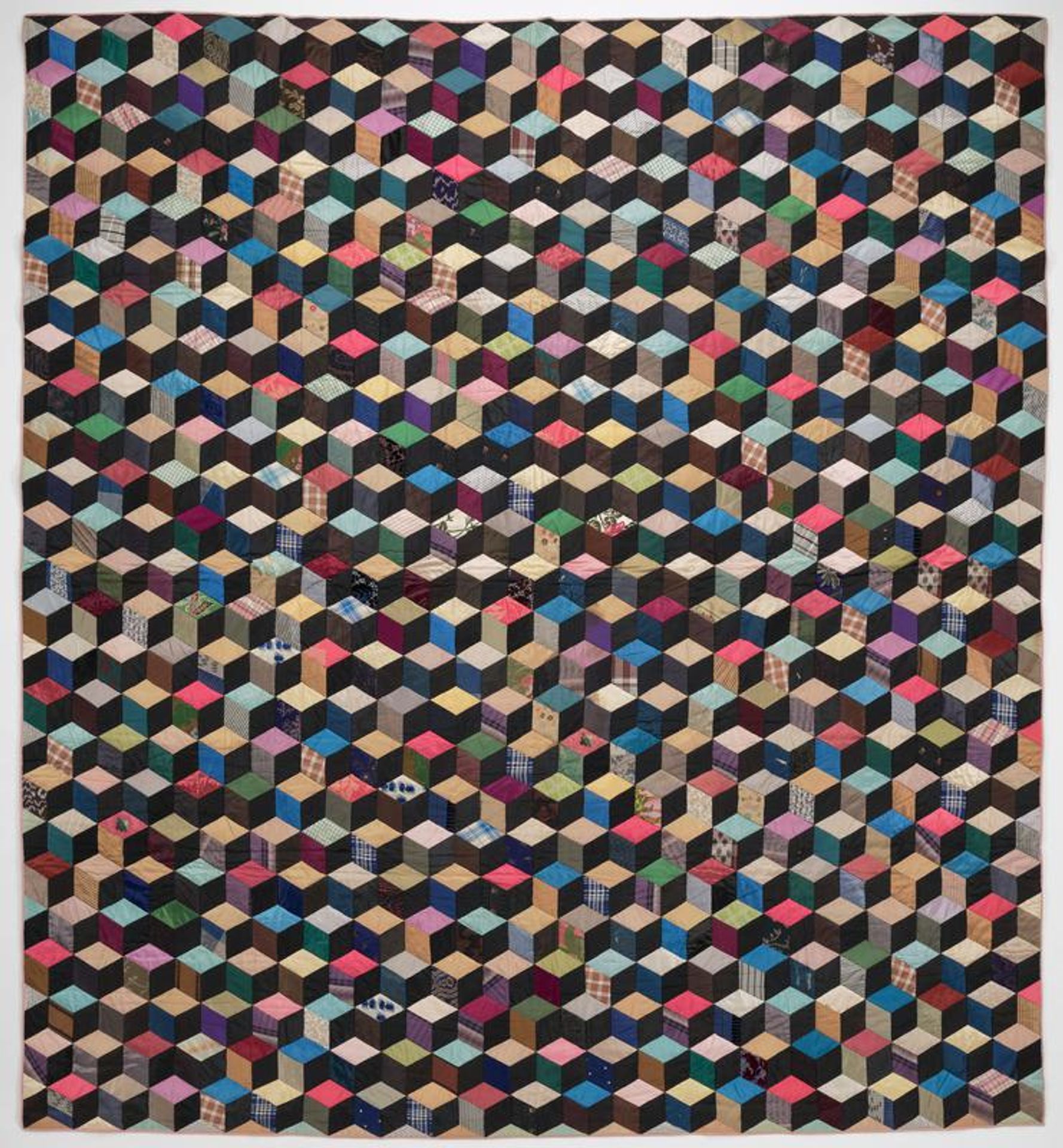
Tumbling Blocks quilt


Listen to curator's interpretation
Curatorial notes
Editor: We’re looking at a "Tumbling Blocks Quilt" crafted between 1881 and 1916 by Irene Nestell Hart, now residing at the Minneapolis Institute of Art. It's created with cotton, and I’m immediately struck by its deceptive depth. It’s like looking into a well, but made of colorful cubes. How do you interpret this work through a formal lens? Curator: Precisely. Disregard, for a moment, its functionality. Observe the masterful manipulation of two-dimensional space to simulate three dimensions. The artist achieves this through carefully calculated shifts in value and hue within each diamond shape. Notice the repetition of pattern, the subtle variations within it, preventing monotony. The individual blocks themselves possess unique color palettes, some warm, others cool, generating visual rhythm across the entire plane. Editor: So, the charm isn't about the cozy domesticity of a quilt, but about the complex arrangement of shape and color? Curator: Indeed. Focus on the optical effect achieved through juxtaposition. Consider how the dark grounding functions not just as a background but as a structural element, defining the edges of the cubes, allowing the tessellation to emerge. Where does the background begin, and the pattern end? Editor: I see what you mean. It's less about the cultural associations of quilting and more about pure visual experience. It really tricks your eyes! Thank you! Curator: The essence lies in understanding how form and color interact to generate depth, volume, and movement on a flat surface.
