![The Seasons [15th state (Winter)] by Jasper Johns](https://d2w8kbdekdi1gv.cloudfront.net/eyJidWNrZXQiOiAiYXJ0ZXJhLWltYWdlcy1idWNrZXQiLCAia2V5IjogImFydHdvcmtzLzllN2RlNTA5LWFmYzctNGNkNC05MmU3LWU5MThlMzE1YjZkNy85ZTdkZTUwOS1hZmM3LTRjZDQtOTJlNy1lOTE4ZTMxNWI2ZDdfZnVsbC5qcGciLCAiZWRpdHMiOiB7InJlc2l6ZSI6IHsid2lkdGgiOiAxOTIwLCAiaGVpZ2h0IjogMTkyMCwgImZpdCI6ICJpbnNpZGUifX19)
1987
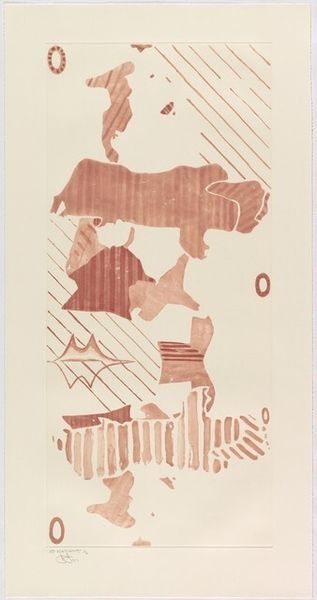
The Seasons [15th state (Winter)]


Listen to curator's interpretation
Curatorial notes
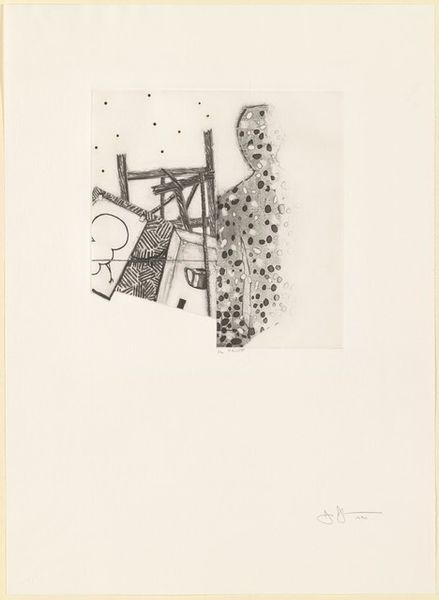
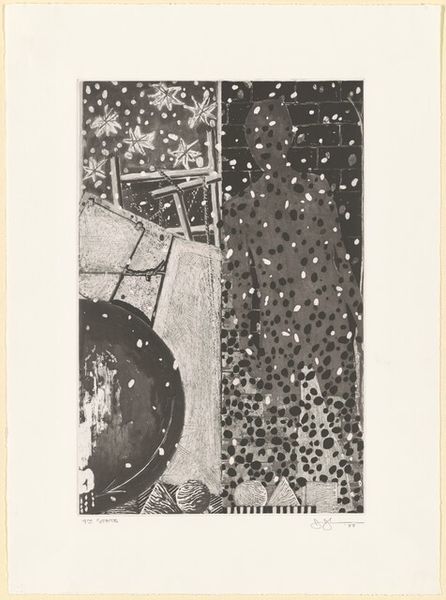
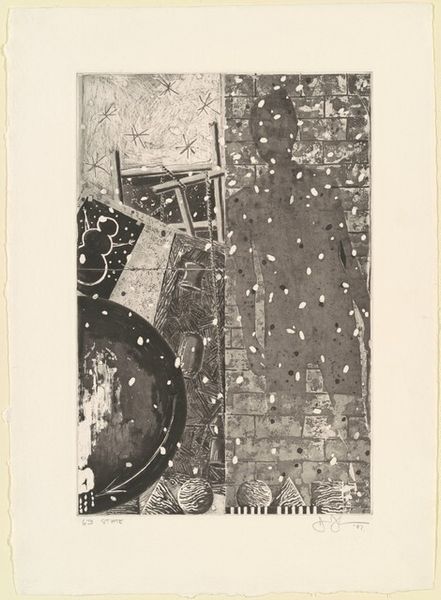
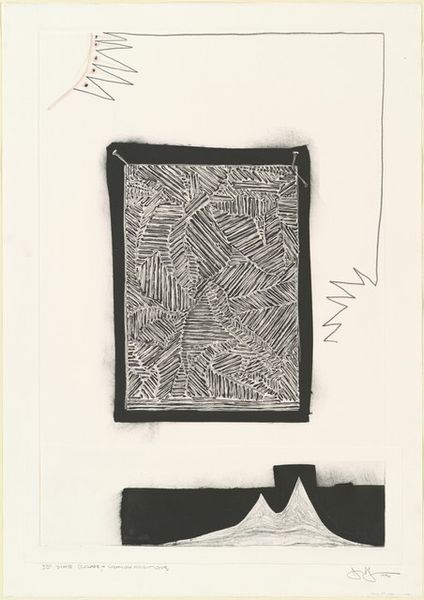
Curator: Here we have "The Seasons [15th state (Winter)]", a 1987 print by Jasper Johns, rendered in ink and graphite on paper. Editor: Well, my initial feeling is one of almost desolate abstraction. There’s a stark quality, a kind of fragmented reality that really gets under the skin. Curator: Yes, there’s a chilling quality to it. The layering of geometric forms and shadowy figure feels very calculated. Consider how Johns is deconstructing imagery; you see echoes of his earlier works, but with a deliberate obscuring, a sense of loss or erasure. Editor: Exactly. The figure itself, composed of these floating dots, feels ghostly, almost disintegrating before our eyes. This motif isn't something new; this makes me reflect on pointillism as a reference but here there is an emotion of cold. And those stark geometric shapes at the bottom. It evokes a primitive almost hieroglyphic, language of emotion, and one that echoes feelings of abandonment, darkness, the core values to a winter aesthetic. Curator: I think your interpretation of the geometric elements is right on. Notice too the fragmented lines of the chair; what remains suggests domesticity or human presence, but also its collapse, like a structure left exposed to the harsh elements. Those disparate symbols arranged almost ritualistically in the foreground enhance this feeling as well. Editor: The layering of lines creates tension in the flat space and gives texture, especially against the washed out paper. I imagine there might also be a spiritual element involved for an iconography lover. It is like we are witnessing our own frozen moment here. Curator: Winter as a state of mind? An interior landscape mirrored through external symbols? I like that. It's all about finding those pockets of meaning. For me, it becomes a personal archaeology – piecing together a narrative, only to realize the narrative itself is ephemeral. Editor: Perhaps it’s in that tension, between clarity and obscurity, presence and absence, where the real power of this "Winter" piece resides.