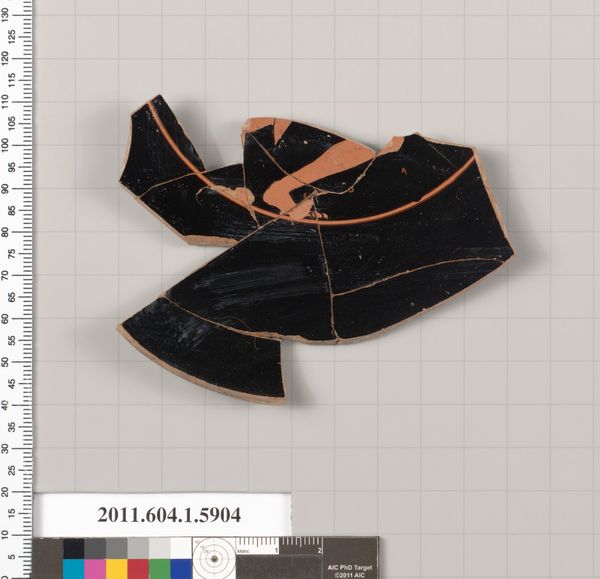
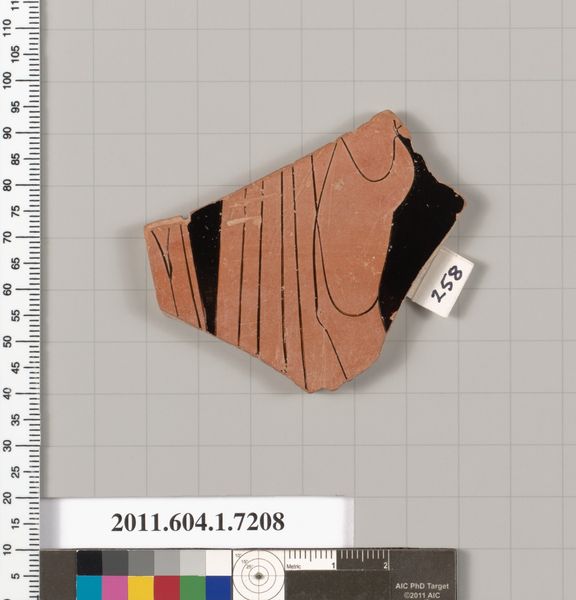
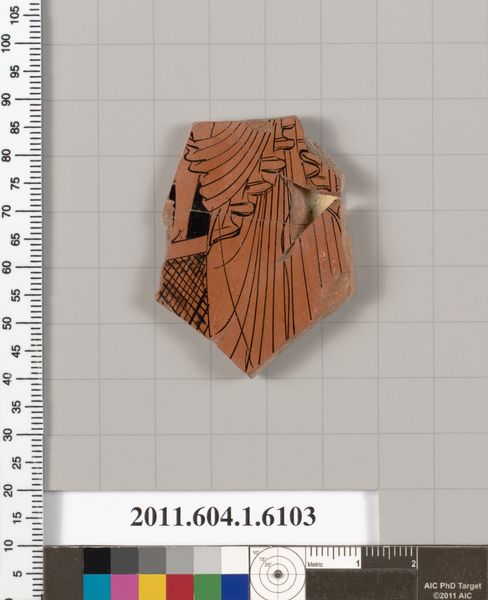
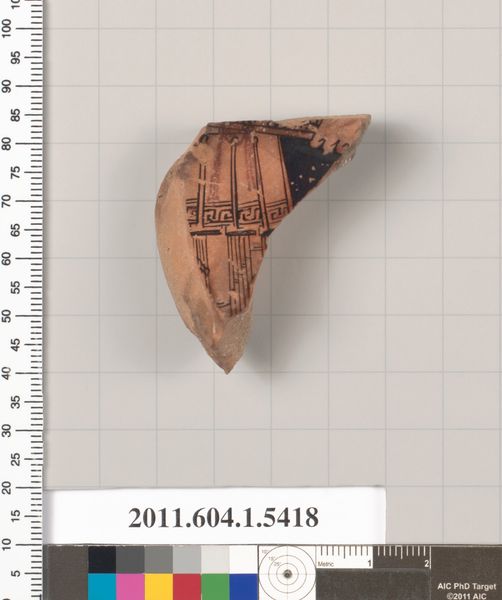
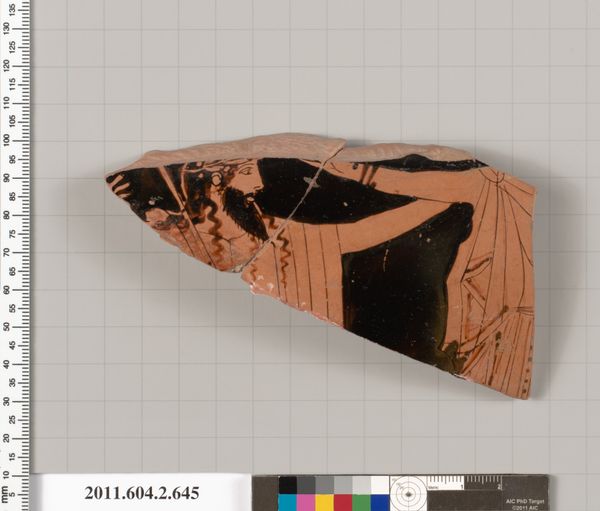
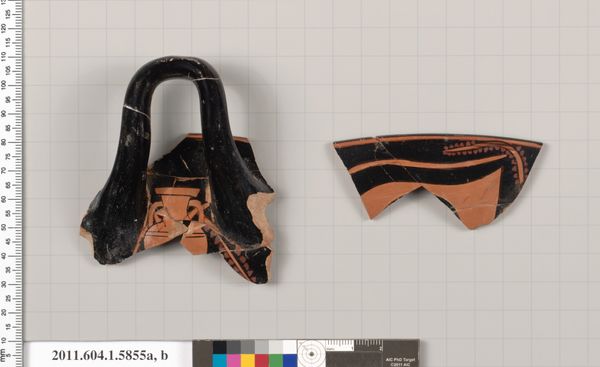
drawing, ceramic
#
drawing
#
greek-and-roman-art
#
ceramic
#
figuration
#
roman-art
#
geometric
#
ancient-mediterranean
Dimensions: Other (A): 1 5/8 x 3 x 4 1/8 in. (4.1 x 7.6 x 10.4 cm) Other (B): 1 1/4 x 1 1/2 x 1/16 in. (3.2 x 3.8 x 0.2 cm) Other (C): 9/16 x 1 1/16 x 1/8 in. (1.4 x 2.7 x 0.2 cm) Other (D): 3/8 x 1 3/16 x 1/8 in. (0.9 x 3 x 0.3 cm)
Copyright: Public Domain
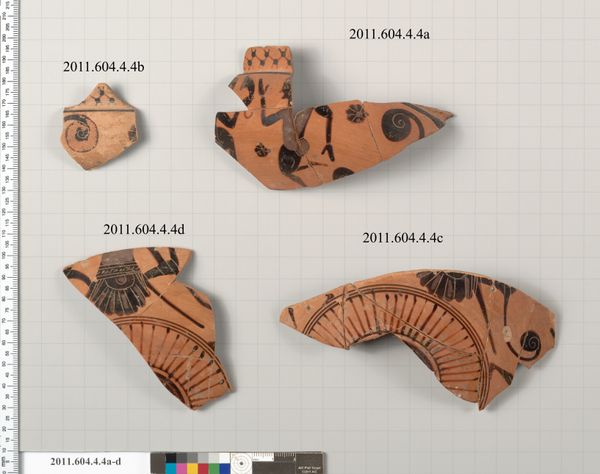
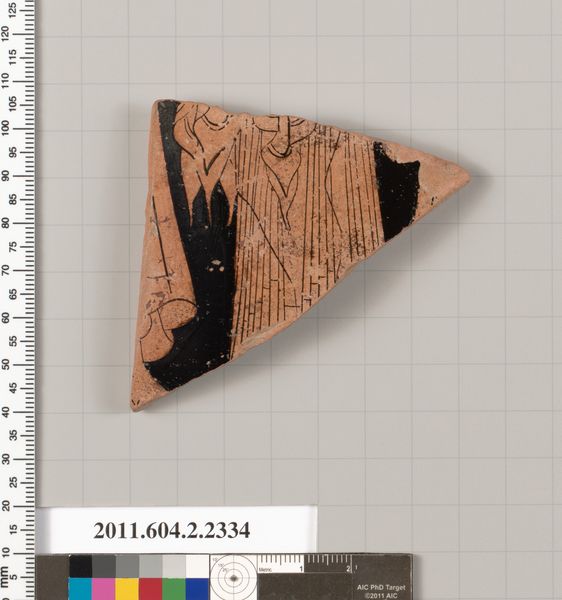
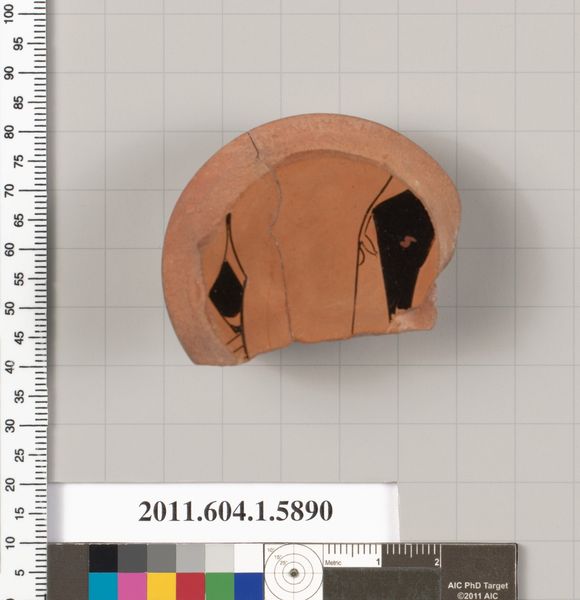
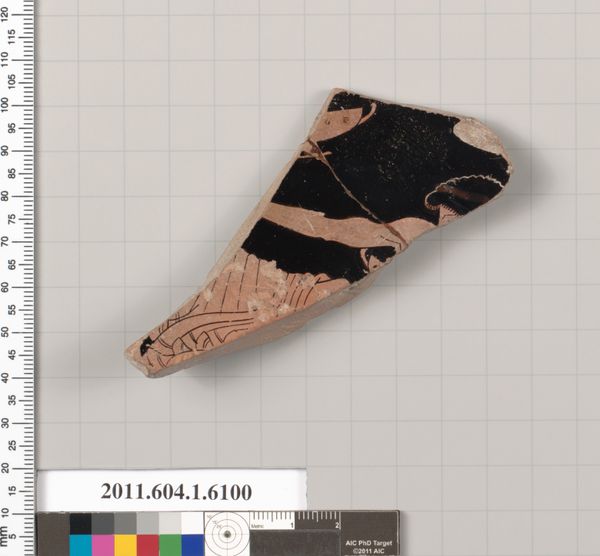
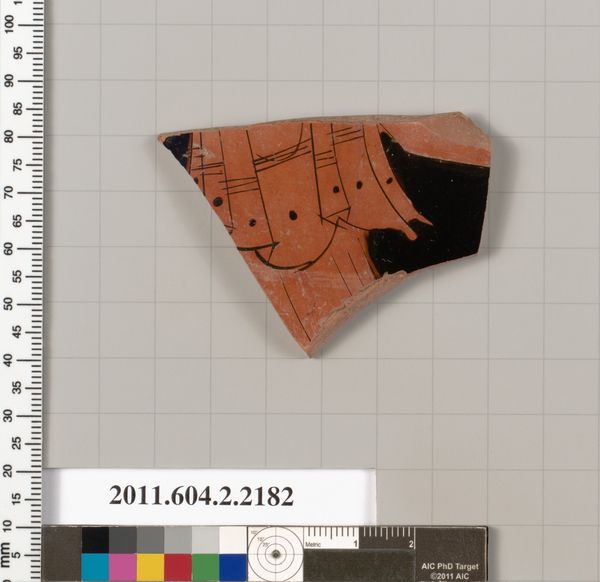
Editor: We're looking at "Fragments of a terracotta kylix: Komast cup," dated to around 575 BC. It’s currently housed at the Metropolitan Museum of Art. These ceramic shards, decorated with drawings, once formed a drinking cup. The broken pieces give a sense of incompleteness. How do you interpret this work beyond its fragmented state? Curator: The fragmentation is key. It allows us to consider the passage of time and the power dynamics inherent in archaeological finds. Who decided which fragments were valuable enough to preserve, and what narratives do these selected pieces perpetuate? This isn't just about a broken cup; it's about the selective preservation of history. What can we infer about the cup’s intended audience based on the imagery? Editor: I see geometric designs and what looks like stylized figures. Would that imply it was made for someone with a specific status, someone wealthy? Curator: Possibly. Consider the *Komast* – a reveller, suggesting a culture of celebratory gatherings, perhaps exclusively male. Now, think about whose stories are *not* represented in these classical forms. How might a female artist or enslaved person have experienced these gatherings, these displays of power? Where is their perspective in this carefully curated history? Editor: So, it’s less about what the cup *is* and more about what it represents and conceals? Curator: Exactly. It’s about challenging the dominant narrative, interrogating the silences, and asking: who benefits from this particular fragment of the past? What other stories could these shards tell if we looked at them through different lenses? Editor: That's given me a whole new way of looking at ancient artifacts. I was focused on the art itself, but now I’m thinking about the power structures at play. Curator: Precisely. Art history isn’t a static discipline; it’s an ongoing conversation.
Comments
No comments
Be the first to comment and join the conversation on the ultimate creative platform.
 Collect
 React
React Comment
More like this