print, engraving
#
allegory
#
baroque
# print
#
landscape
#
figuration
#
line
#
engraving
Dimensions: height 298 mm, width 197 mm
Copyright: Rijks Museum: Open Domain
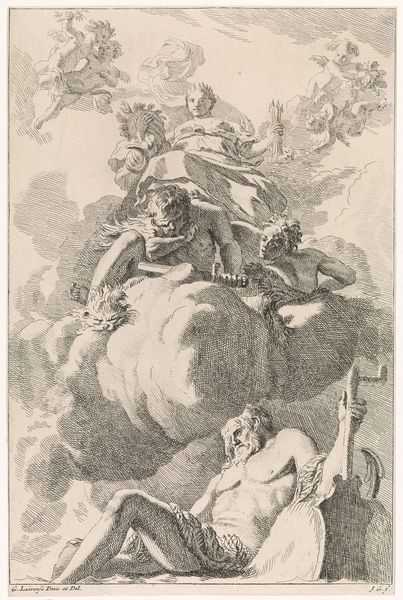
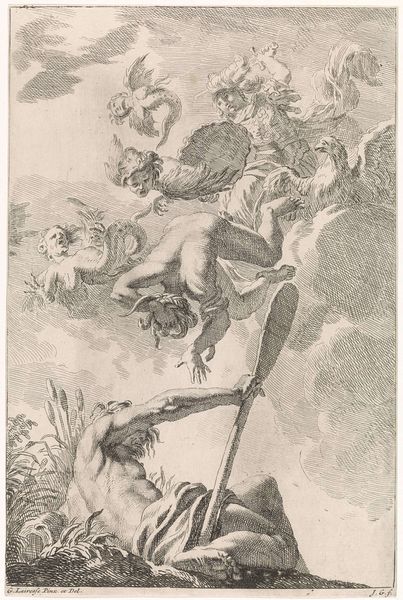
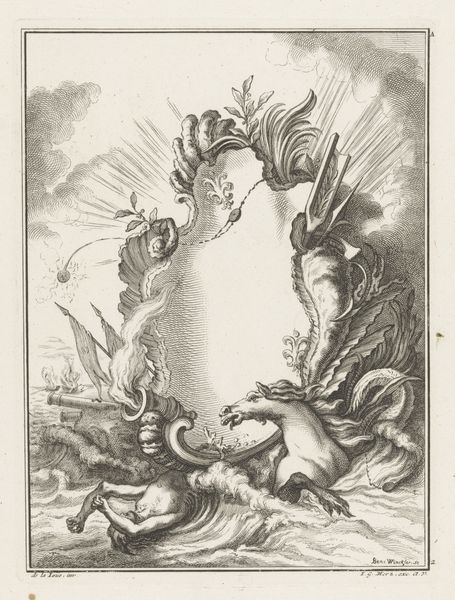
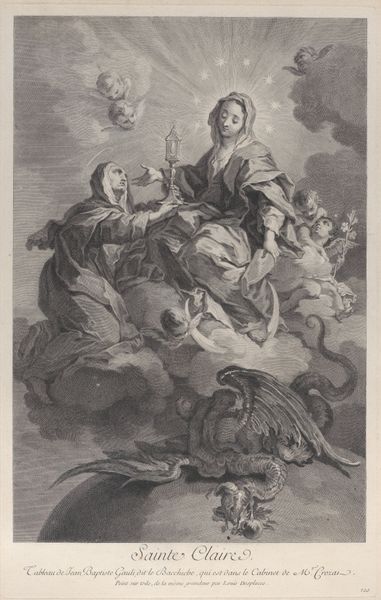
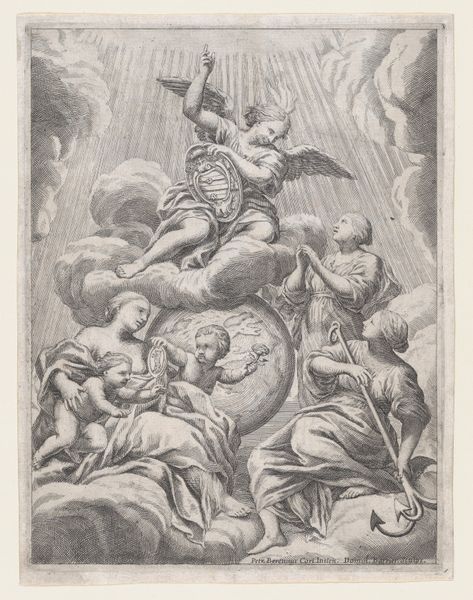
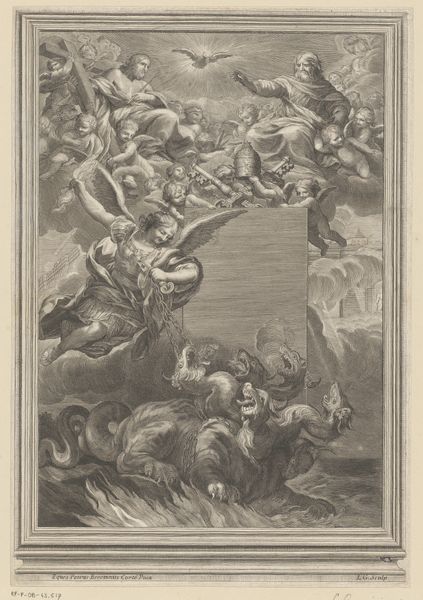
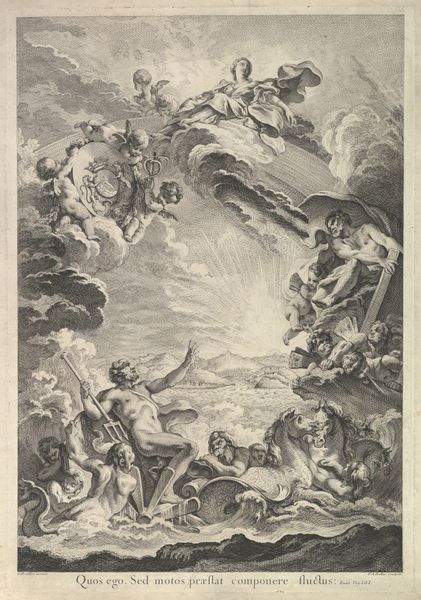
Curator: Let's turn our attention to a detailed engraving entitled "Allegorie op de vrije handel: de Bataafse leeuw" which roughly translates to "Allegory of Free Trade: The Batavian Lion" attributed to Johannes Glauber and dated between 1672 and 1726. What's your immediate reaction? Editor: A flurry of activity, almost frantic! There's a definite upward thrust in the composition, with figures swirling upwards toward what feels like… liberation? Despite the subject matter, there’s almost an overwhelming exuberance in the way it’s depicted. Curator: The “frantic activity,” as you call it, stems from the nature of engraving itself, and particularly the deployment of line. Glauber, or whoever made the print, had to rely entirely on the incisive precision of lines to create depth, shadow, and volume. It’s a laborious, repetitive process to produce prints. How do you read those production efforts in the end result here? Editor: Absolutely. It’s visually overwhelming, and those lines construct the iconography. A central female figure dominates the scene, holding what looks like a liberty cap aloft, while putti frolic around her and what looks to be a shield bearing heraldic markings grasped by a formidable lion. Freedom personified! And those cherubic figures add to a sense of celebratory endorsement for the core symbol. Curator: Well, consider the social and political context, the free trade system being installed in Amsterdam depended greatly on a vast colonial empire extracting labor and materials in ways we today recognize as exploitative. How much is the symbol divorced from the social conditions under which Dutch trade prospered in this moment, particularly as materialized by enslaved people in its colonies? Is "freedom" purely an abstract symbol here? Editor: It certainly gives one pause, reflecting on what symbols truly represent and to whom they extend freedoms and opportunities. In this moment, what’s rendered isn't necessarily about the labor of those people. It's the image that the commissioning patron or body would prefer. Curator: Exactly! And thinking about who was producing these prints. How many people do you think had a hand in creating the physical plates, papers, and distributing the final version to print buyers and collectors? Consider the division of labor in the 17th and 18th centuries, not only among the colonies but also in workshops here in Europe, in visualizing and supporting "free trade" itself. Editor: Seeing it through that lens, I begin to appreciate how dense and multifaceted a seemingly straightforward allegory can be. It’s a great way to peel back what visual shorthand glosses over and look closer at real costs. Curator: Precisely. In summary, this print invites us to analyze the social costs inherent in seemingly triumphant visual narratives of a colonial society. Thanks for that great conversation!
Comments
No comments
Be the first to comment and join the conversation on the ultimate creative platform.
 Collect
 React
React Comment
More like this