

c. 1939
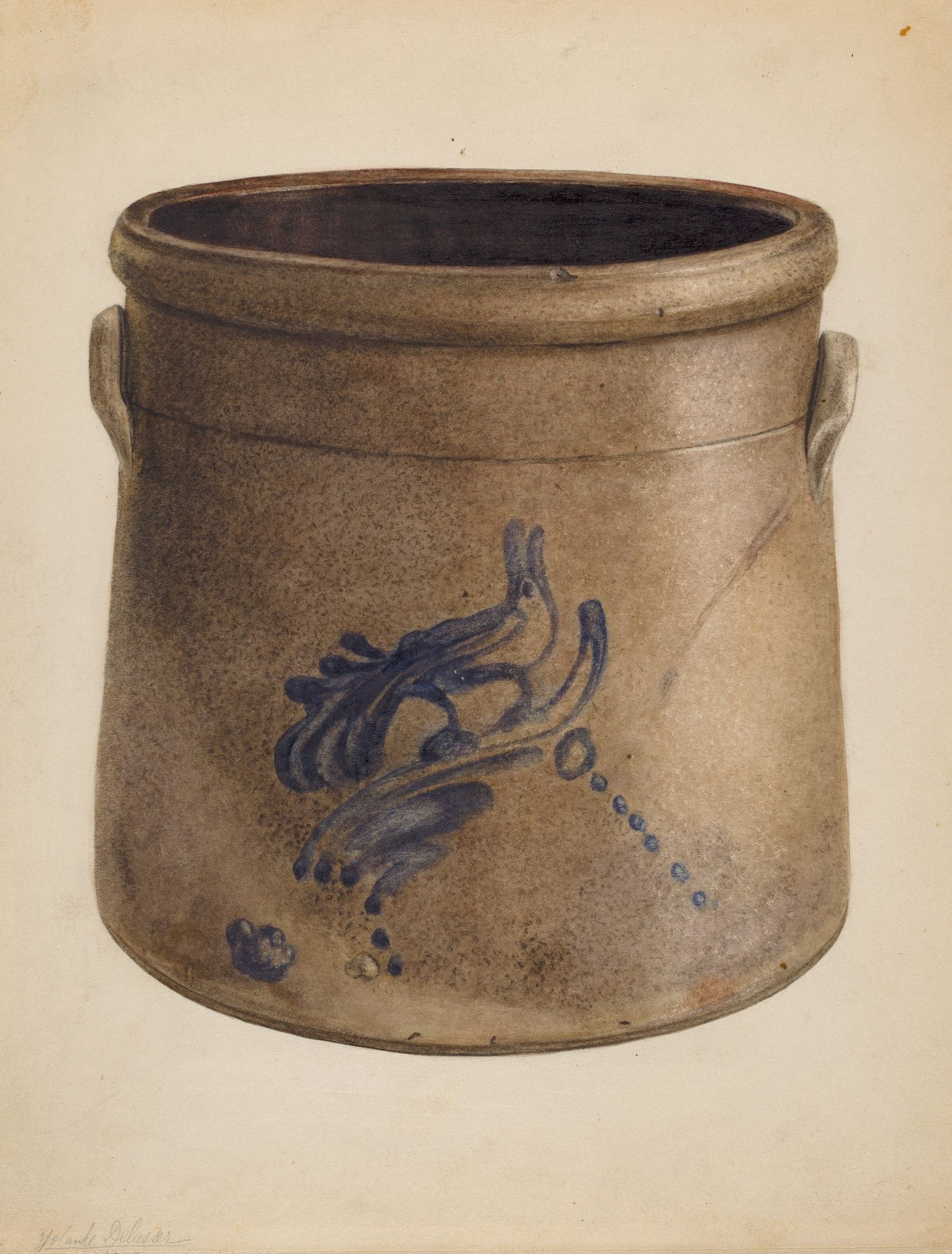
Crock


Listen to curator's interpretation
Curatorial notes
Editor: This watercolor, "Crock," painted around 1939 by Yolande Delasser, captures a humble earthenware crock. There's a quiet, almost nostalgic quality to it. What strikes me is how she elevates such a mundane object. What's your interpretation? Curator: It's fascinating how Delasser isolates this utilitarian object. In the context of the 1930s, this representation transcends mere still life. Consider the Dust Bowl era; simple, durable goods took on new significance. Do you see how this "Crock" symbolizes resilience, self-sufficiency? The folk art-inspired cobalt decoration too hints at this era. Editor: I do see that now. It is as if this piece speaks to simpler times, and the dignity of labour during a time of crisis. The colours she used are so subdued. Curator: Exactly! And think about the socio-economic implications: ceramics, as a medium, historically links art to the everyday, to the working class. Displaying it in a museum, transforming it into art, challenges traditional hierarchies. Did Delasser choose her subject consciously, knowing she would later contribute this simple "crock" for us to observe? Editor: Perhaps. So its accessibility also plays a role in its message, removing barriers of comprehension for art audiences that weren’t familiar with abstract themes? Curator: Precisely. By rendering it with the finesse typically reserved for 'high art', Delasser democratizes both the object and artistic expression, placing it within everyone’s reach. Editor: That gives me a completely different view of the piece. Thank you for elaborating! Curator: And thank you. Looking closely at everyday objects can often be an intriguing window to understand art as cultural history.