drawing, print, ink, engraving
#
pen and ink
#
drawing
#
baroque
# print
#
landscape
#
ink
#
cityscape
#
history-painting
#
engraving
Dimensions: height 263 mm, width 208 mm
Copyright: Rijks Museum: Open Domain
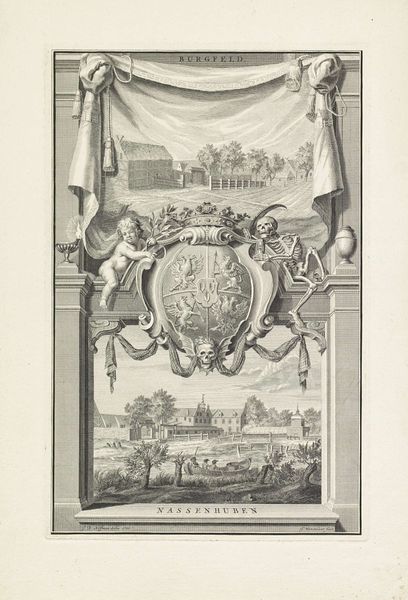
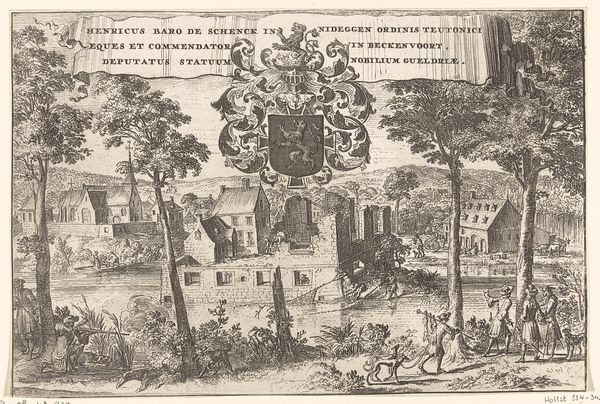
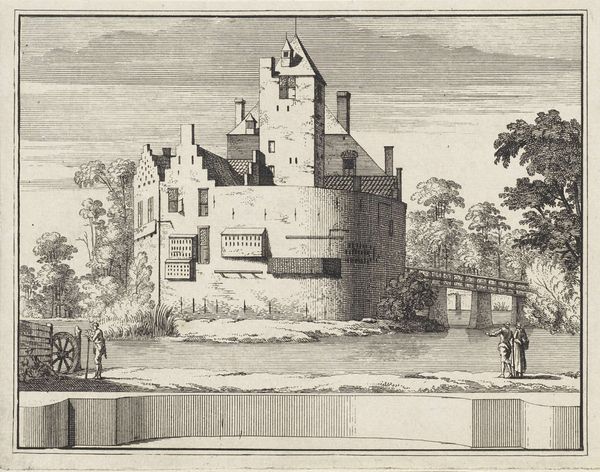
Curator: I'm immediately struck by the fragility depicted here; this meticulous rendering somehow underscores the ephemeral nature of power and place. Editor: Indeed. What we have here is an engraving dating to before 1730, entitled "Huis van Spangen," created by I. Baudouin. It depicts, in minute detail, the Spangen house, or what remains of it, rendered with ink and pen on paper. Curator: The engraving is divided into registers. The upper one showcases what looks like the Spangen house in its prime, almost like a prospectus. It’s juxtaposed with the lower portion depicting its ruined state. This contrasting representation resonates powerfully with discussions about legacy, decline, and the transient nature of material culture. There is commentary at play here, a certain mournfulness. Editor: Absolutely, the strategic depiction begs for social commentary. To either side, the detailed arrangement of heraldic shields further contextualizes the piece within the sociopolitical structure of the time. These are not just images of a house and its ruins, but representations of a family's status, its rise and, evidently, its fall from grace. Curator: How do these familial crests on both sides factor into how it was displayed or distributed, do you imagine? Could it be, in a manner, about genealogical boasting through the visual display? Or do the ruins and the contrast work to instill conversations about family values gone awry? Editor: Most likely, yes. Heraldry served as both marker and narrative. Placed within civic spaces or private collections, heraldry served to affirm belonging and legacy. This print makes an effort to illustrate not only historical records but potentially convey narratives or political symbolism aimed towards elite society's own consciousness, or those aware of the Spangen lineage. The piece becomes almost didactic in its visual presentation of loss and resilience. Curator: That resonates deeply. In foregrounding historical and architectural degradation within such rigid symbolic markers, it certainly critiques not only individual familial fate, but comments also on Dutch societal flux, inviting audiences to confront mortality’s looming shadow cast on inherited stature and wealth. Editor: Well said. It’s a work steeped in the social and cultural context of its era, serving not only as documentation but also as an implicit statement regarding societal expectations, prestige, and, ultimately, their fragility.
Comments
No comments
Be the first to comment and join the conversation on the ultimate creative platform.
 Collect
 React
React Comment
More like this