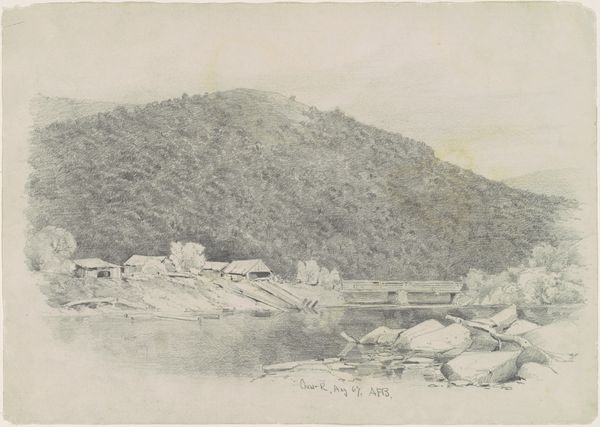
drawing, pencil
#
drawing
#
pencil sketch
#
landscape
#
river
#
etching
#
romanticism
#
mountain
#
pencil
#
cityscape
#
watercolor
Dimensions: height 462 mm, width 665 mm
Copyright: Rijks Museum: Open Domain
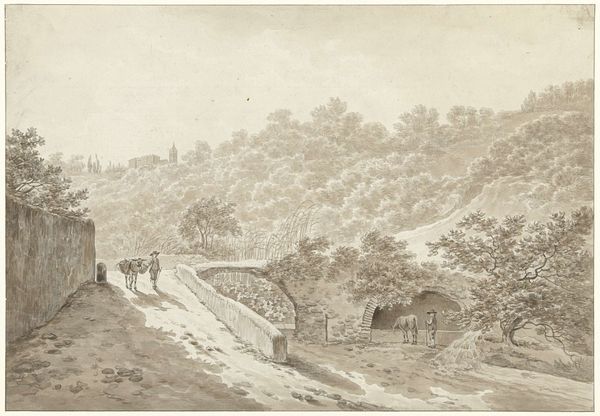
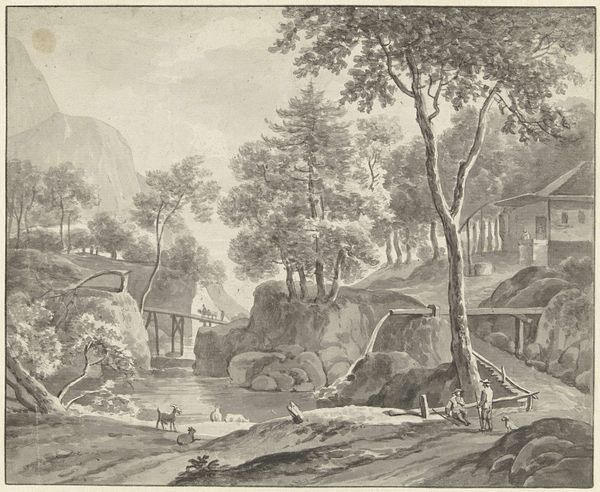
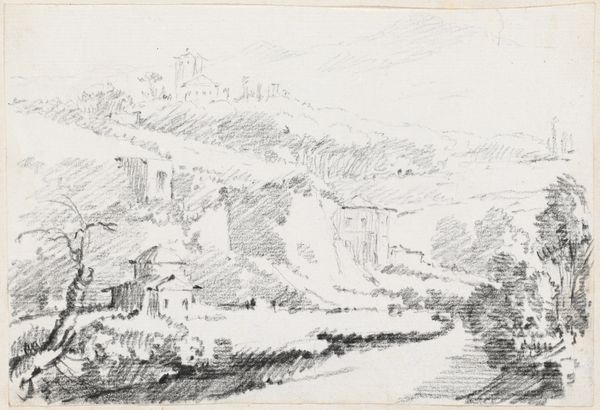
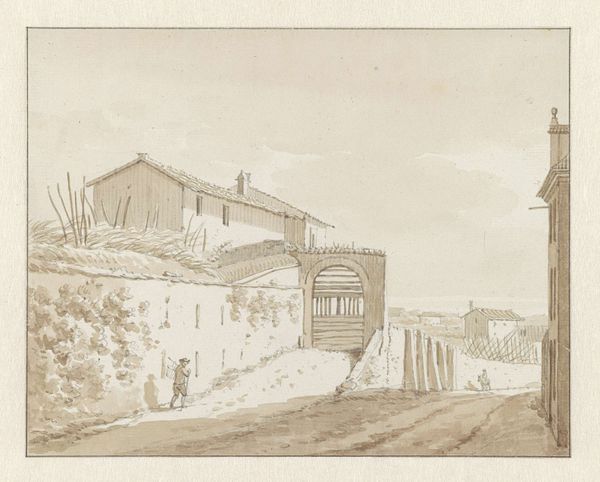
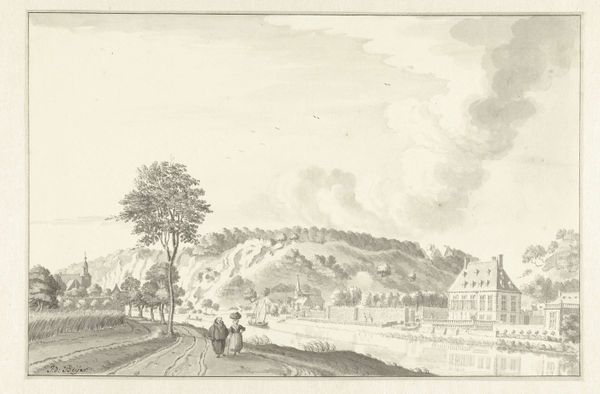
Editor: So, this is "View of a riverbed (the Tiber?)" by Abraham Teerlink, likely from the early to mid-19th century. It's a pencil drawing. It feels quite serene and idyllic, a bit like looking at a postcard from another era. What do you see in this piece that stands out from a historical perspective? Curator: What immediately strikes me is how this seemingly simple landscape engages with evolving ideas about nature and nationhood during that period. This picturesque rendering, perhaps intended as an etching, idealizes a specific vision of Italy – potentially the Tiber as the title suggests – aligning with the Romantic era’s fascination with sublime landscapes and their cultural significance. How does its composition, framing that city through a specific lens, contribute to a broader understanding, or even construction, of Italian identity? Editor: That's fascinating, I hadn't thought about the political dimension. It felt so straightforward! But I see what you mean about "construction." The almost theatrical framing, like a stage set…were images like this used to promote certain ideas? Curator: Absolutely. Consider the rise of tourism and the burgeoning art market. Images like these were often commissioned by wealthy travelers as souvenirs, reinforcing a particular, often romanticized, narrative of the Italian landscape. Moreover, think about the role of institutions like the Rijksmuseum itself, where this drawing is housed. How does its presence in the collection shape our understanding of Dutch artistic engagement with other European cultures? Who was this available to, who might have seen it, what social groups are implied here? Editor: That makes perfect sense. I guess I was initially drawn in by the artistic skill and didn’t consider the wider implications of its creation and circulation. Curator: And that's exactly why bringing a historical perspective is crucial! By questioning the socio-political context, we unlock deeper meanings within seemingly simple landscapes. Editor: I see so much more now – thank you! Curator: It's all about digging beneath the surface, isn’t it?
Comments

rijksmuseum over 2 years ago
⋮
Many artists scrupulously inscribed on their drawings where and when they made them. Abraham Teerlink sometimes forgot to do this, and so we are often left guessing as to the geographic location and date of origin of his drawings. We still do not know where he drew this sweeping view of a town along a river nestled among hills.


Join the conversation
Join millions of artists and users on Artera today and experience the ultimate creative platform.
 Collect
More like this