About this artwork
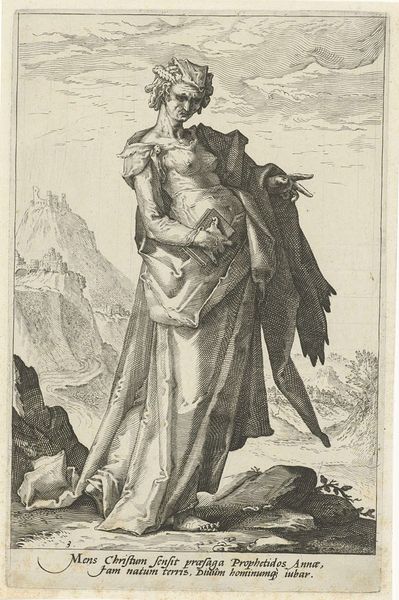
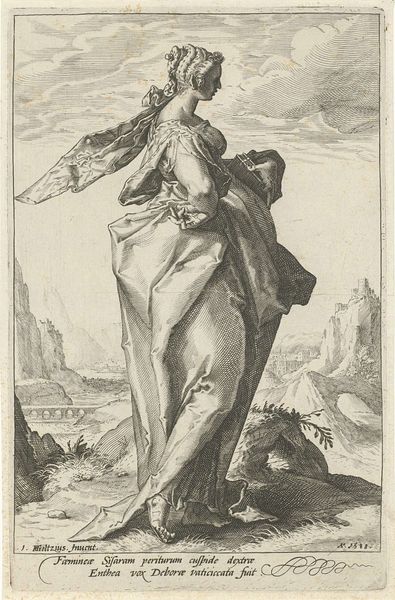
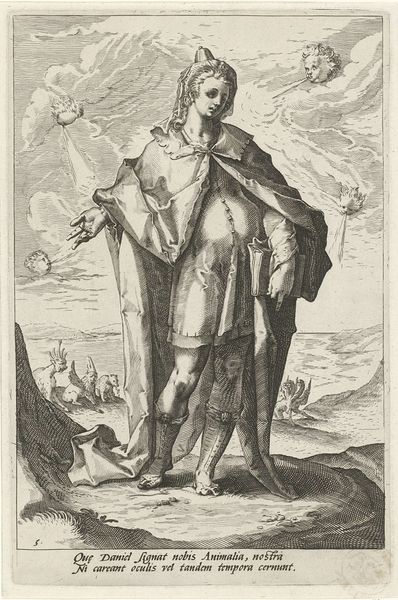
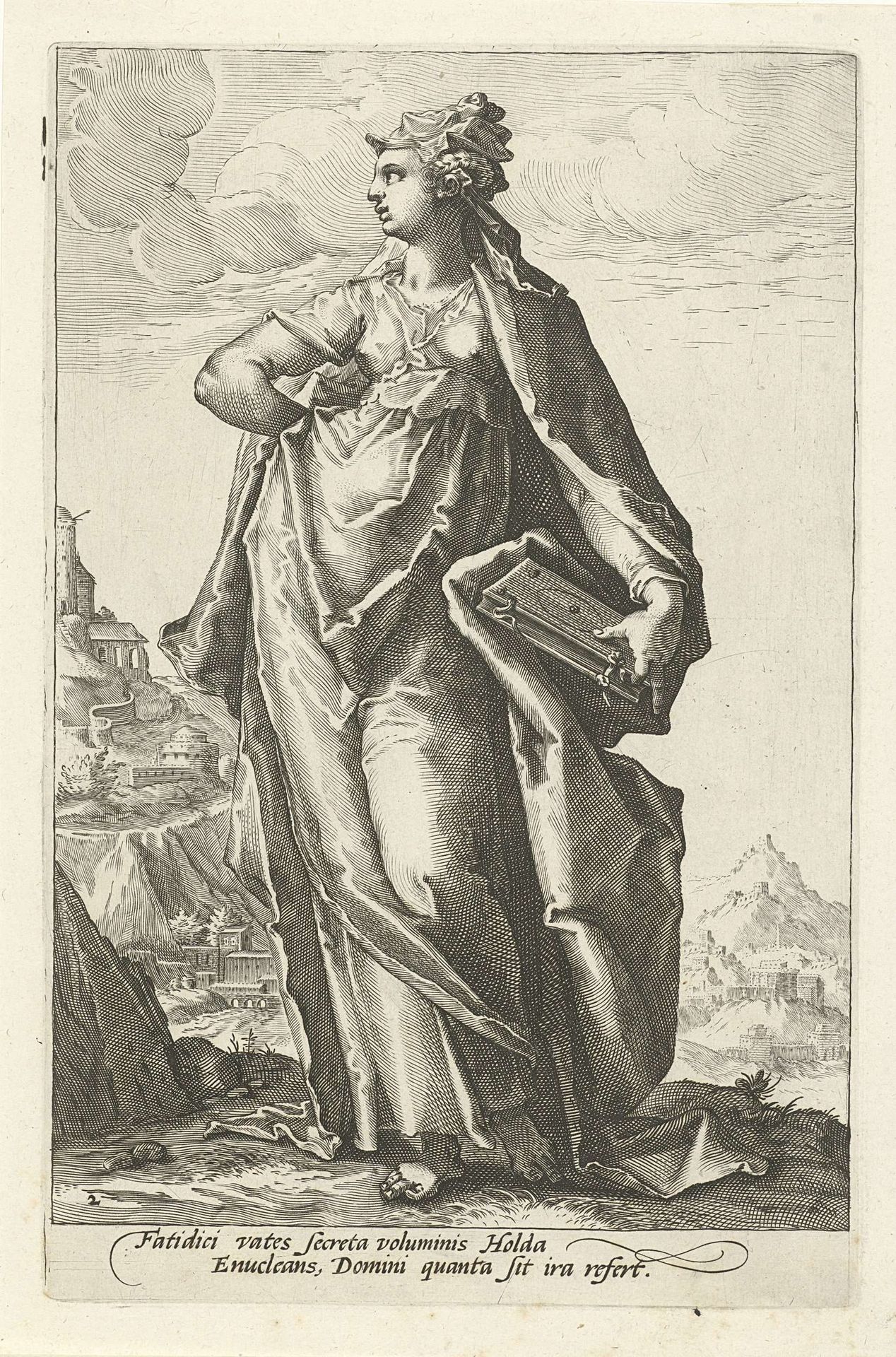
Editor: This is “Hulda,” an engraving by Jacob Matham, made in 1588. She seems to loom over a tiny world, a powerful, almost foreboding figure. What symbols do you notice in this piece? Curator: Hulda, often interpreted as a prophetess, is shown with a book – a symbol ripe with cultural and historical weight. What does the book signify to you? Is it knowledge? Power? Perhaps something else? Editor: I’d say it’s a sign of revealed wisdom. The Latin inscription also mentions "secrets". Curator: Exactly. Engravings like this often played a role in transmitting classical knowledge and mythological narratives. Notice the detailed rendering of her clothing and hair, yet her gaze avoids direct contact. Consider the relationship between visibility and secrecy – what's revealed and what's concealed. Editor: The buildings in the background seem like a small, almost insignificant civilization beneath her, doesn't it? I suppose it makes sense, as it suggests this woman can shape civilization through prophesy and fate. Curator: It raises the question, doesn't it, about who holds the real power, earthly or divine? In viewing Hulda, we're encountering a very specific projection of power encoded within a carefully constructed visual language. Editor: So, it's not just a portrait, but also a commentary on power structures and knowledge. I’ve definitely gained a deeper understanding of how engravings function beyond simple illustration! Curator: And I find that pondering on it always shifts and changes meaning with the context. Symbols never remain static.

Artwork details
- Medium
- engraving
- Dimensions
- height 250 mm, width 162 mm
- Location
- Rijksmuseum
- Copyright
- Rijks Museum: Open Domain
Tags
Comments
Share your thoughts
About this artwork
Editor: This is “Hulda,” an engraving by Jacob Matham, made in 1588. She seems to loom over a tiny world, a powerful, almost foreboding figure. What symbols do you notice in this piece? Curator: Hulda, often interpreted as a prophetess, is shown with a book – a symbol ripe with cultural and historical weight. What does the book signify to you? Is it knowledge? Power? Perhaps something else? Editor: I’d say it’s a sign of revealed wisdom. The Latin inscription also mentions "secrets". Curator: Exactly. Engravings like this often played a role in transmitting classical knowledge and mythological narratives. Notice the detailed rendering of her clothing and hair, yet her gaze avoids direct contact. Consider the relationship between visibility and secrecy – what's revealed and what's concealed. Editor: The buildings in the background seem like a small, almost insignificant civilization beneath her, doesn't it? I suppose it makes sense, as it suggests this woman can shape civilization through prophesy and fate. Curator: It raises the question, doesn't it, about who holds the real power, earthly or divine? In viewing Hulda, we're encountering a very specific projection of power encoded within a carefully constructed visual language. Editor: So, it's not just a portrait, but also a commentary on power structures and knowledge. I’ve definitely gained a deeper understanding of how engravings function beyond simple illustration! Curator: And I find that pondering on it always shifts and changes meaning with the context. Symbols never remain static.
Comments
Share your thoughts