graphic-art, mixed-media, print, stencil, paper
#
graphic-art
#
mixed-media
# print
#
appropriation
#
stencil
#
paper
#
geometric
#
abstraction
#
decorative-art
Dimensions: height 145 mm, width 93 mm
Copyright: Rijks Museum: Open Domain
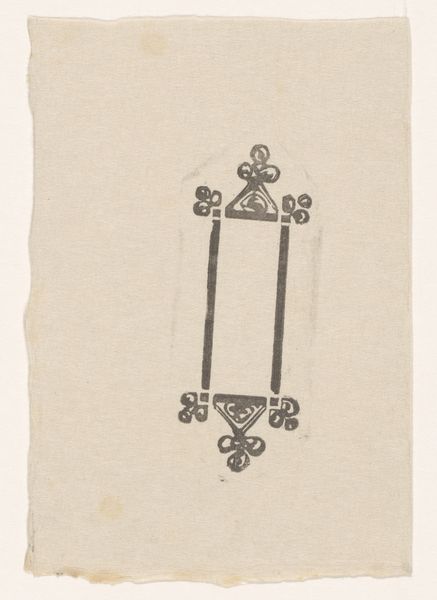
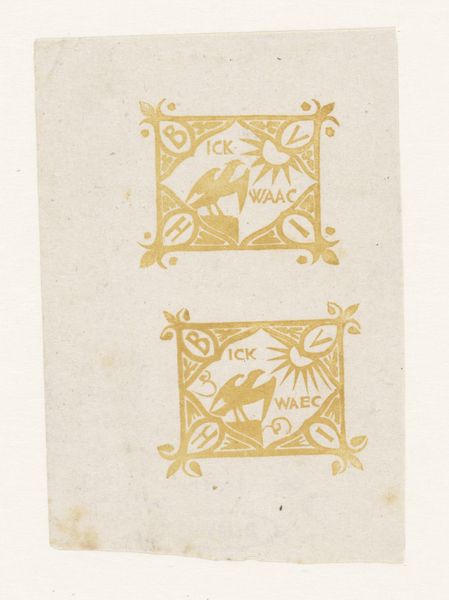
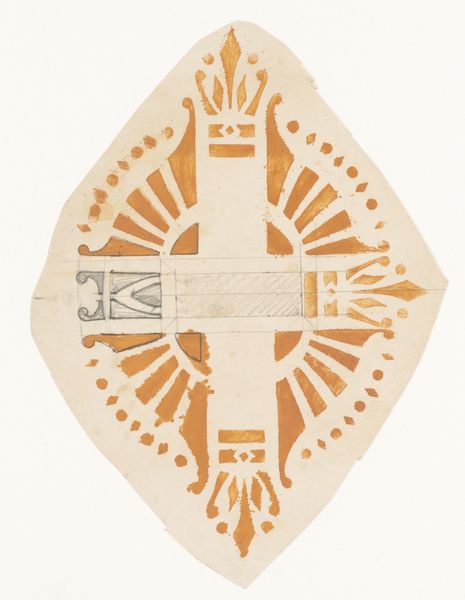
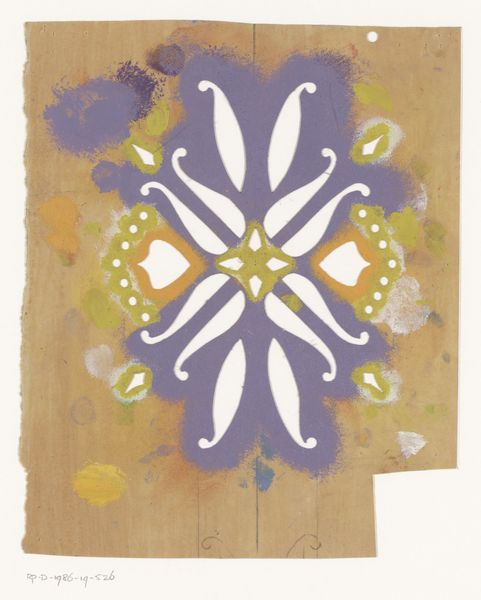
Editor: Here we have "Sjabloon met fleur de lis," created sometime between 1884 and 1952, attributed to Reinier Willem Petrus de Vries, using mixed media on paper. It has a handmade quality...the stark contrast between the stencil and its negative space is pretty striking. What compositional elements stand out to you in this piece? Curator: The strength of this piece lies precisely in that stark contrast you mention. The fleur-de-lis form, rendered through the stencil technique, compels us to consider the interplay between positive and negative space. Consider the way the artist has employed the very idea of absence to define form. What is revealed, and what is concealed? How does the relationship between the brown and the white activate the work? Editor: That's a cool way to look at it! I was so focused on the simplicity, I didn't really think about the intention behind leaving space. Is the rough, almost unfinished texture intentional, you think? Curator: That's a pertinent question. One could argue that the texture contributes to the overall aesthetic. Notice how the roughness subverts any impulse towards pure representation; the piece becomes about the materiality of its making. How does the imperfect execution challenge our expectations of a decorative motif like the fleur-de-lis? Editor: So, it’s like the medium and the execution *are* the message, pushing past the symbol itself. It definitely makes you rethink something you might otherwise consider just decorative. Curator: Precisely! It urges us to decode how form and content intertwine. Editor: I see. Thinking about the work through the lens of its structure really clarifies the choices the artist made and what they emphasize. Curator: Indeed. Visual analysis provides a powerful means of unlocking layers of meaning.
Comments
No comments
Be the first to comment and join the conversation on the ultimate creative platform.
 Collect
 React
React Comment
More like this