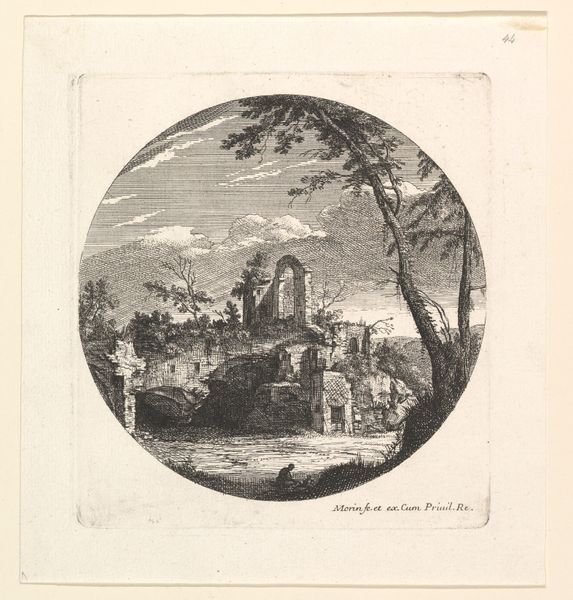
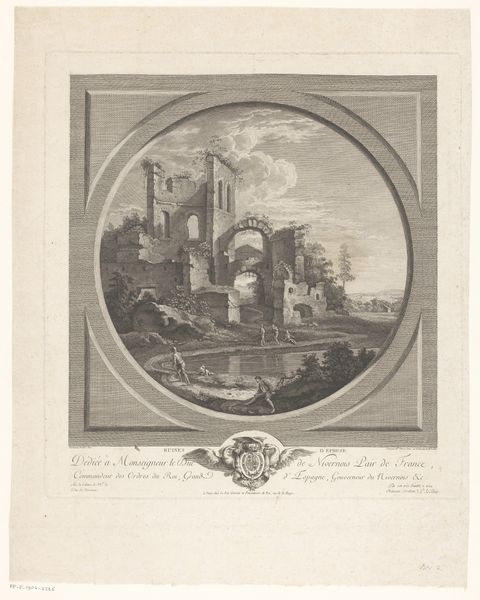
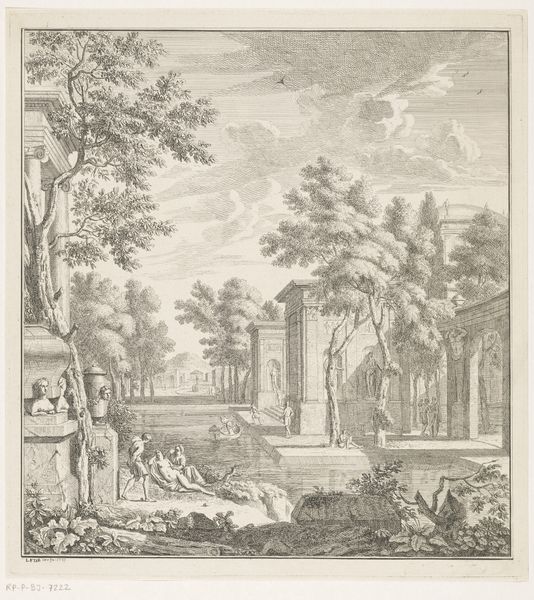
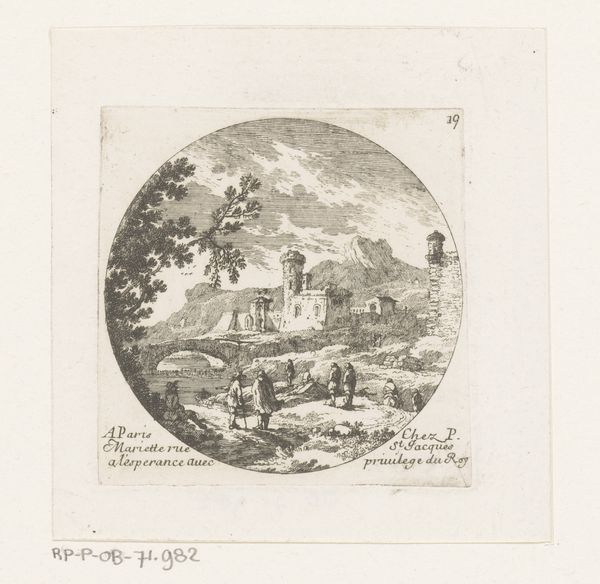
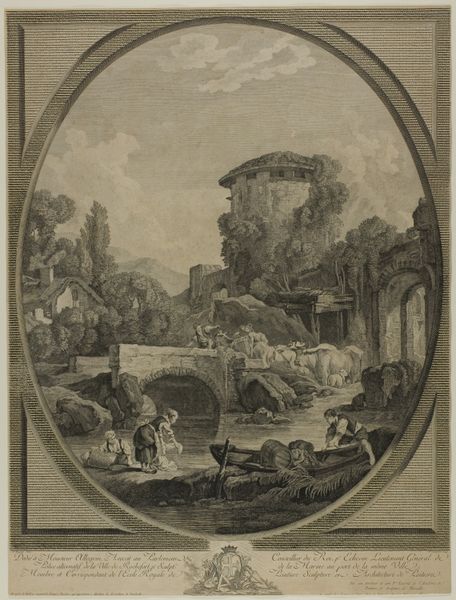
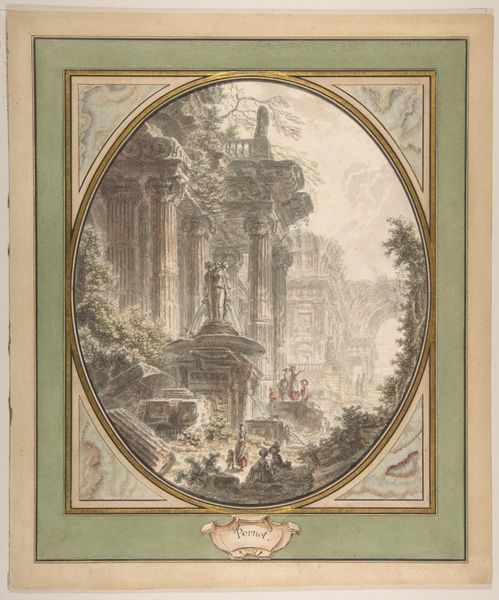
Seascape with the Ruins of the Temple of the Sybil at Tivoli after a painting in the cabinet of the Duc de Choiseul 1700 - 1790
0:00
0:00


drawing, print, engraving
#
drawing
#
baroque
# print
#
old engraving style
#
landscape
#
figuration
#
line
#
cityscape
#
history-painting
#
engraving
Dimensions: Sheet: 6 1/2 x 5 9/16 in. (16.5 x 14.2 cm)
Copyright: Public Domain
Curator: Here we have an engraving, "Seascape with the Ruins of the Temple of the Sybil at Tivoli after a painting in the cabinet of the Duc de Choiseul," dating roughly from 1700 to 1790, presently housed at The Metropolitan Museum of Art. Editor: The immediate impression is one of classical decay, but romantic decay! The circular framing emphasizes a contained world, with intricate line work capturing the rough textures of the ruins and surrounding landscape. Curator: Indeed. Note how the ruin of the Temple, high on the clifftop, dominates the visual field. The Temple of the Sibyl itself, what's left of it, takes on potent associations, particularly in its original context. It connects us to pagan prophecies. The temple suggests a gateway, or an aperture through which the divine can be glimpsed. Editor: The activity around the base – figures fishing, conversing, or simply observing – speaks to humanity's continued engagement with history, perhaps even an indifference to past glories, a new generation going about their lives, heedless. It lends a sense of scale, underscoring the immensity and the remoteness of that historical echo of the Temple above them. Curator: The choice of a circular frame or 'tondo' also enhances a feeling of completion, of destiny fulfilled. There is an almost overwhelming formal precision in the structure, the artist taking the 'picturesque' landscape, and rendering it within strict geometrical parameters. This contrast is a kind of vital formal friction in the composition. Editor: And that contrast speaks volumes. Even in decay, these historical landmarks shape collective memory and our present-day identity. That silhouette against the sky becomes a potent, almost primal, signifier of the transience of empires, but also that their symbols resonate across eras, from ancient oracles to modern art. It offers a link in the cultural imagination between the fall of one civilization and the seeds of the next. Curator: Well observed. The beauty of studying a print like this comes in recognising it’s about line and space as a symbol itself. This image is both document and, through its considered artistry, something far more than a document. Editor: Absolutely. It's a compelling visual essay. These crumbling icons, after all, reflect not just historical loss, but the possibility for continued, reimagined cultural renewal.
Comments
No comments
Be the first to comment and join the conversation on the ultimate creative platform.
 Collect
 React
React Comment
More like this