print, engraving
# print
#
romanticism
#
orientalism
#
cityscape
#
history-painting
#
engraving
Dimensions: image: 41.8 x 54.2 cm (16 7/16 x 21 5/16 in.) sheet: 47 x 61.2 cm (18 1/2 x 24 1/8 in.)
Copyright: National Gallery of Art: CC0 1.0
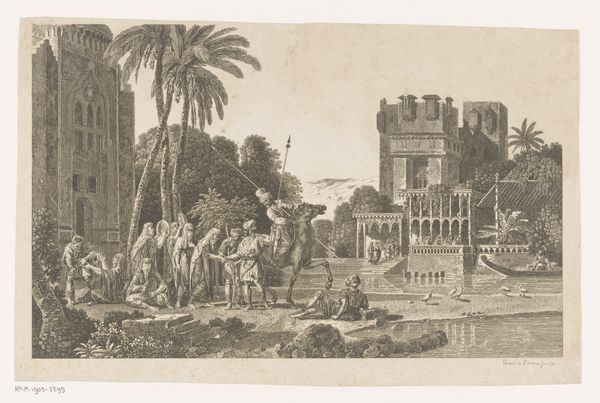
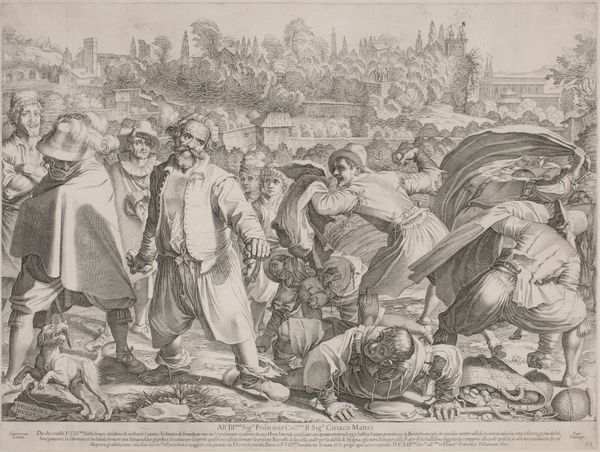
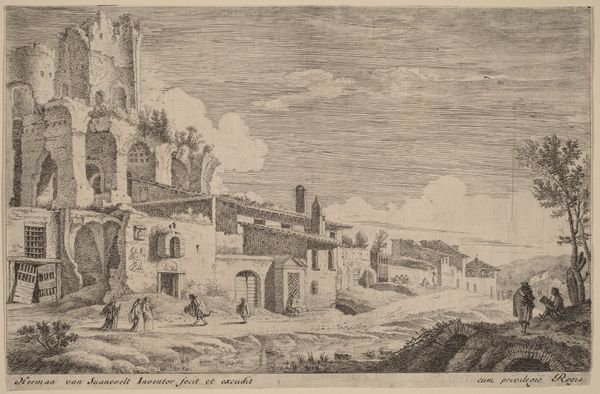
Editor: So, this engraving, "Massacre of the Mameluke Rebels in the Cairo Citadel" by Horace Vernet, dates back to 1818. The scene itself feels...detached, almost staged. How do you interpret Vernet's depiction of such a violent event? Curator: Detached is an interesting word, like looking at a play unfold. I see the careful composition, the dramatic contrast between the serene figures in the foreground and the chaotic battle in the background. This distance could be read as a commentary on power and perspective. The victors watch, almost as if spectators to their own triumph. What do you make of the orientalist elements? Does that affect your reading? Editor: I hadn't thought about the distance like that! And yes, I definitely see the orientalism in the almost romanticized portrayal of the "Eastern" setting. I suppose it adds a layer of exoticism to the violence, making it seem almost unreal. It reminds me a bit of Delacroix, but much less raw. Curator: Exactly. This isn’t quite Delacroix’s visceral take. It's history seen through a very particular, perhaps rose-tinted, European lens. Look closely, can you see hints of the politics of the time bleeding into the lines and shadows? I mean what’s in the foreground versus what the people in the background are doing. Editor: It’s true, you see how much it's about framing a specific narrative, rather than objective representation of the carnage. I didn’t pick up on the politics earlier on. Curator: Well, engravings have that power, don’t they? To freeze moments in time and invite, sometimes, demands to re-examine and question those frozen narratives. Editor: Definitely. I will always remember the importance of perspective in art, something I’ll carry with me.
Comments
No comments
Be the first to comment and join the conversation on the ultimate creative platform.
 Collect
 React
React Comment
More like this