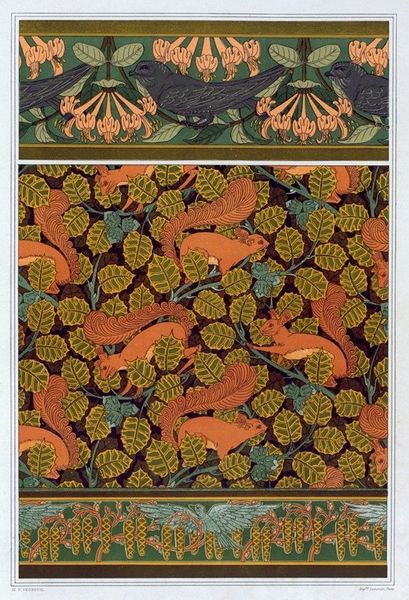
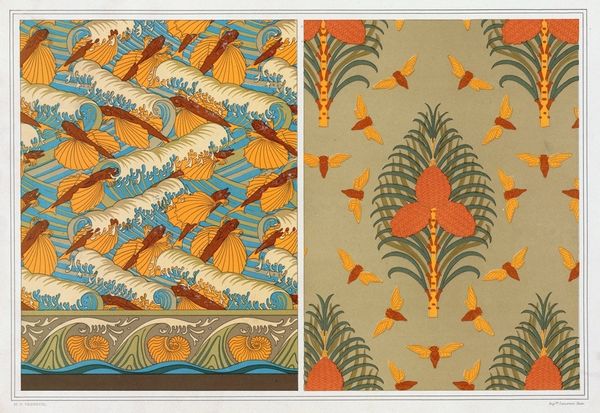
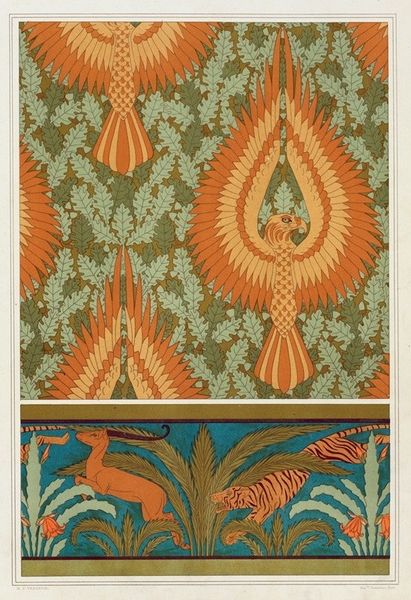
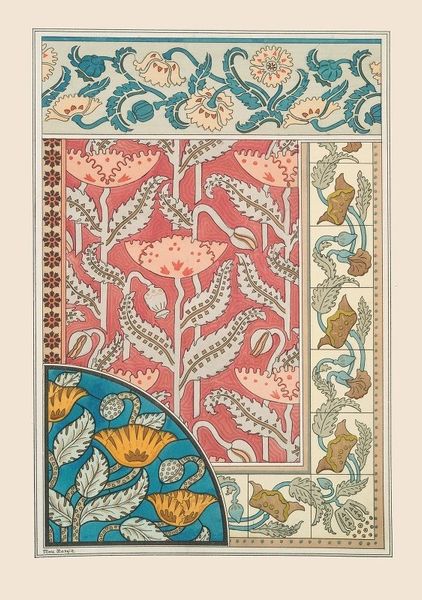
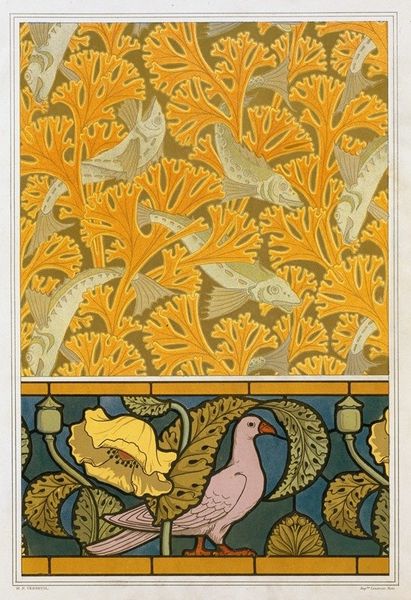
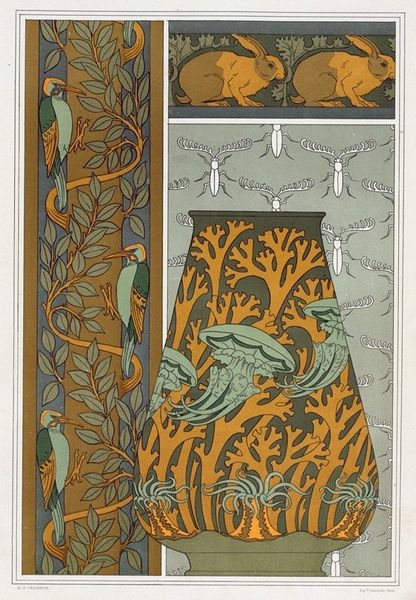
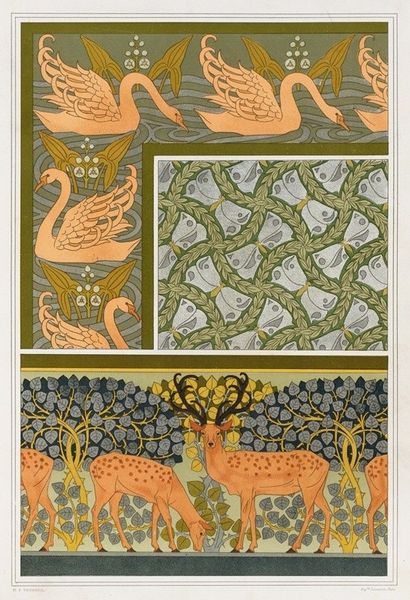
Martins-pêcheurs et butome en ombelle, papier peint. Chevaux et arbres, bordure. 1897
0:00
0:00

graphic-art, print
#
graphic-art
#
natural stone pattern
#
naturalistic pattern
#
art-nouveau
# print
#
pattern background
#
tile art
#
abstract pattern
#
organic pattern
#
pattern repetition
#
layered pattern
#
pattern in nature
#
motif
Copyright: Public Domain: Artvee
Curator: This is a wallpaper design from 1897 by Maurice Pillard Verneuil entitled "Martins-pecheurs et butome en ombelle, papier peint. Chevaux et arbres, bordure", featuring kingfishers and flowering rush alongside a border of horses and trees. Editor: Immediately I’m struck by the distinct separation and the almost surreal nature of these two very different decorative schemes. The cool, muted palette in the kingfisher scene evokes a sense of serene, stylized nature. Curator: Right, Verneuil was a significant figure in the Art Nouveau movement, which deliberately moved away from industrial production towards handcrafted techniques and designs often inspired by natural forms. Wallpaper, particularly, became a battleground for showcasing these ideals within the domestic sphere. Editor: It’s so fascinating to see these highly stylized, decorative schemes intended for mass reproduction. Were such nature-inspired designs a sort of bourgeois aspiration? Bringing a rarefied world into their everyday surroundings? Curator: In a sense, yes. However, it’s also crucial to acknowledge the complex social narratives interwoven within Art Nouveau. This stylized rendering, far from being a simple reflection of nature, conveys societal perceptions about idealization through aesthetics. Editor: Speaking of perceptions, what I find fascinating is that horses—symbols frequently of nobility and power—are relegated to the border while birds dominate the full pictorial. The juxtaposition feels almost… subversive, especially considering gendered roles. Curator: That's a fascinating perspective. The placement certainly questions conventional symbolic hierarchy, prompting a discourse around the positioning of both human and animal representations. The flattened perspective and strong outlines, characteristic of the Art Nouveau, adds another layer of visual encoding. Editor: It's like Verneuil is using decorative arts to subtly interrogate societal norms—offering not just pleasant imagery, but a point of entry to broader discussions around power structures and aesthetics. Curator: Ultimately, Verneuil's designs were at the forefront of discussions about taste, aesthetics, and societal ideals. Editor: Leaving us with the question: how might we reclaim decorative spaces today to reflect and disrupt power relations, making these historical considerations incredibly relevant?
Comments
No comments
Be the first to comment and join the conversation on the ultimate creative platform.
 Collect
 React
React Comment
More like this