drawing, print, engraving
#
portrait
#
drawing
#
neoclacissism
# print
#
history-painting
#
engraving
Dimensions: sheet (trimmed to plate): 6 3/8 x 5 1/8 in. (16.2 x 13 cm)
Copyright: Public Domain
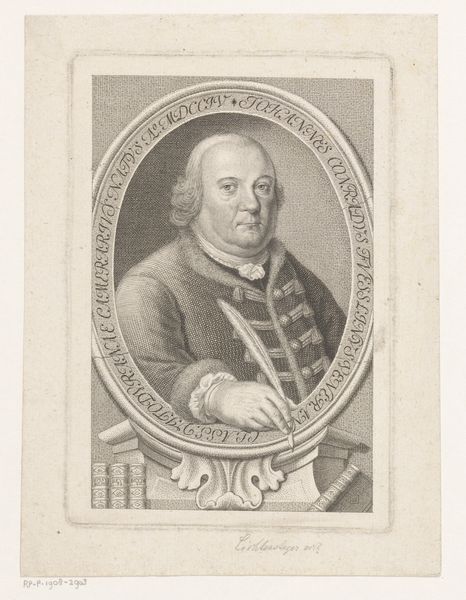
Curator: Standing here, we observe Charles Willson Peale's 1787 engraving, "Benjamin Franklin," currently residing at the Metropolitan Museum of Art. It’s an insightful portrayal from the Neoclassical period. Editor: The first thing that strikes me is the framing; the oval is strict, classical even. It contains Franklin so completely, creating a powerful, if somewhat rigid, composition. Curator: Absolutely. The oval functions almost like a halo here. Consider the lettering surrounding Franklin, each title acting as an aura: "His Excellency," "President of Pennsylvania," “Minister of the United States"... The circular structure mimics halos we find on religious icons. Editor: The stark black and white contrast only amplifies that sense of formality and gravity. It highlights the fine lines of the engraving, emphasizing detail while suppressing warmth. Do you think that inherent seriousness lends the subject matter some authority? Curator: I do, because this portrait freezes Franklin in the public imagination, creating an instantly recognizable image associated with American intellectualism, political power, and revolutionary thought. The eyeglasses particularly act as emblems for enlightenment. Editor: Indeed. His gaze, though indirect, suggests a visionary, someone who sees beyond the immediate. Curator: More than visionary, also teacher! Someone who transmits insight. I’m reminded of the cultural role that Franklin filled for aspiring colonial thinkers, acting almost as a figurehead for new sciences. Editor: The material aspect here, engraving, itself supports a symbolic link between vision and instruction, acting as one stage in the mass transmission of knowledge, ideas, and enlightenment thinking through the mass reproducibility afforded by the printing press. Curator: Well observed. This engraving acts as more than an individual portrait, in some sense turning into a representation for colonial American virtues. Editor: Considering its historical context and striking formalism, this print speaks volumes about the creation of the modern hero. Curator: Precisely. We see here an excellent representation for Peale’s engagement with not only portraying Franklin, but shaping our understanding of him today.
Comments
No comments
Be the first to comment and join the conversation on the ultimate creative platform.
 Collect
 React
React Comment
More like this