

1972
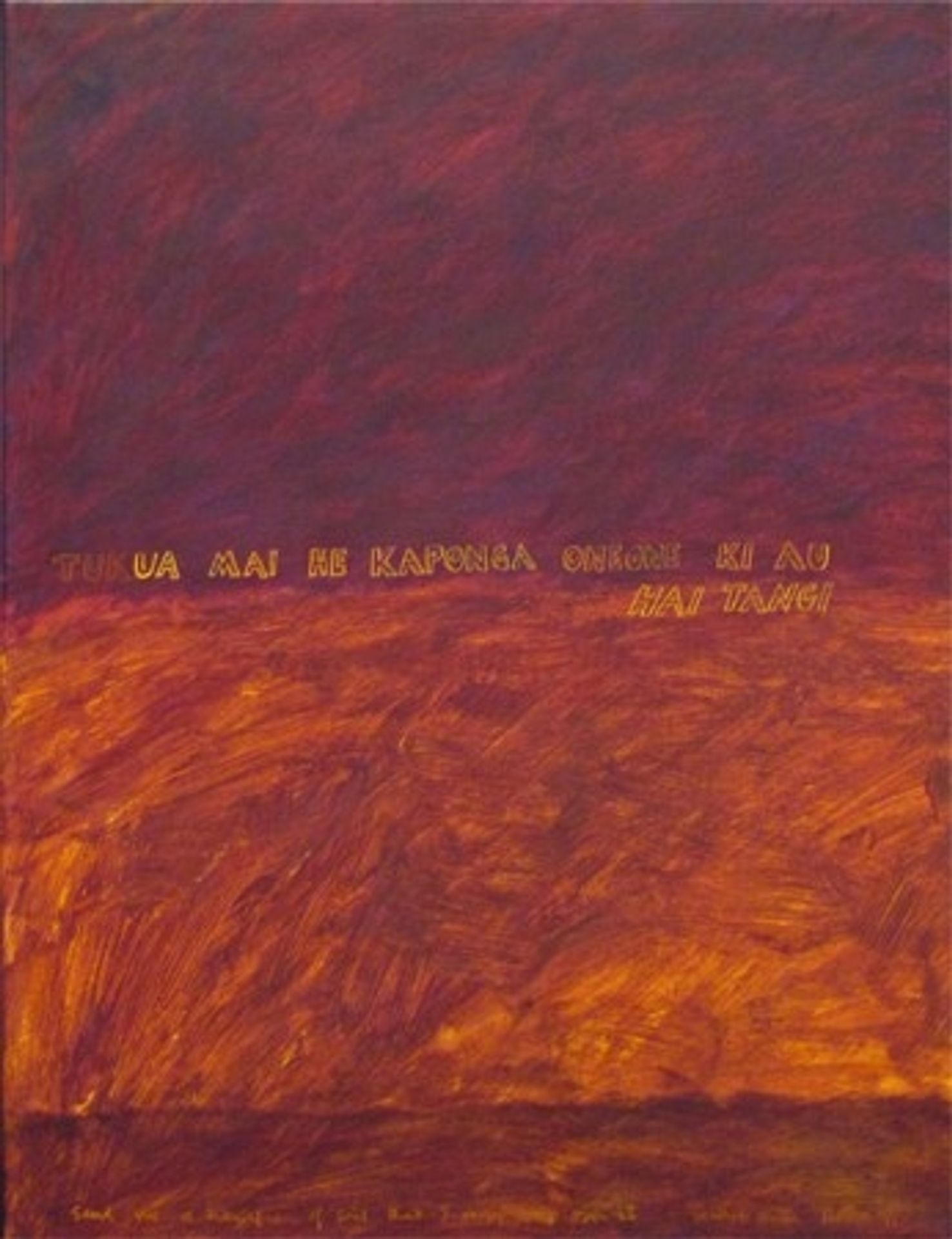
Tukua Mai He Kaponga Oneone Ki Au Hai Tangi (Send me a Handful of Soil)

Listen to curator's interpretation
Curatorial notes
Curator: Before us hangs Ralph Hotere's 1972 painting, "Tukua Mai He Kaponga Oneone Ki Au Hai Tangi," an acrylic work translating to "Send me a Handful of Soil That I May Weep." Editor: Immediately, the colors strike me—a powerful, almost violent sunset. A burnt umber horizon bleeds into a deep, bruised purple sky. There's a rawness, a pain here that's quite palpable. Curator: Hotere's masterful manipulation of color and texture embodies a deep sense of grief, that feeling the title alludes to, as does his striking use of text. What could this soil symbolize, in this context? Editor: Soil is a foundation, connection to ancestors and land. To ask for it in order to weep speaks to a profound disconnect, a cultural dispossession. It's not just personal sorrow, it resonates with collective trauma. Given his Māori identity, it hints at colonial impacts. Curator: Yes, the colours could reflect physical landscapes, or emotional terrain, both resonating in that cultural and historical context. We can even consider the cross, here a very minimal band between earth and sky. It isn't overtly Christian but carries heavy cultural connotations. Editor: I read the mark-making almost as a battle, between dark sky pressing down and this hopeful, burning earth straining to rise. But text in painting functions in various ways beyond simply relaying semantic content: it brings written language into dialog with modes of pictorial representation, and in this case, colonial history itself. Curator: In Māori culture, words carry immense power, are almost alive. That text then transforms this from abstraction into a very pointed, embodied lament, drawing on generations of history. The artist uses the tradition of history painting in order to address modern themes in this minimalist abstraction, allowing for an act of cultural continuity to come forward. Editor: Absolutely. And thinking about how "abstract expressionism" gets used, often lazily, in art history, it's crucial to see how Hotere imbues this style with a very specific, grounded cultural and political urgency. It's abstraction, yes, but fiercely decolonized. Curator: He brings tradition and avant-garde form into striking dialog. Editor: Ultimately, I think it leaves me considering how art can serve as both a vessel for grief and a powerful act of cultural resistance.