painting, oil-paint
#
allegory
#
narrative-art
#
fantasy art
#
painting
#
oil-paint
#
figuration
#
neo expressionist
#
romanticism
#
mythology
#
painting painterly
#
animal drawing portrait
#
history-painting
Dimensions: 189 x 241.5 cm
Copyright: Public domain
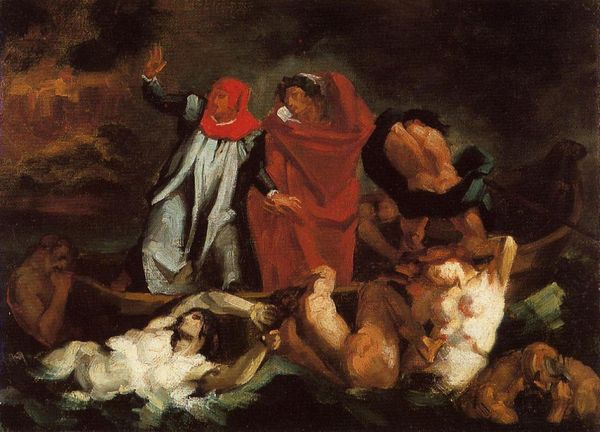
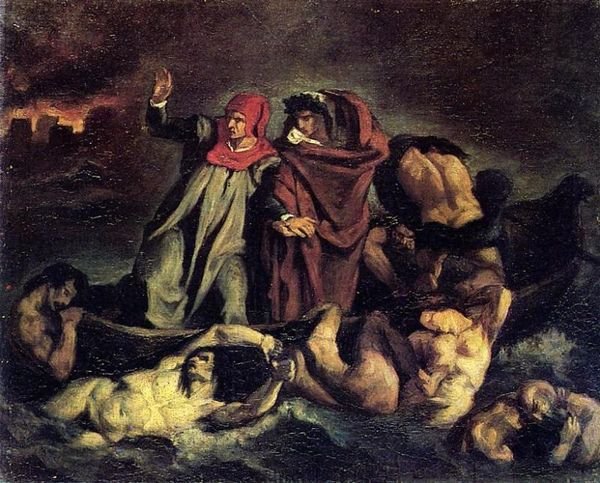
Curator: Eugène Delacroix painted The Barque of Dante, or Dante and Virgil in the Underworld, in 1822. It depicts a scene from Dante Alighieri's Inferno. It now resides in the Louvre, Paris. Editor: My initial reaction is one of unease. The chaotic composition, the murky color palette—it really captures the sense of despair and struggle in the underworld. Curator: Absolutely. This canvas represents Delacroix's early artistic rebellion against the more rigid, neoclassical style of his time, as upheld in the French academy. He chose the harrowing scene to challenge the aesthetic conventions of his era and create a sense of sublime terror, perhaps reflective of the turbulence following the Napoleonic era. Editor: Delacroix is so obviously focused on texture and the emotive use of color, you can see it particularly in the swirling forms of the water and tormented figures. He is exploring an aesthetic of excess and intense sensation that becomes a key aspect of Romanticism. The whole visual field seems designed to assault the senses! Curator: Exactly, and the politics surrounding its initial reception speak volumes about the cultural landscape. The Salon audience, accustomed to idealized forms and controlled narratives, found this display of raw emotion unsettling. Critics saw it as an affront to good taste, too caught up in the academic values of perfect form. Editor: You’re right. If we analyze the organization, the serpentine arrangements of bodies lead the eye into the maelstrom. There’s no single point of focus but a series of intense encounters. It mirrors, structurally, the feeling of Dante's layered and fragmented journey. Curator: Its display was inevitably interpreted as a direct statement on society after the French Revolution; its horrors, and failed ideals. The imagery invited consideration of revolution-era upheaval in France as much as it did Dante’s medieval hell. Editor: It is a striking visualization of chaos and suffering through very carefully orchestrated means! Delacroix channels terror through brushstroke and pigment, pushing paint to its expressive limits. Curator: He harnessed those feelings stirred up during that era. That raw human element gives Delacroix his ability to create these paintings, full of emotion, that have captivated audiences for centuries. Editor: Definitely. He constructed an emotional theatre.
Comments
No comments
Be the first to comment and join the conversation on the ultimate creative platform.
 Collect
 React
React Comment
More like this