#
photo of handprinted image
#
natural tone
# print
#
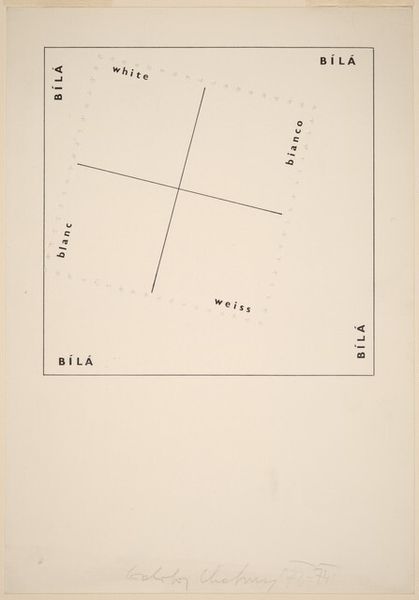
white dominant colour
#
hand drawn type
#
repetition of white
#
white palette
#
fading type
#
embossed
#
tonal art
#
repetition of white colour
Copyright: National Gallery of Art: CC0 1.0
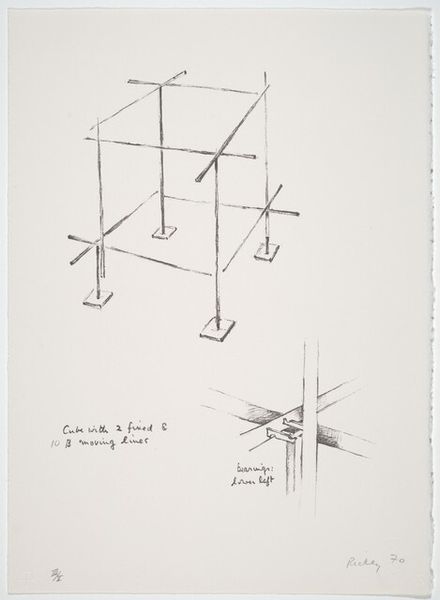
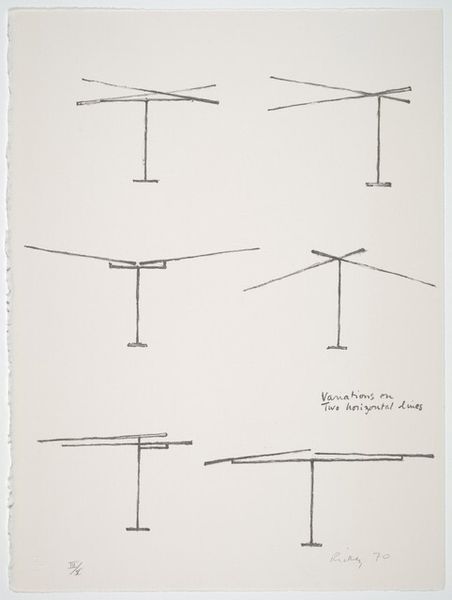
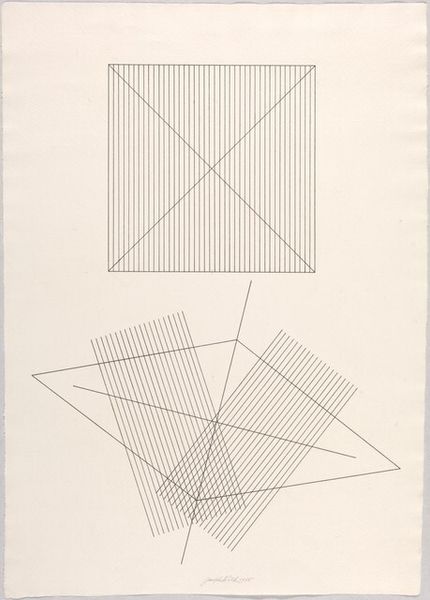
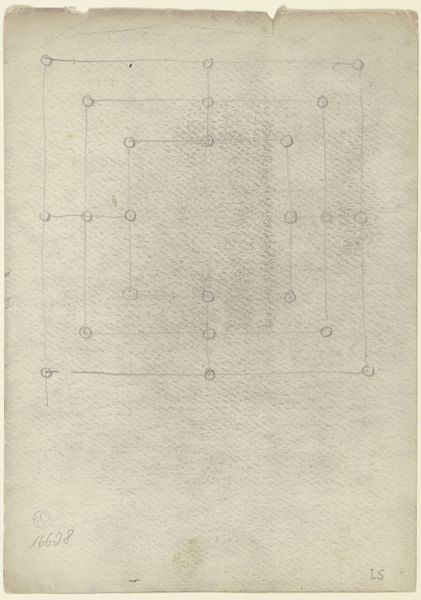
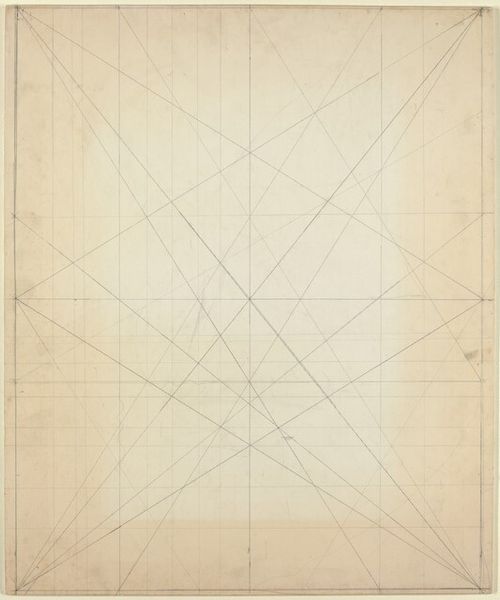
Editor: We are looking at George Rickey’s 1970 print, "Four Lines in a Square Diagonal Variations." I am struck by the way the stark, almost architectural, forms interact within the rigid structure of the square. What can you tell me about how its form conveys meaning? Curator: Consider the structural components. The linear elements intersect and diverge, establishing a dynamic interplay between stasis and movement, order and controlled chaos. The variations subtly alter the geometric harmony. How does this arrangement influence your reading of the overall piece? Editor: I see each square almost as a small performance of balance. There is an instability to the line, like a mobile caught in a breeze. Curator: Precisely. Note how the formal arrangement rejects conventional notions of balance through asymetrical placement within a confined system. It engenders a constant visual reevaluation. Editor: The "performance of balance" makes sense, especially in contrast to the "rigidity." Almost as though each form fights that rigidity with its variance. Does the repetition serve a specific purpose, further encoding meaning within a relatively constrained visual vocabulary? Curator: The repetition amplifies the minute differences. Think about it like a linguistic study. Through careful examination of these permutations, one perceives new qualities, as in an evolution of the base form. Editor: So, in isolating a visual system and presenting variations on its form, Rickey directs our focus toward an in-depth study of those qualities themselves. Curator: Indeed. By engaging with a simplified geometric lexicon, we sharpen our visual analysis to expose latent dynamism. I find it powerful how a seemingly minimal gesture contains unexpected depth through relational transformation. Editor: I see the movement between variations in a completely different light now, having heard your view of the underlying visual architecture.
Comments
No comments
Be the first to comment and join the conversation on the ultimate creative platform.
 Collect
 React
React Comment
More like this