c. 1797
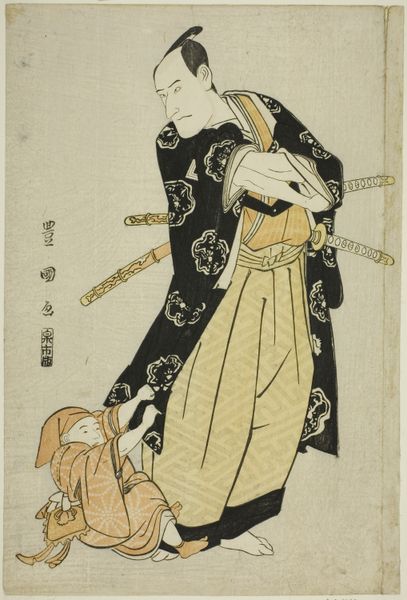
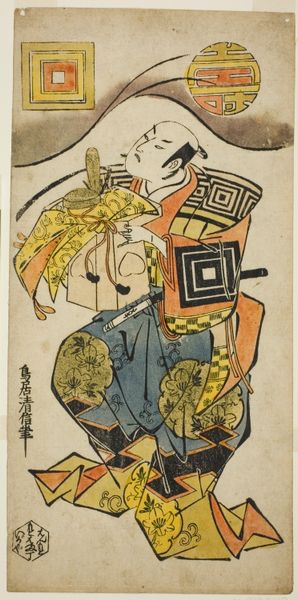
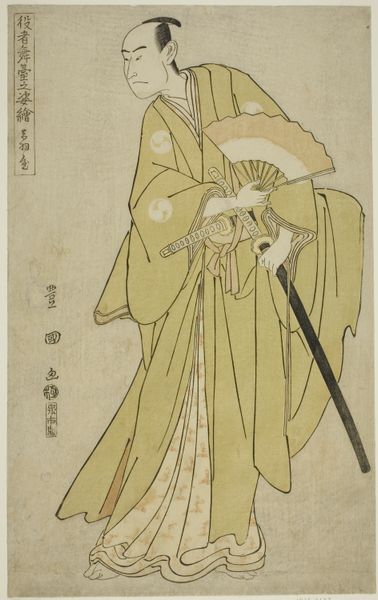
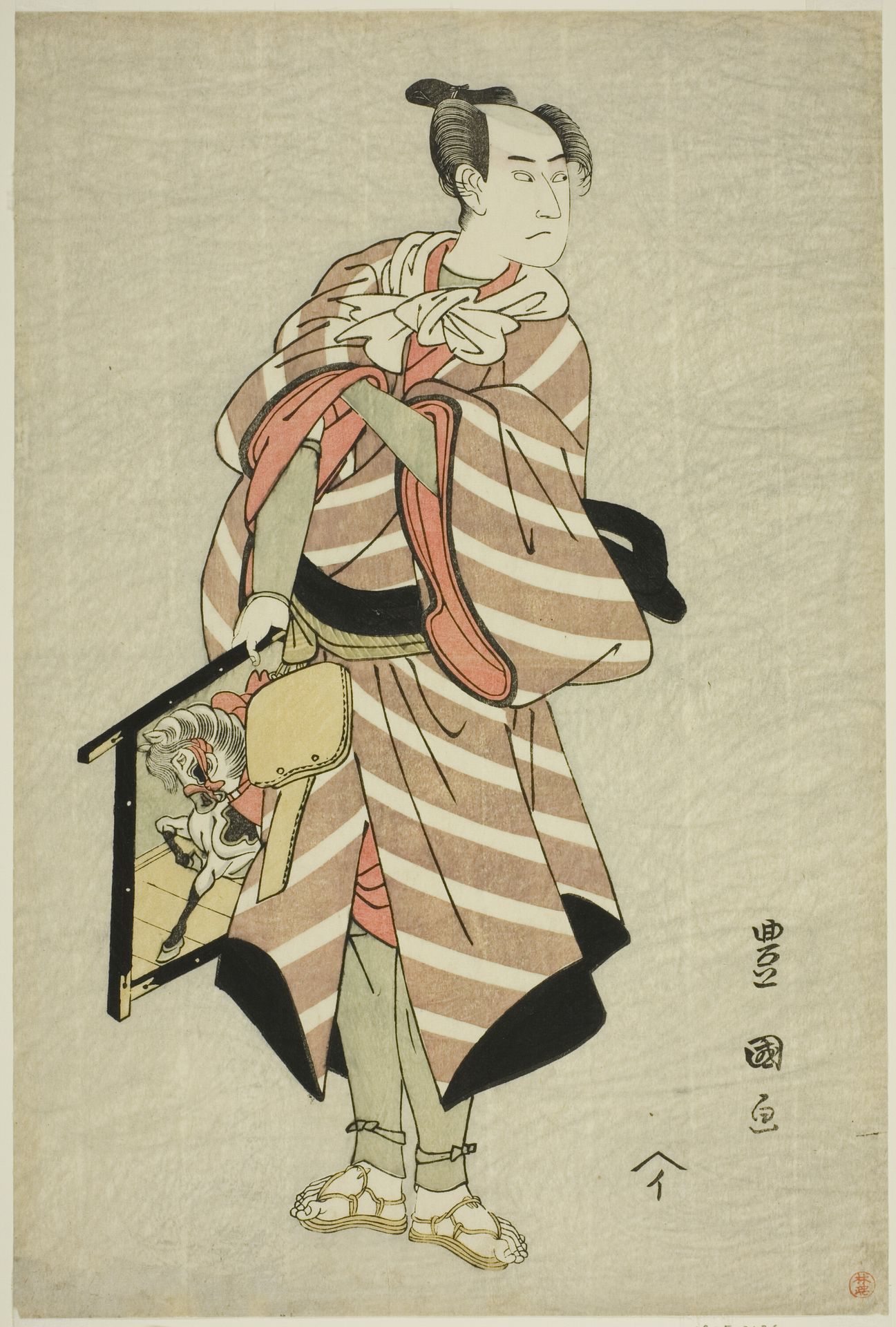
The actor Sawamura Sojuro III as the packhorse-man Muchizo in the play "Miyamairi Musubi no Kamigaki," performed at the Kiri Theater in the eleventh month, 1797


Listen to curator's interpretation
Curatorial notes
Editor: This woodblock print from around 1797 by Utagawa Toyokuni I shows the actor Sawamura Sojuro III. It’s called "The actor Sawamura Sojuro III as the packhorse-man Muchizo in the play 'Miyamairi Musubi no Kamigaki,'" quite a mouthful. I find it captivating because even though it's a portrait, it tells a whole story. What stands out to you when you look at this? Curator: Well, isn't it marvelous how a single figure can hold so much theatre! It feels as if Toyokuni is winking at us, saying, "Here’s life, but make it art." Ukiyo-e prints were, in essence, the celebrity snapshots of their day, weren’t they? Capturing favorite actors and scenes for a hungry public. Notice how the actor is not just posing but performing, even off-stage. The stylized expression, the deliberate arrangement of his robes… he’s *being* Muchizo, and we, dear viewer, are his captivated audience. And tell me, doesn't the prop he carries almost feel like another character in the play? Editor: Yes, it’s like a play within a play. And the colors, that subtle palette, almost makes it feel contemporary. Were these prints popular? Curator: My dear, imagine a world without paparazzi or Netflix. These prints *were* popular culture. They were collected, traded, adored… little windows into a glamorous world available to almost everyone. And the skill involved! Every line, every shade is carefully planned and executed, a true collaboration between the artist, the carver, and the printer. Does it change how you see it now? Editor: Absolutely. I see now that it’s not just a picture, it’s a whole cultural phenomenon squeezed onto a single sheet of paper. Curator: Precisely. It is proof of a shared human experience, wasn't it? A story, told and retold, forever captured in ink and wood. We should be so lucky to find such vibrant echoes of our own fleeting performances.