1888
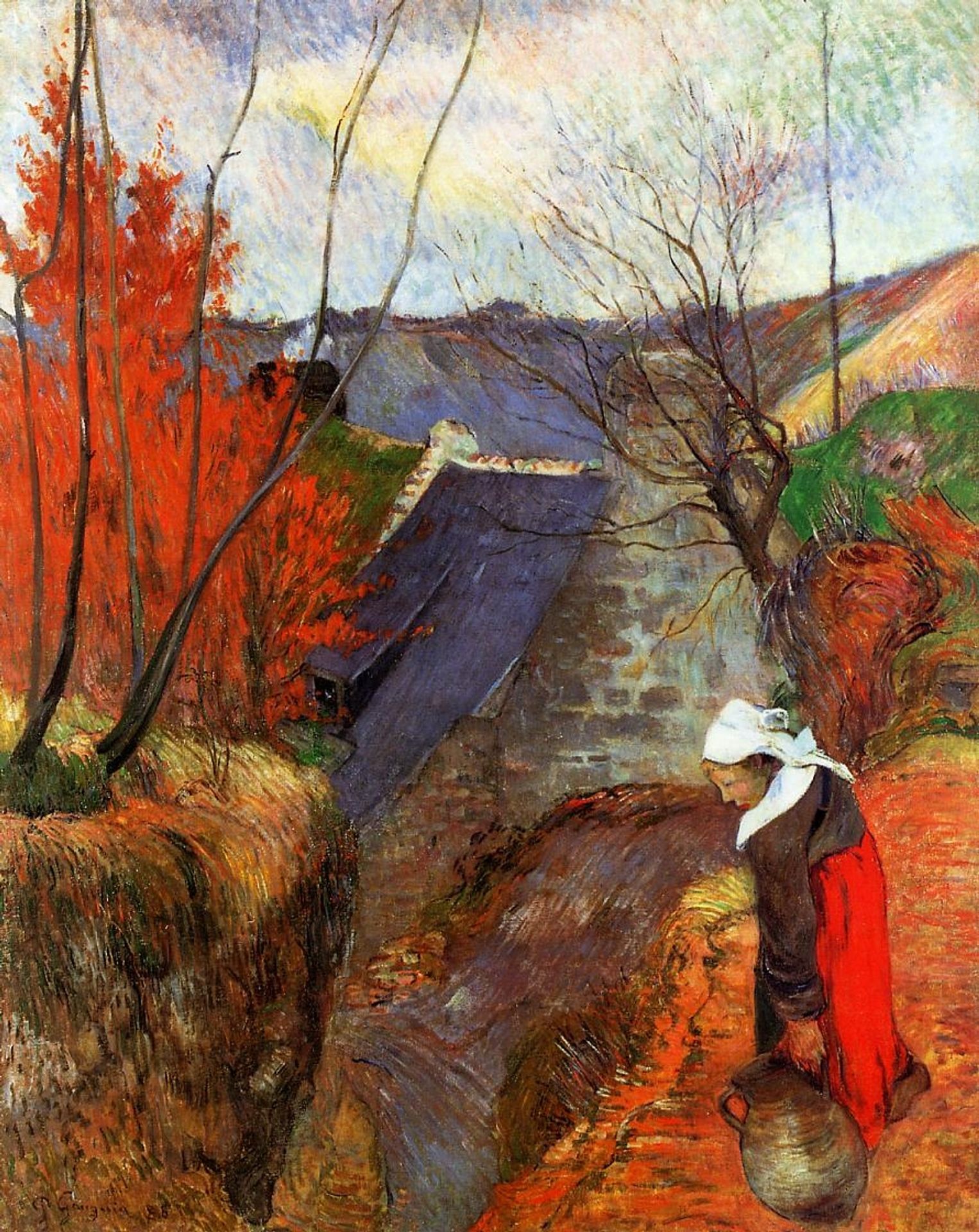
Breton Woman with a Pitcher

Paul Gauguin
1848 - 1903Location
Private CollectionListen to curator's interpretation
Curatorial notes
Editor: This is Paul Gauguin’s "Breton Woman with a Pitcher," painted in 1888. It feels so dreamlike, with those vivid colors…almost not real. How do you interpret this work? Curator: Notice the simplification of form and the intense, non-naturalistic colors, reflecting a symbolic representation of rural life. What feelings do these colors evoke in you, beyond simply describing them? Editor: There’s something almost melancholy about the reds and browns mixed with the purplish roof and the woman’s posture, as though it’s about burdens… not necessarily sad, but serious. Curator: Indeed. The pitcher itself becomes symbolic. The water it carries isn’t just water; it's life, sustenance, and a connection to ancient rituals. The weight of the vessel parallels the weight of tradition, community, and female responsibility. Do you see other symbols suggesting tradition and cultural memory here? Editor: Perhaps in the setting? The house, the landscape… it all seems very rooted in a specific place and way of life. Not like something fleeting. Curator: Exactly. The stylized landscape, though perhaps “naive” to some eyes, presents a deep understanding of cultural continuity and the enduring spirit of the Breton people. Gauguin is less depicting a literal scene, and more conveying a timeless essence, loaded with generational memory. Editor: So, he’s not just showing us a woman, but the weight of a culture and a way of life tied to her. I wouldn't have seen that initially. Curator: Art often invites us to look deeper, to understand the layers of meaning encoded within seemingly simple images. That’s where its power truly lies.