

1852
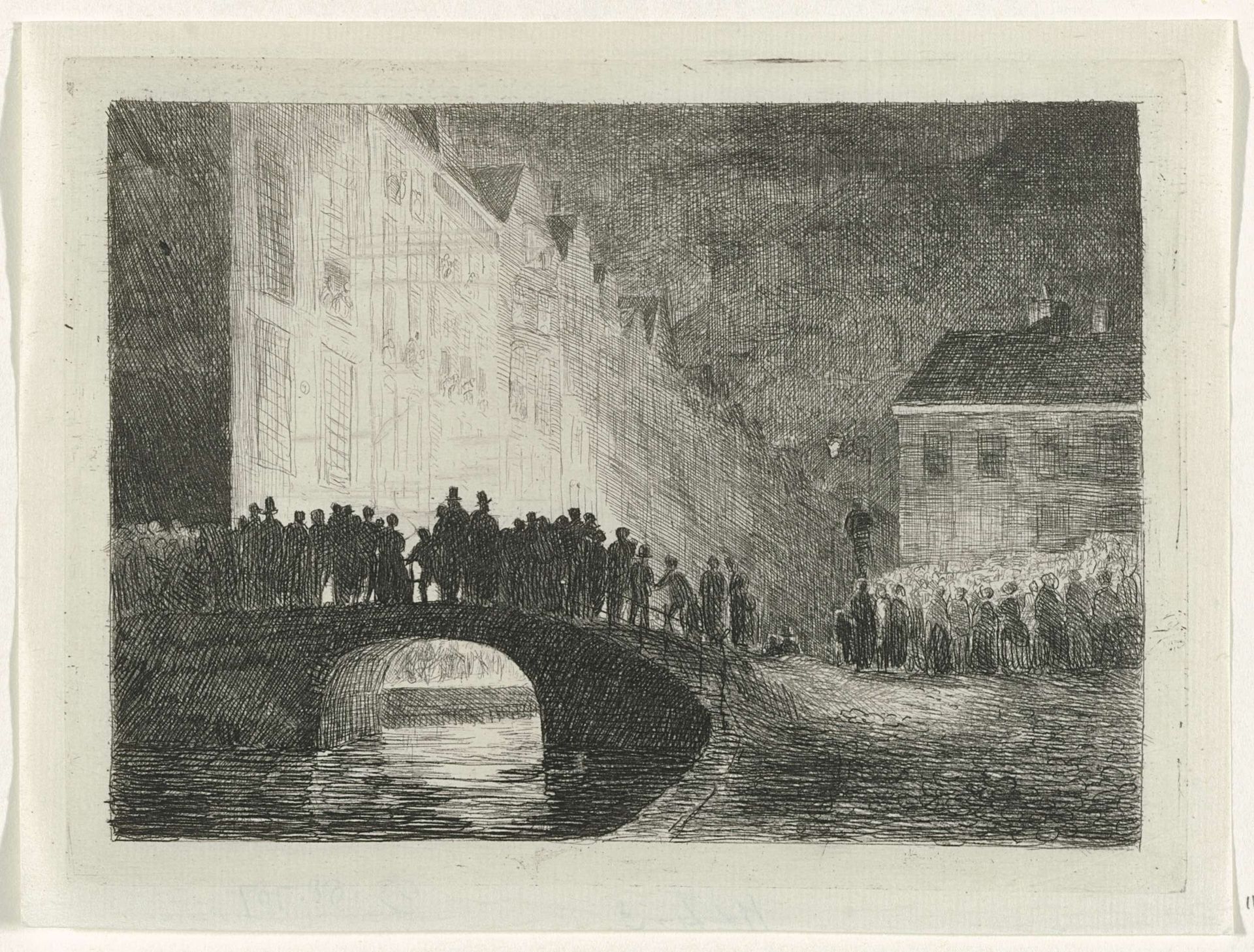
Brand in Delft, 1847

Cornelis Ouboter van der Griendt
1797 - 1868Location
RijksmuseumListen to curator's interpretation
Curatorial notes
Editor: We’re looking at “Brand in Delft, 1847,” an etching by Cornelis Ouboter van der Griendt. It depicts a large crowd gathered around what appears to be a fire in a city. The scene is rendered with incredible detail, but it’s also quite dark. What do you see in this piece in terms of its formal qualities? Curator: Indeed. Let’s begin by analyzing the deployment of line. Notice how van der Griendt uses dense, almost frenetic lines to build form and texture, particularly in the crowd and the buildings. This creates a sense of depth but also a kind of nervous energy. Editor: I hadn't thought about that, but the density does create tension. Is that why the tones are all rather subdued and close together, lacking strong contrast? Curator: Precisely. This limited tonal range flattens the image somewhat, drawing attention to the surface and the intricate network of lines. What effect does this flattening have on your interpretation? Editor: It makes me focus less on depth and more on the shapes, creating a pattern. So even though the subject matter is quite dramatic, the etching feels strangely… composed. Curator: Well observed. The controlled composition, despite the apparent chaos, is paramount here. How does the artist’s manipulation of light and shadow contribute to this effect? Editor: I see the light mostly reflecting off of the building at the end of the canal, creating the mood with this reflection. What this etching reveals, through formal means, about the potential to contain what is clearly a dramatic and chaotic moment, is pretty stunning. Curator: Agreed, and such is the paradoxical nature of realist composition, isn’t it? Van der Griendt orchestrates a realistic portrayal while exercising tight artistic control. The structure of feeling and emotion, embedded in the image, become visible in its composition.