About this artwork
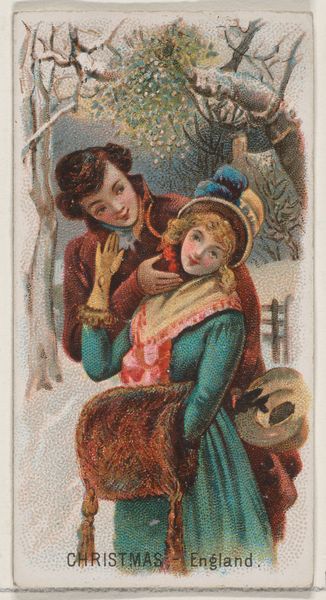
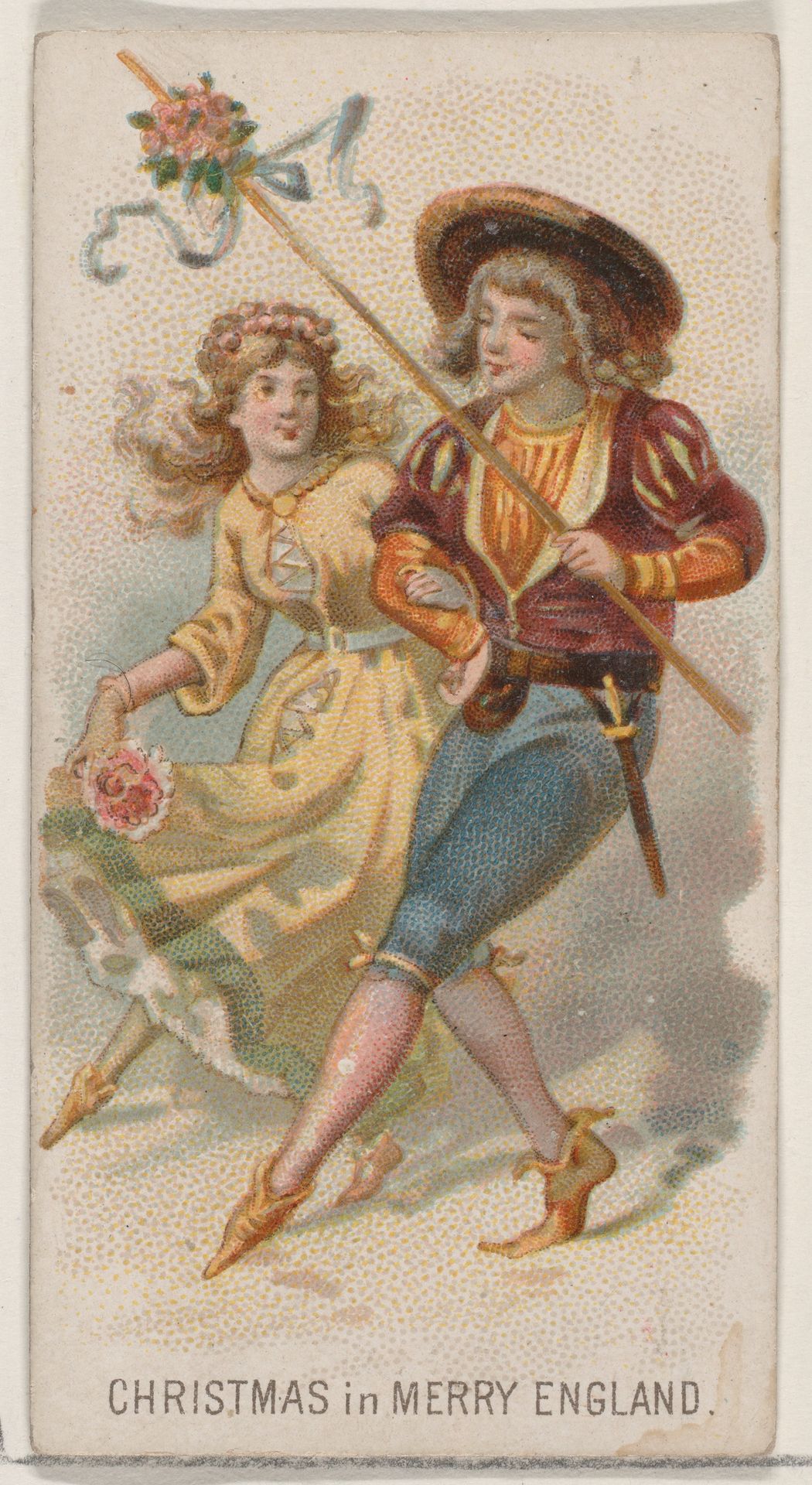
This chromolithograph called 'Christmas in Merry England', made by W. Duke, Sons & Co. between 1870 and 1920, offers a charming glimpse into holiday festivities. The most striking symbol is perhaps the maypole, adorned with flowers, carried by the female figure. The maypole is steeped in ancient pagan rituals, symbolizing fertility and the renewal of life, a motif that predates Christianity yet finds itself intertwined with Christmas celebrations here. This echoes similar syncretic processes observed across cultures where older, indigenous beliefs are assimilated into new religious contexts. Think of the Christmas tree itself, originating in pre-Christian winter solstice celebrations. The image is more than a mere depiction of festive cheer; it embodies the enduring human need to find joy and connection during the darkest time of the year. The maypole, like the Christmas tree, has undergone a transformation, imbued with new meanings, yet its essence remains—a testament to our deep-seated longing for renewal and hope. Thus, the emotional power of the image resides in this convergence of ancient symbols and contemporary festivities.
Christmas in Merry England, from the Holidays series (N80) for Duke brand cigarettes
1890

W. Duke, Sons & Co.
1870 - 1920
The Metropolitan Museum of Art
Metropolitan Museum of Art, New York, NYArtwork details
- Medium
- drawing, coloured-pencil, print
- Dimensions
- Sheet: 2 3/4 x 1 1/2 in. (7 x 3.8 cm)
- Location
- Metropolitan Museum of Art, New York, NY
- Copyright
- Public Domain
Tags
Comments
Share your thoughts
About this artwork
This chromolithograph called 'Christmas in Merry England', made by W. Duke, Sons & Co. between 1870 and 1920, offers a charming glimpse into holiday festivities. The most striking symbol is perhaps the maypole, adorned with flowers, carried by the female figure. The maypole is steeped in ancient pagan rituals, symbolizing fertility and the renewal of life, a motif that predates Christianity yet finds itself intertwined with Christmas celebrations here. This echoes similar syncretic processes observed across cultures where older, indigenous beliefs are assimilated into new religious contexts. Think of the Christmas tree itself, originating in pre-Christian winter solstice celebrations. The image is more than a mere depiction of festive cheer; it embodies the enduring human need to find joy and connection during the darkest time of the year. The maypole, like the Christmas tree, has undergone a transformation, imbued with new meanings, yet its essence remains—a testament to our deep-seated longing for renewal and hope. Thus, the emotional power of the image resides in this convergence of ancient symbols and contemporary festivities.
Comments
Share your thoughts