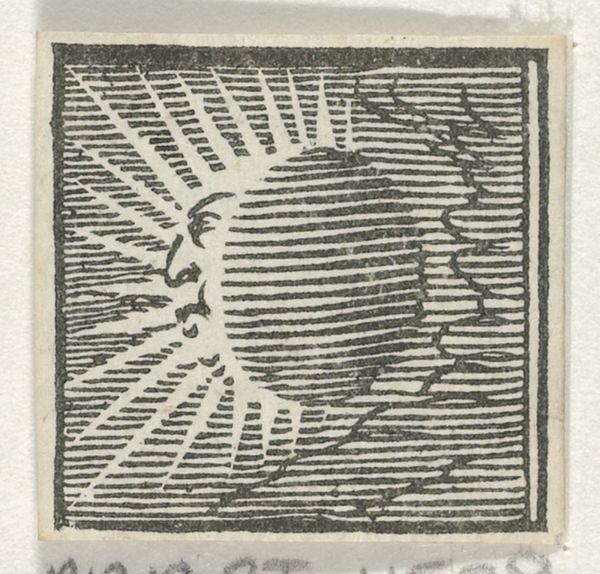
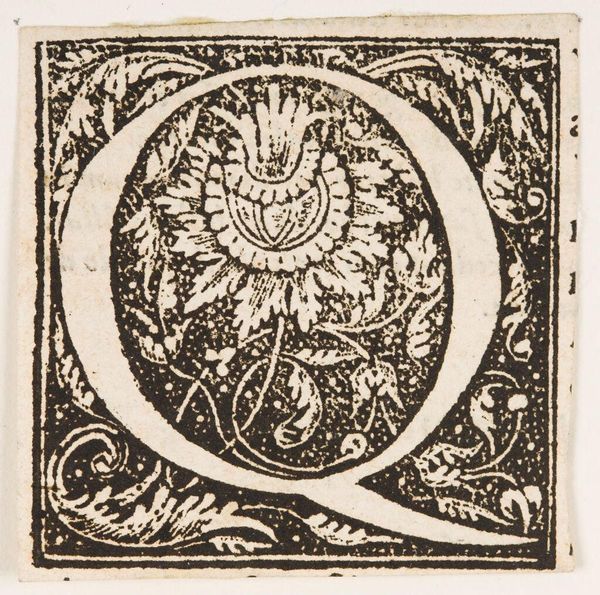
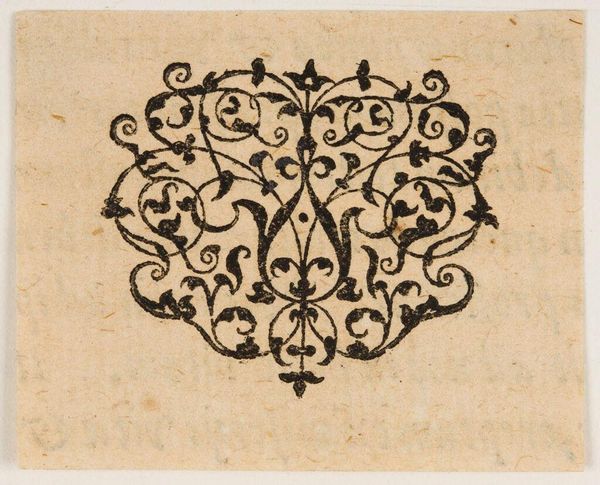
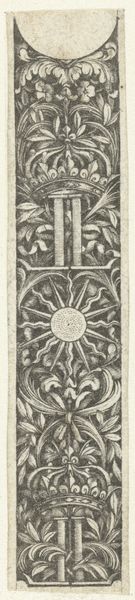
Fragment titelpagina voor: Geerard ter Brugge, Verlichtery kunst-boeck inde welke de rechte fondamenten, en̄ het volcomen gebruyck der illuminatie met alle hare eygenschappen klaerlijcken werden voor oogen gestelt, 1616 1616
0:00
0:00

claesjanszvisscher
Rijksmuseum
Dimensions: height 24 mm, width 22 mm
Copyright: Rijks Museum: Open Domain
Editor: This woodcut, created in 1616 by Claes Jansz. Visscher, is a fragment from the title page of "Verlichtery kunst-boeck." The stylized sun immediately caught my eye. What kind of cultural memory does this symbol evoke for you? Curator: This sun isn't just a celestial body; it's a loaded symbol. Its human-like face, the closed eyes – almost melancholic – what feelings do you have here? Think about light, divinity, and knowledge during the Northern Renaissance. It represented enlightenment, not just in the literal sense, but intellectual and spiritual illumination. It makes you wonder; were people melancholic for enlightenment? Editor: That’s fascinating! So, the sun represents both external light and internal wisdom? The geometric, almost rigid, lines of the woodcut also give it a certain austere quality, I think. Curator: Precisely! And note the conscious line work used to craft the sun’s rays. Consider how such images reinforced cultural values. Remember, visual culture shaped belief systems; and it also might be more playful that we realize. Do you feel it playful or melancholy? Editor: Hmm, I hadn’t thought of playful, but now I see how the slightly cartoonish face can point in that direction. It seems less serious. I never considered the degree to which the image reinforces the era’s value system, and not just knowledge but a sort of optimism perhaps. Curator: I think the interesting push and pull of that is where the value lies. Seeing how potent these symbols once were gives you food for thought about the potency of symbols today, doesn’t it? Editor: It certainly does. Thank you; I’ll never look at the sun the same way again!
Comments
No comments
Be the first to comment and join the conversation on the ultimate creative platform.
 Collect
 React
React Comment
More like this