painting, oil-paint
#
figurative
#
painting
#
oil-paint
#
figuration
#
oil painting
#
cityscape
#
post-impressionism
Copyright: Public Domain: Artvee
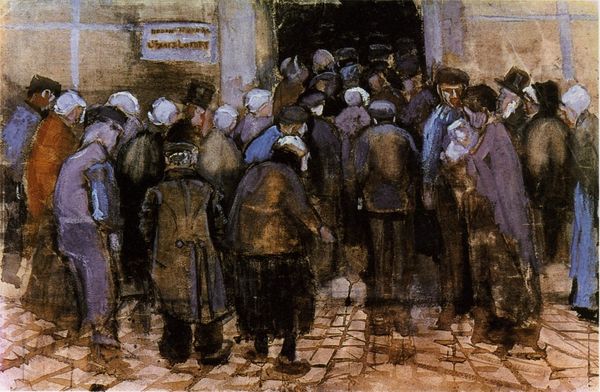
Curator: Standing before us is Van Gogh's "The Prison Courtyard," painted in 1890, during his stay at the Saint-Paul-de-Mausole asylum. It's an oil on canvas. Editor: My first impression is just how suffocating the composition feels. The walls are looming, and the figures seem trapped in this cyclical march. It's devoid of hope, wouldn’t you say? Curator: Absolutely. This work underscores the relationship between confinement and creativity during that era, how institutions shaped both perception and, in Van Gogh’s case, production of art. Notice how the institution and the artist both engage with alienation? Editor: And speaking of alienation, observe the endless circle; that motif is laden with meaning. It's the wheel of fate, isn't it? Or perhaps Sisyphus’s punishment rendered visually, an unceasing, monotonous task. Also, it mirrors the cycles of his illness; imprisonment and recovery were never really separate for him. Curator: The imagery he chose is quite potent, indeed. It has been speculated that the central figure, the blond man, is actually Van Gogh himself. This could align with some notions regarding the burden of being an artist in a rapidly changing cultural landscape, don’t you think? Editor: Very possible, I would say. Van Gogh had made a copy of Gustave Doré’s “The Newgate Exercise Yard”. He identifies, visually at least, with that sense of hopelessness that pervades this setting, no matter the identity of each specific figure within the space. He is showing solidarity. He also found inspiration in the illustrations by Charles Keene. Curator: You know, it is compelling to reflect on the politics inherent in exhibiting an artwork such as this, that addresses mental institutions, in these very halls today. Editor: Precisely. Images carry the memory of cultural patterns; perhaps Van Gogh’s paintings make visible our modern relationship with madness and order, with free expression versus sanctioned existence.
Comments
No comments
Be the first to comment and join the conversation on the ultimate creative platform.
 Collect
 React
React Comment
More like this