print, paper, ink, engraving
#
medieval
#
ink paper printed
# print
#
paper
#
ink
#
genre-painting
#
history-painting
#
engraving
#
watercolor
#
realism
Dimensions: height 190 mm, width 240 mm
Copyright: Rijks Museum: Open Domain
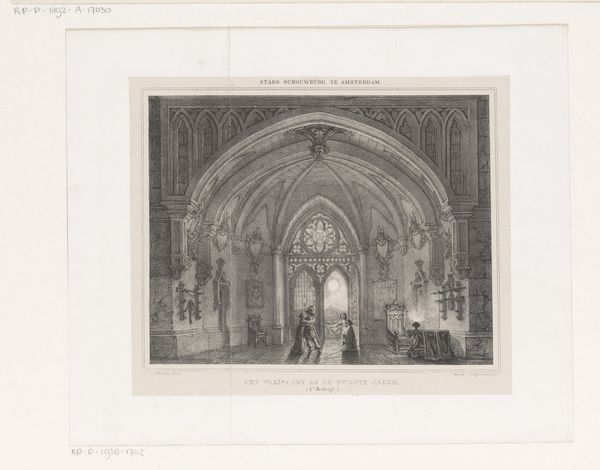
Editor: So, we are looking at "Graaf Floris V sticht de orde van St. Jacob, 1290" made between 1865 and 1870 by Willem Steelink. It's an engraving, ink on paper. It depicts a historical scene... it almost feels like a staged photograph rather than a spontaneous event. What catches your eye? Curator: Ah, Steelink! You're right, it has that strangely composed, almost theatrical air, doesn't it? I am immediately transported back to my childhood, playing with my grandfather's model trains. I mean, look at this grand hall – the weight of history, the light filtering through that rose window… but it's also this precise detail that arrests me: the meticulously rendered figures, like tin soldiers lined up in service of some grand narrative. Editor: "Tin soldiers"... That resonates! So it’s like he’s constructing an idea of the past, rather than showing the past itself? Curator: Precisely! It makes you wonder what's real, and what's constructed isn’t it? And think about the act of engraving itself – it's painstaking. Every line, every shadow is consciously etched. The "realism" becomes an elaborate performance. The past is like that too, I suppose. We assemble the fragments and try to make a picture. What do you feel he is saying about power and authority in this carefully constructed scene? Editor: That’s interesting, almost as if power needs to be so deliberately ‘performed’ to exist… and that resonates even today, I think! Thank you so much for sharing your vision. Curator: My pleasure! It makes one question the difference between seeing and knowing, doesn't it? Now, let’s move on to the next illusion, shall we?
Comments
No comments
Be the first to comment and join the conversation on the ultimate creative platform.
 Collect
 React
React Comment
More like this