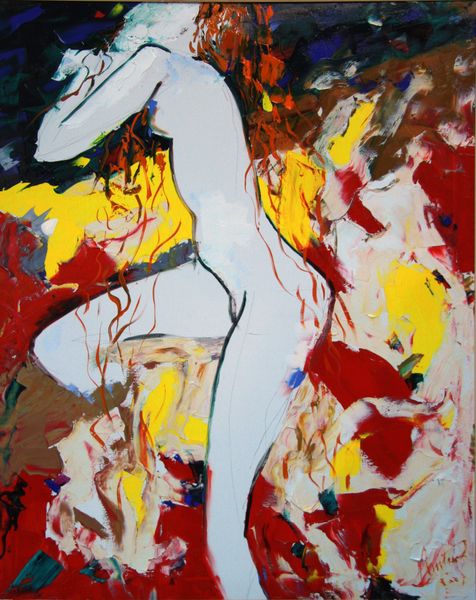
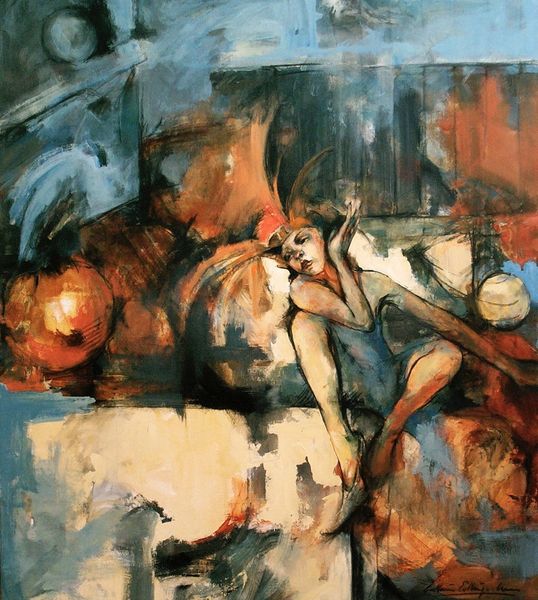
Dimensions: 90 x 80 cm
Copyright: Vasiliy Ryabchenko,Fair Use
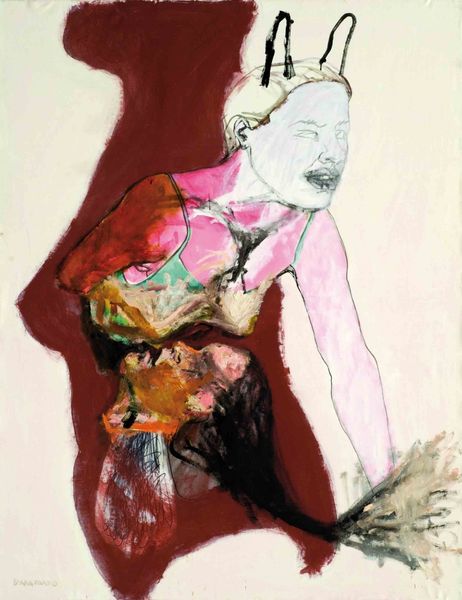
Editor: Here we have Vasiliy Ryabchenko’s “Narcissus,” created in 1991 using acrylic paint. It’s quite abstract, but I see a figure bending over, perhaps gazing at their reflection? There's an emotional rawness... How do you interpret this work, especially considering the title? Art Historian: The title “Narcissus” immediately directs us towards the myth of self-obsession, a concept rife with social and political implications. The raw, almost violent brushstrokes suggest a fractured sense of identity. How do you think the Neo-Expressionist style, prominent in the late 20th century, contributes to this portrayal of Narcissus? Editor: Well, Neo-Expressionism feels very personal and confrontational, so maybe the fragmented figure and intense colours represent the internal struggle with vanity? Like, it's not just about being pretty, but a deeper, darker obsession? Art Historian: Precisely! And considering Ryabchenko's Ukrainian background, creating this work shortly before and after Ukraine gained independence from the Soviet Union in 1991, how might we interpret "Narcissus" as a commentary on the construction and potential pitfalls of national identity? Is there a danger of a nation becoming too self-absorbed, losing sight of the global community and social justice? Editor: That’s a fascinating perspective. I hadn't considered the geopolitical context. So, maybe the painting isn’t just about individual vanity but also about the ego of a newly independent nation? A cautionary tale? Art Historian: Exactly. The layering of personal and political anxieties makes this "Narcissus" far more than a simple retelling of a Greek myth. What have you gleaned from our discussion? Editor: I've learned that art doesn't exist in a vacuum. Examining the historical and political background can dramatically change the meaning and create social dialogue. Thanks for opening my eyes! Art Historian: And I appreciate your willingness to consider new perspectives! It highlights the continuing relevance of art in understanding ourselves and our place in the world.
Comments
No comments
Be the first to comment and join the conversation on the ultimate creative platform.
 Collect
 React
React Comment
More like this