About this artwork
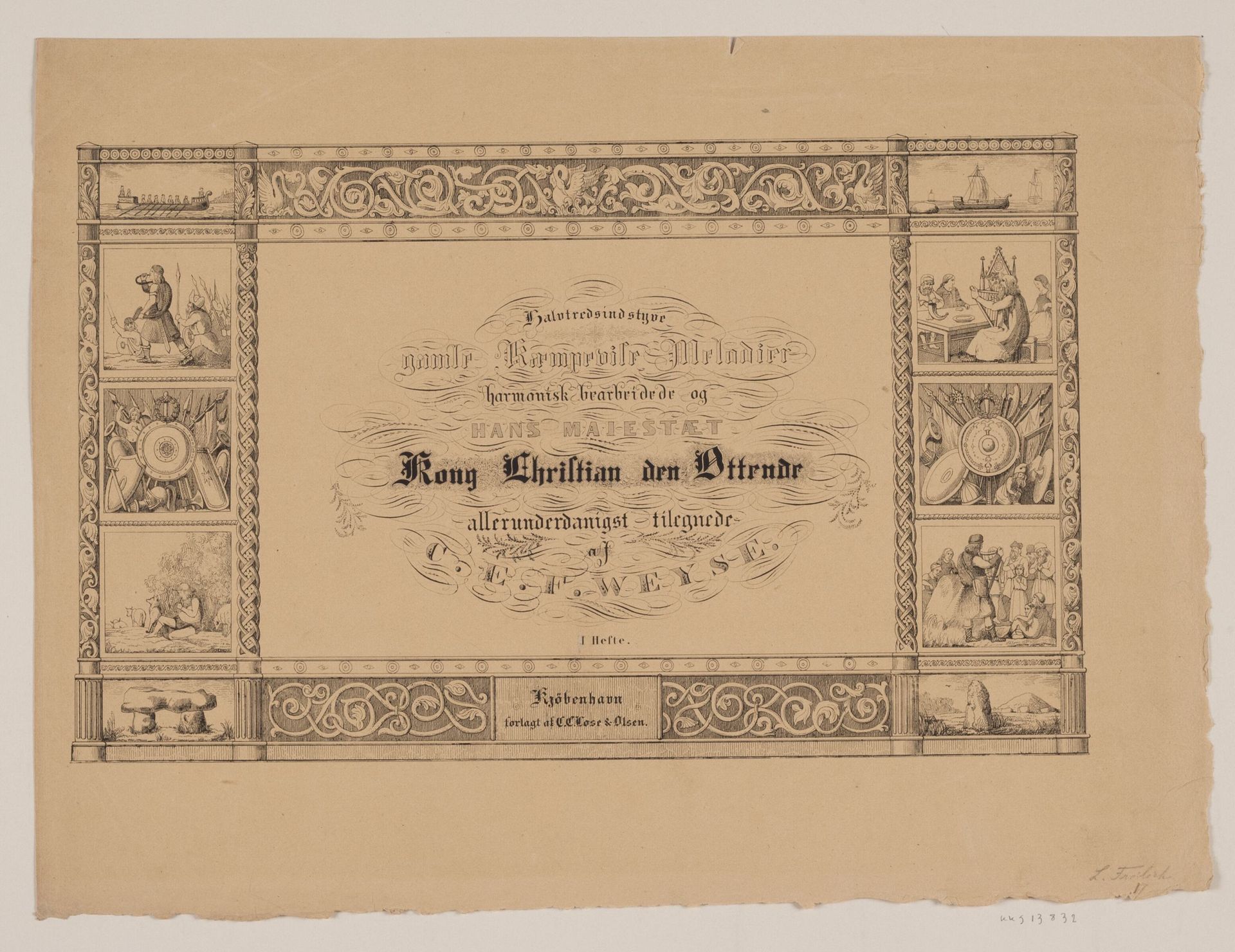
Curator: Here we have Lorenz Frølich's title page for "Halvtredsindstyve gamle Kæmpevise-melodier," created in 1842. It’s a lithograph, currently housed at the SMK in Copenhagen. Editor: The intricate frame immediately catches my eye. The dark lines against the off-white paper create a nostalgic, almost fairytale-like quality. It feels very illustrative and decorative. Curator: Indeed. The materiality of the lithograph, a relatively new technology at the time, allowed for detailed reproduction. Consider its context: this title page served to introduce a collection of old heroic ballads. These songs likely circulated amongst working class Danes, evoking a sense of shared history and national identity at a time of great social and political change in Denmark. Editor: I see how that might be true, and my focus tends to be on form. Note how each framed scene seems self-contained, contributing to the overall symmetry and balanced composition, almost like viewing a series of miniature paintings within the larger work. The artist cleverly uses a decorative border to integrate medieval motifs—ships, figures, and shields. The title text sits in the middle and follows the aesthetic values of Romanticism Curator: And Frølich’s role here extends beyond mere aesthetics; he's acting as a conduit, translating cultural heritage into a consumable form for King Christian the Eighth who patronized his activities. This project speaks to the romantic nationalism of the time, creating a symbolic offering of traditional folk material tailored for aristocratic consumption and distribution. This process allowed certain musical pieces to gain status in Danish society. Editor: Still, one can’t deny the visual impact. The texture achieved through lithography provides depth and character. It's a lovely demonstration of romanticism using the traditional forms and themes. The figures remind me of tapestries and old manuscripts in their look. Curator: For me, the artwork opens avenues into a cultural moment and illuminates class and material exchange. I am compelled to examine it from the outside, the economic relationships of artists to those they seek to support. Editor: While I appreciate the socio-historical aspects you emphasize, my reading hinges on the inherent formal characteristics. The linear nature of the frame makes this piece one of great interest. Curator: It’s remarkable how two lenses can reveal such different yet valuable perspectives on a single piece. Editor: Exactly. It just confirms that an artwork's beauty exists in its design, execution, but also in the story of its journey to completion.
Titelblad til "Halvtredsindstyve gamle Kæmpevise-melodier" 1842


Artwork details
- Medium
- graphic-art, lithograph, print
- Dimensions
- 280 mm (height) x 375 mm (width) (bladmaal)
- Location
- SMK - Statens Museum for Kunst
Tags
graphic-art
medieval
lithograph
romanticism
genre-painting
decorative-art
Comments
No comments
About this artwork
Curator: Here we have Lorenz Frølich's title page for "Halvtredsindstyve gamle Kæmpevise-melodier," created in 1842. It’s a lithograph, currently housed at the SMK in Copenhagen. Editor: The intricate frame immediately catches my eye. The dark lines against the off-white paper create a nostalgic, almost fairytale-like quality. It feels very illustrative and decorative. Curator: Indeed. The materiality of the lithograph, a relatively new technology at the time, allowed for detailed reproduction. Consider its context: this title page served to introduce a collection of old heroic ballads. These songs likely circulated amongst working class Danes, evoking a sense of shared history and national identity at a time of great social and political change in Denmark. Editor: I see how that might be true, and my focus tends to be on form. Note how each framed scene seems self-contained, contributing to the overall symmetry and balanced composition, almost like viewing a series of miniature paintings within the larger work. The artist cleverly uses a decorative border to integrate medieval motifs—ships, figures, and shields. The title text sits in the middle and follows the aesthetic values of Romanticism Curator: And Frølich’s role here extends beyond mere aesthetics; he's acting as a conduit, translating cultural heritage into a consumable form for King Christian the Eighth who patronized his activities. This project speaks to the romantic nationalism of the time, creating a symbolic offering of traditional folk material tailored for aristocratic consumption and distribution. This process allowed certain musical pieces to gain status in Danish society. Editor: Still, one can’t deny the visual impact. The texture achieved through lithography provides depth and character. It's a lovely demonstration of romanticism using the traditional forms and themes. The figures remind me of tapestries and old manuscripts in their look. Curator: For me, the artwork opens avenues into a cultural moment and illuminates class and material exchange. I am compelled to examine it from the outside, the economic relationships of artists to those they seek to support. Editor: While I appreciate the socio-historical aspects you emphasize, my reading hinges on the inherent formal characteristics. The linear nature of the frame makes this piece one of great interest. Curator: It’s remarkable how two lenses can reveal such different yet valuable perspectives on a single piece. Editor: Exactly. It just confirms that an artwork's beauty exists in its design, execution, but also in the story of its journey to completion.
Comments
No comments