drawing, chalk
#
drawing
#
narrative-art
#
baroque
#
figuration
#
pencil drawing
#
chalk
#
history-painting
Copyright: Public Domain
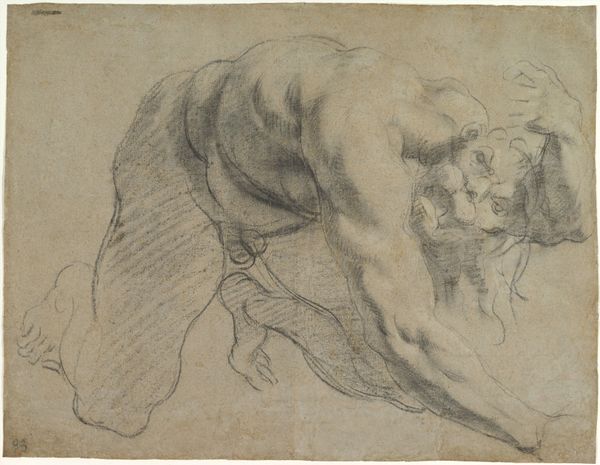
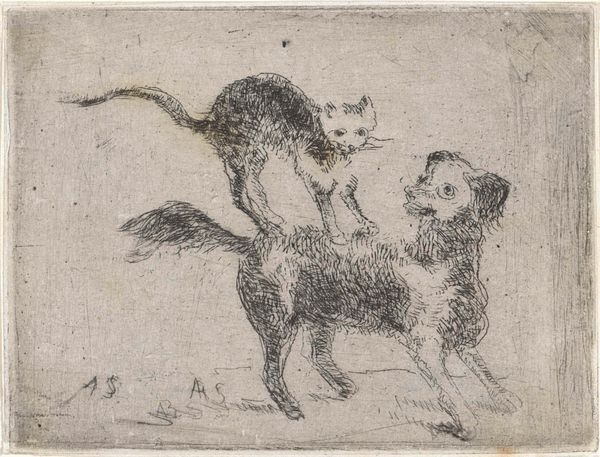
Curator: Well, this drawing titled "A bear strangling a dog" by Johann Melchior Roos, has quite the direct title. It seems the artist decided not to leave much to our imaginations, visually. Editor: It’s undeniably dramatic. My first thought is… what’s the backstory here? Is there a political metaphor woven into the animal violence? The intense interlocking forms evoke raw emotion, but it also feels strangely staged. Curator: The image presents this tension beautifully through line work alone. Considering Roos’ body of work, his animal drawings were meant to provide an example of life in the wilderness; there's a contrast here, with elements that resemble stagecraft. These drawings weren't exactly made for private contemplation, right? They speak to the development of a broader artistic market and collecting practices in his time. Editor: So, are we to understand this drawing not as a depiction of reality, but a posed narrative crafted for a particular audience? I think considering audience is crucial, as it challenges us to consider how the realities and struggles represented in art have often been used to perpetuate colonial agendas or, worse, simple commodification of animals. Curator: Absolutely, it gives a voice to questions of agency, power dynamics and social order, where animals—or certain types of people—might be seen as naturally dominant over others, legitimizing hierarchical societal structures. Editor: It begs the question: whose perspective are we prioritizing? Is this about showing raw animal dominance, a kind of ‘might makes right’ philosophy translated through a specific aesthetic lens? Are we meant to admire the bear's strength or mourn the dog’s struggle? Curator: Or perhaps simply to contemplate nature as a spectacle? While open to various interpretations, it offers insight into the cultural mindset that might appreciate seeing animal dominance visualized in a drawing, a mindset that may still persist in many ways in how we use and view nature today. Editor: Seeing it this way challenges me to re-evaluate my own relationship to the narrative being presented. What does it say about me as a viewer if I'm drawn to its composition and the dramatic tension instead of critically assessing the brutal encounter at hand? I have to remind myself to question not just what I see, but *how* and *why* I see it. Curator: The brilliance of unpacking historical art lies, perhaps, precisely in these questions. Editor: Indeed, in challenging our assumptions. Thank you for your deep analysis.
Comments
No comments
Be the first to comment and join the conversation on the ultimate creative platform.
 Collect
 React
React Comment
More like this