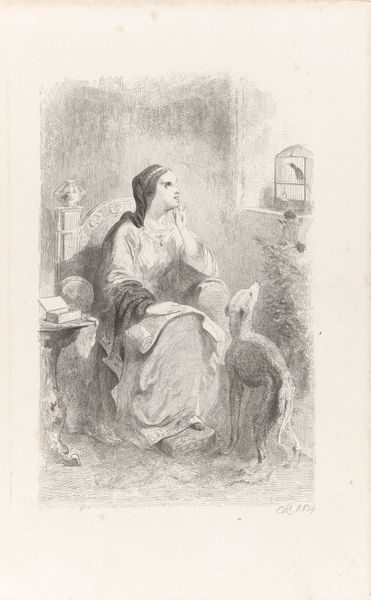
Dimensions: height 184 mm, width 122 mm
Copyright: Rijks Museum: Open Domain
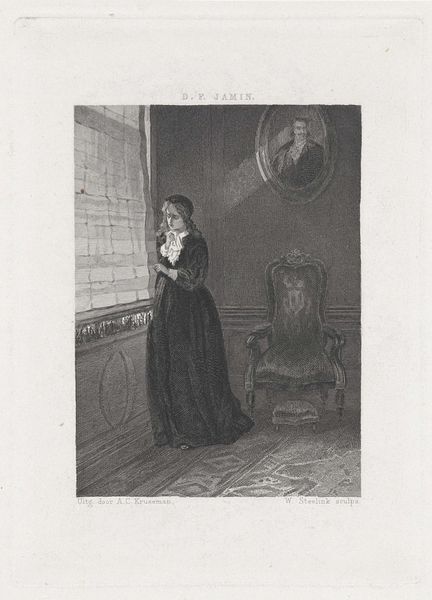
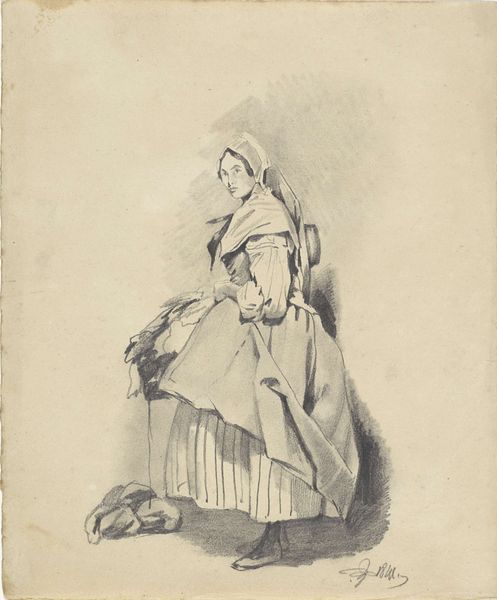
Editor: Here we have Willem Steelink’s graphite drawing, "Het haantje van de toren," created in 1859. It features a woman gazing out of a window, a church spire visible in the distance. It feels… wistful. What draws your eye in this piece? Curator: It’s the context of production that intrigues me most. Consider graphite: seemingly simple, yet vital. This drawing, made with graphite on paper, becomes an artifact of 19th-century industry, dependent on the extraction and processing of raw materials, like graphite mines. How does the apparent ease of the drawing contrast with the labor involved in producing these materials? Editor: That's a good point. I hadn’t really thought about graphite beyond a simple art supply. So you're saying the medium itself connects the image to broader industrial processes of the time? Curator: Precisely. And it asks a larger question of the romanticism that the image conveys. Here's this young woman in a romantic portrait, possibly longing for the "old times," while the image is being created with modern means that propel a more urban future. Editor: That really reframes my understanding of it. Instead of just a portrait, it becomes an intersection of industrialization and romantic longing, all embodied in a simple drawing. So, seeing her connection to “old times”, in contrast with our perspective now as being the old times to a future generation makes the act of labor… cyclical. Thank you for offering me a perspective into that. Curator: Indeed! Recognizing the materials, process, and how labor plays a role adds complexity and richness.
Comments
No comments
Be the first to comment and join the conversation on the ultimate creative platform.
 Collect
 React
React Comment
More like this