

1890
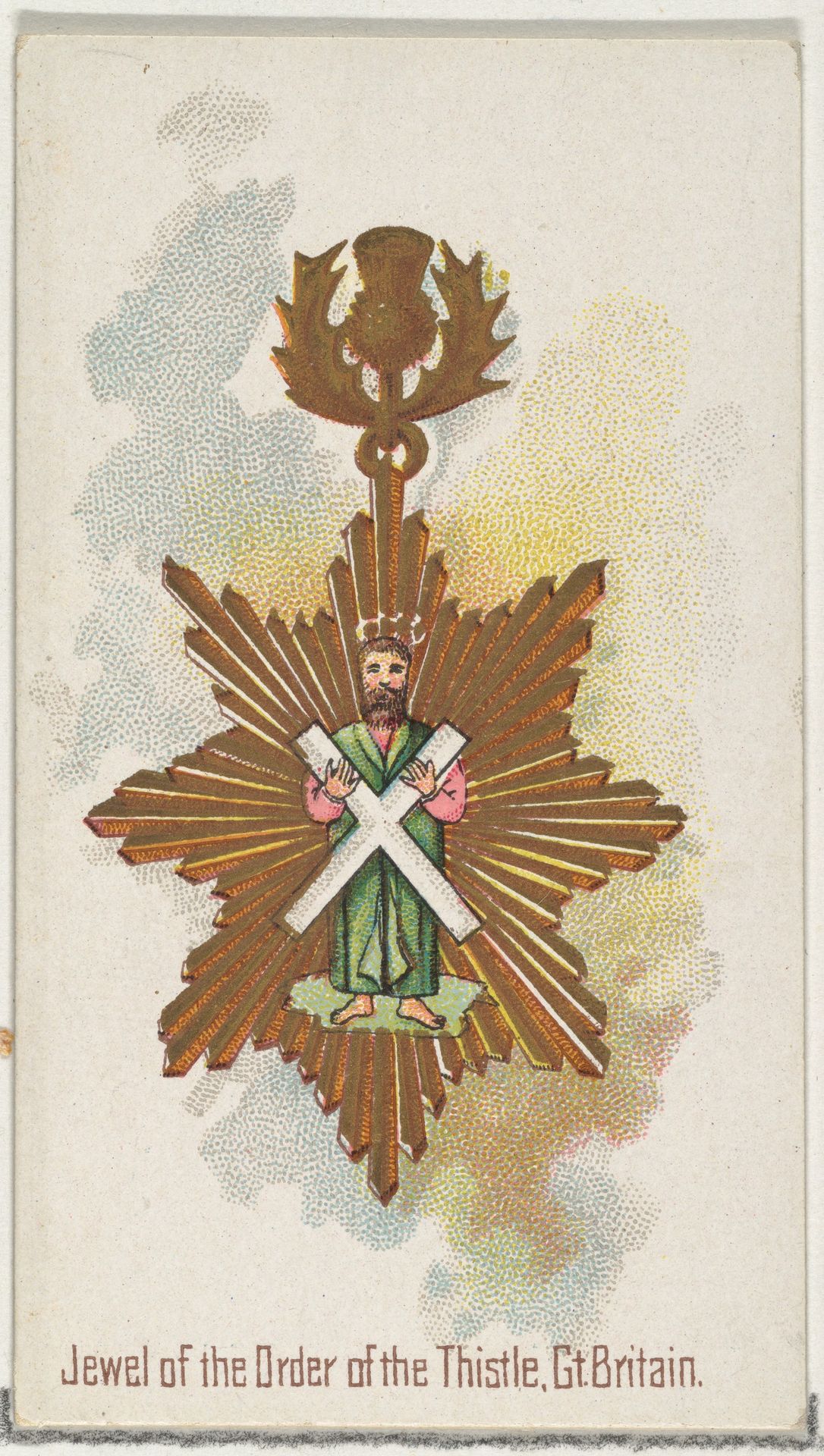
Jewel of the Order of the Thistle, Great Britain, from the World's Decorations series (N30) for Allen & Ginter Cigarettes

Listen to curator's interpretation
Curatorial notes
Editor: This is "Jewel of the Order of the Thistle, Great Britain" from 1890, part of the World's Decorations series by Allen & Ginter Cigarettes. It's a drawing with coloured pencils and print, quite small. The image has this kind of… regal yet old-fashioned vibe to it. What do you see in this piece? Curator: Well, immediately, I notice how this cigarette card draws upon a rich symbolic language. The thistle itself is the national emblem of Scotland, representing resilience and defiance – think of its prickly defense. And then there’s St. Andrew, holding the saltire, his cross. The sunburst behind him suggests divine authority, illuminating the saint and the order. Editor: So, it's not just a pretty design; it's loaded with meaning. Was this common for cigarette cards back then? Curator: Absolutely! These cards were mini-encyclopedias, educating the public about history, geography, and, in this case, heraldry. The Order of the Thistle is an ancient chivalric order, a symbol of Scottish identity, and this card served to promote that identity, even as it promoted tobacco. It also speaks volumes about Britain's cultural memory in the late 19th century, when notions of nationhood and empire were being consolidated through the popular press. Notice, too, how the coloured pencils evoke an earlier age, harking back to illuminated manuscripts while simultaneously embracing new printing technologies. Do you think the artist would have had to use symbolism? Editor: I hadn’t thought about it that way! The connection to illuminated manuscripts makes sense. Seeing all the symbolism opens up so many layers in what initially seemed like a simple image. Thanks for this overview. Curator: My pleasure. It's amazing how a seemingly trivial object can reveal so much about a culture's values and self-image. It reminds me to examine details to discover multiple historical perspectives.