1620 - 1630
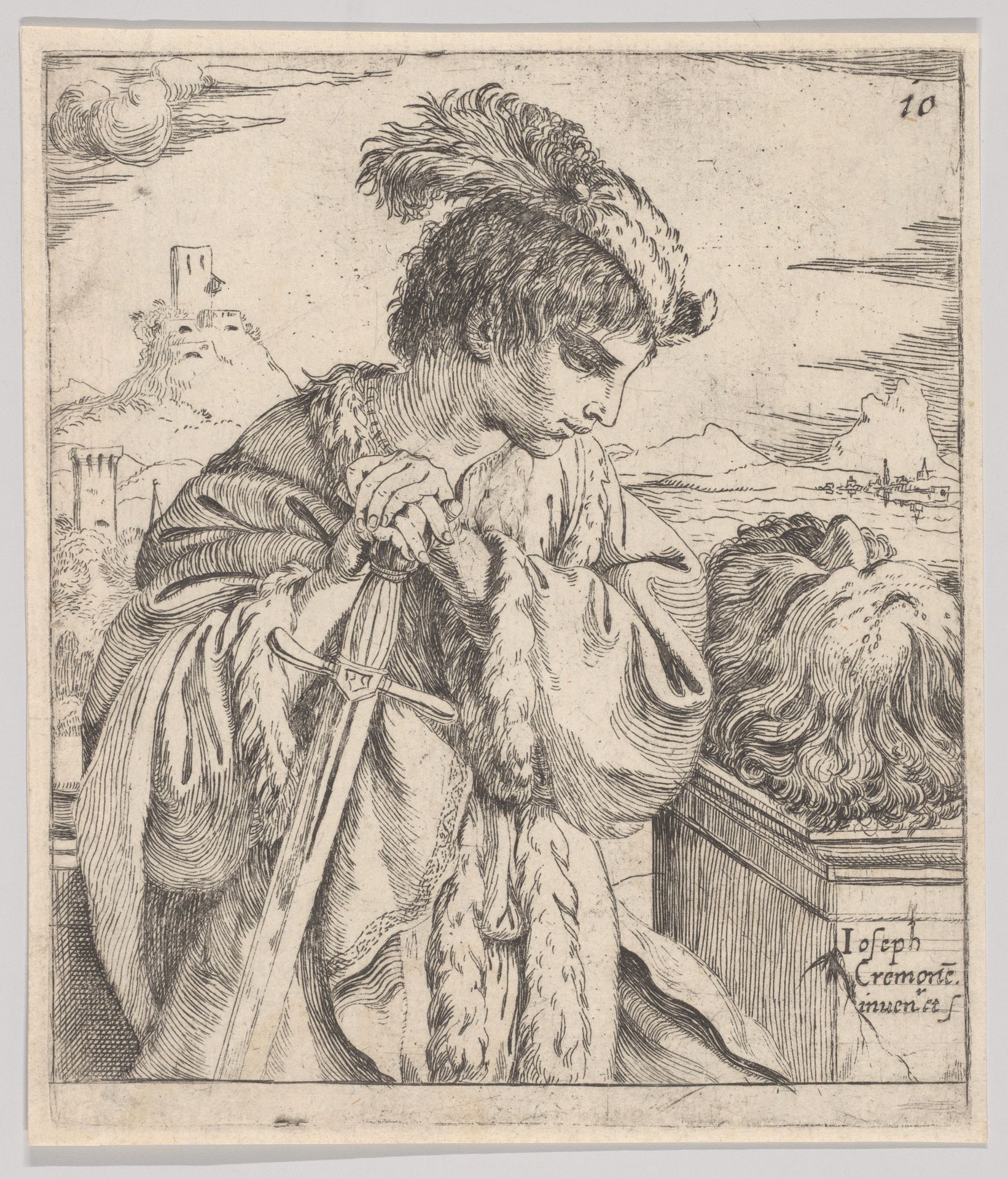
David looking at the head of Goliath

Giuseppe Caletti, called Cremonese
1600 - 1660
The Metropolitan Museum of Art
Metropolitan Museum of Art, New York, NYListen to curator's interpretation
Curatorial notes
Editor: So this is "David looking at the head of Goliath," an etching by Giuseppe Caletti from around 1620-1630. I'm struck by David's melancholic pose, even after such a victory. How do you interpret this work? Curator: It's compelling, isn't it? Considering it through a contemporary lens, it's impossible to ignore the visual echoes of colonial violence. We have this lone, youthful figure – adorned, privileged – standing over the severed head, a symbol of the vanquished. What does it mean to depict a moment of supposed triumph as one of somber reflection? Editor: That's a powerful point. I hadn't thought about the potential for a post-colonial reading of it. So, are you suggesting it isn't a straightforward celebration of David's triumph? Curator: Precisely. Instead, Caletti seems to invite a consideration of the psychological and moral weight of victory, especially when achieved through violence. Whose story are we really telling? What perspective dominates this narrative? The Bible presents a tale of liberation, but we might consider this instead through trauma and grief. The body as a site of struggle. David looks away, avoiding direct confrontation, the same way that conquerors can ignore the consequences of their power. Editor: That makes me rethink the whole composition, David looks much less triumphant and the head of Goliath is in sharp contrast, almost looking more important somehow. Curator: Exactly! And if Goliath can stand in for a marginalized or oppressed group, does David embody a problematic idealization of power? Are we meant to see him as a hero, or is there a critique embedded in his thoughtful pose? How might this resonate with current dialogues surrounding power, privilege, and historical accountability? Editor: I never thought of it that way. Looking at it now, it seems less about victory and more about the burden of power and its consequences. Thanks, this was really insightful. Curator: And for me, this is a reminder that even in the Old Masters, there are stories waiting to be unveiled that speak to our present.