

1647
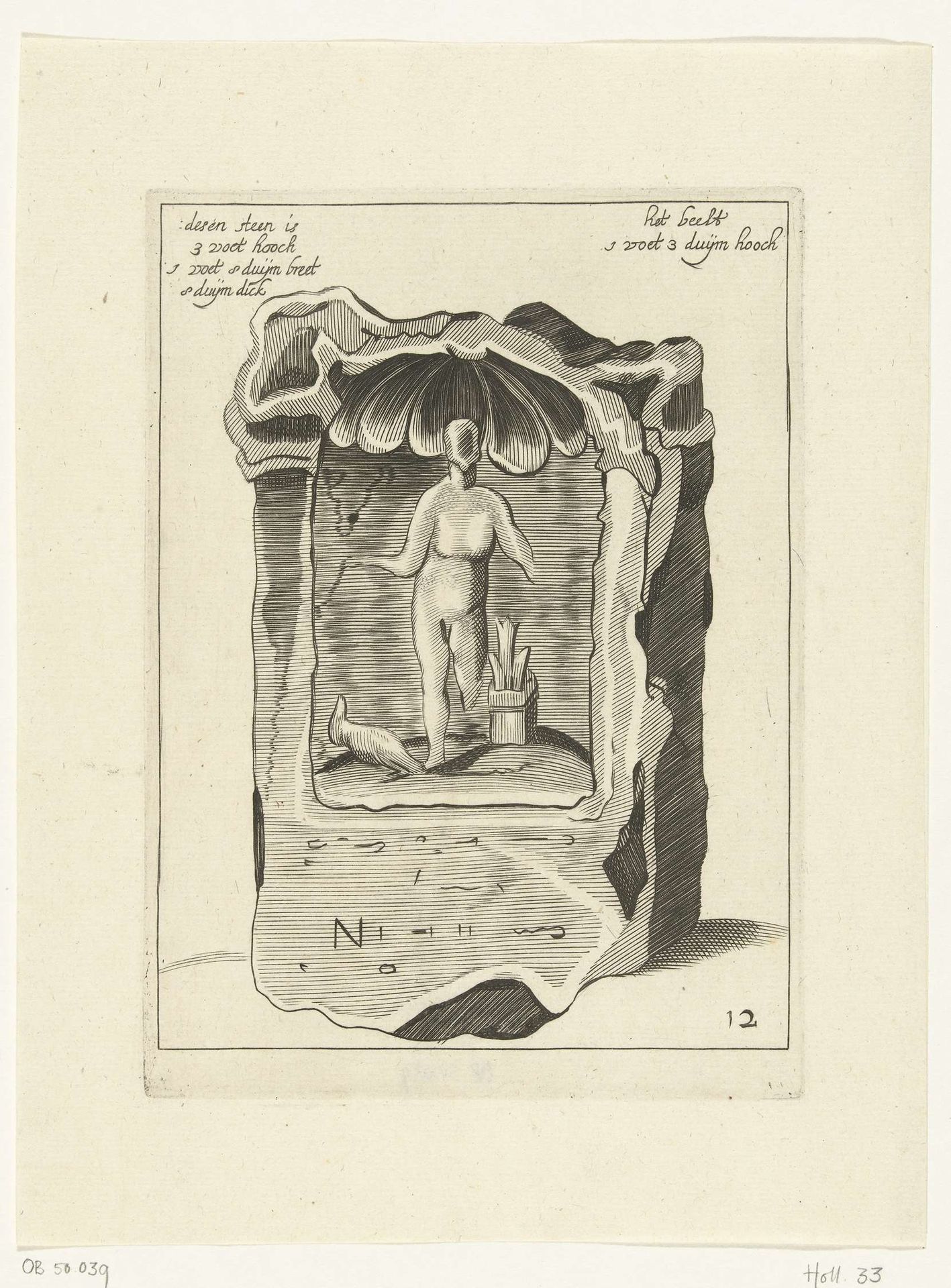
Sterk verweerd Romeins altaar

Listen to curator's interpretation
Curatorial notes
Editor: This engraving from 1647, titled "Sterk verweerd Romeins altaar" by Hendrick Danckerts, presents a weathered Roman altar. I’m struck by how this scene, seemingly of ancient Rome, is presented through the lens of the Baroque. It almost feels like a stage set. How do you interpret the contrast between the ruin and the idealised nude figure? Curator: That's an insightful observation! The juxtaposition is key. We have to consider the context of 17th-century Dutch art. There was a fascination with the classical past, but also a critical engagement with its legacy. How does the artist seem to position power, gender and the societal decay, literally ‘verweerd,’ or weathered? Does this work offer a critique of the past, or an idealized vision? Editor: I see what you mean. It is difficult to celebrate the ruin. Perhaps the altar represents institutions of power itself, the cracks revealing vulnerability? And what about the figure? Are we meant to empathise or objectify? Curator: Precisely! Consider the gaze, the lack of clear narrative context. This work is rooted in its moment, the baroque, reflecting ideas about knowledge and truth, about history and how we should use it, particularly during periods of great societal upheaval. In what way do you feel it represents the canon gaze on femininity? Editor: This makes me consider how we today, too, continue to re-interpret and wrestle with classical ideals. I hadn't thought about how this scene is constructed within its own moment of history. Curator: And how the construction continues today! Paying attention to how these works participate in social narratives invites crucial reflections, don't you think?